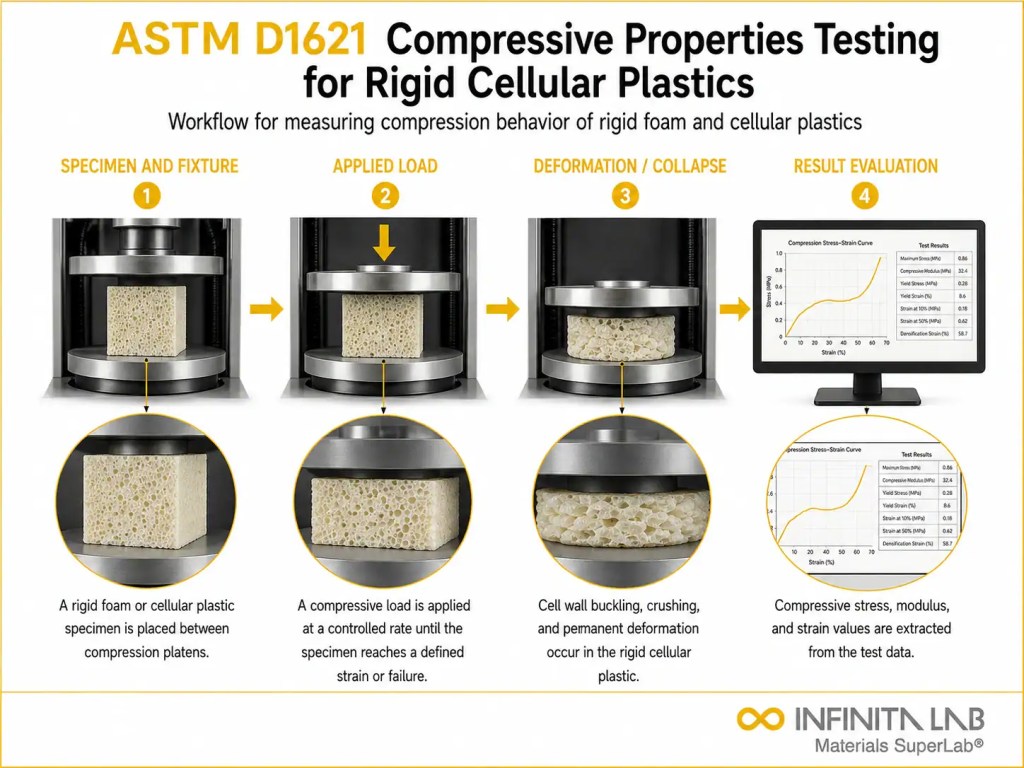


What Is ASTM D1621 Rigid Cellular Plastic Compressive?
ASTM D1621 describes the standard test method for the compressive properties of rigid cellular plastics: compressive strength, compressive modulus, and deformation behavior under compressive loading. The test methodology applies to how rigid polymer foams will respond to forces that tend to crush or deform them.
This test is widely used for materials such as polyurethane foams, polystyrene foams, PVC foams, and other lightweight structural cellular plastics. ASTM D1621 provides essential data on load-bearing capacity, dimensional stability, and resistance to crushing, supporting material selection, and performance validation under service conditions.
Applications and Benefits of ASTM D1621 Rigid Cellular Plastic Compressive Testing
Scope
ASTM D1621 outlines procedures for measuring the compressive behavior of rigid cellular plastics under controlled laboratory conditions.
It evaluates:
- Compressive strength at a specified strain
- Compressive modulus
- Stress–strain response and deformation behavior
- Material uniformity and consistency across production batches
The method applies to rigid foam materials with closed-cell or open-cell structures used in structural and insulation applications.
Applications
- Construction and building insulation panels
- Structural insulation and sandwich core materials
- Automotive interior and structural components
- Protective packaging materials
- Aerospace and marine core structures
Benefits
- Quantifies load-bearing and crushing resistance
- Supports material selection for structural applications
- Evaluates dimensional stability under compression
- Enables quality control of foam density and structure
- Allows comparison of materials under standardized conditions
Our ASTM D1621 Testing Procedure
Specimen Preparation
Rigid cellular plastic specimens are cut to specified dimensions with parallel faces to ensure uniform loading.
1Conditioning
Specimens are conditioned at standard laboratory temperature and humidity before testing.
2Compressive Loading
The specimen is placed between parallel compression platens and compressed at a constant deformation rate.
3Data Recording & Evaluation
Load, stress–strain behavior, compressive strength, and modulus are recorded until a defined strain or failure occurs.
4ASTM D1621 Test Parameters and Requirements
| Parameter | Details |
|---|---|
| Applicable Materials | Rigid cellular plastics (polyurethane, polystyrene, PVC foams, etc.) |
| Specimen Shape | Rectangular or cylindrical |
| Typical Dimensions | ~50 mm × 50 mm × 25 mm (or material thickness) |
| Test Rate | Constant deformation rate as specified |
| Measured Outputs | Compressive strength, compressive modulus, stress–strain curve |


- Universal testing machine
- Compression platens with parallel loading surfaces
- Precision load cells and displacement sensors
- Calipers or micrometers for specimen measurement
- Data acquisition and analysis software
Equipment and Instrumentation Used for ASTM D1621 Testing
What You Receive: Test Report, Data, and Certification
- Compressive strength at specified strain levels
- Compressive modulus values
- Stress–strain behaviour of rigid cellular plastics
- Assessment of foam uniformity and density effects
- Data supporting material selection and design decisions
- Documentation for quality control and product certification
ASTM D1621 Rigid Cellular Plastic Compressive FAQs
ASTM D1621 is used to determine the compressive strength, compressive modulus, and deformation characteristics of rigid cellular plastics such as polyurethane or polystyrene foams.
Rigid foams are often used in load-bearing or structural applications. This test ensures they can support mechanical stress without collapsing or losing shape.
Materials include structural and insulation foams like PU, PVC, EPS, XPS, phenolic foam, and other rigid polymer foams.
ASTM D1621 determines the compressive properties of rigid cellular plastics, particularly foam materials. A prepared specimen is placed between compression platens, and a testing machine applies a controlled compressive load while measuring deformation. The results are used to determine compressive strength, stress-strain behavior, and compressive modulus, as applicable.
Why Choose Infinita Lab for Rigid Cellular Plastic Compressive Testing
When your Rigid Cellular Plastic Compressive results have to hold up - for compliance, a customer audit, or an engineering decision - ASTM D1621 accuracy and an unbiased third-party report matter more than price. Infinita Lab routes your ASTM D1621 rigid cellular plastic compressive testing to ISO/IEC 17025-accredited U.S. partner labs with hands-on method experience, so you get defensible data, transparent reporting, and turnaround times built around your project deadline - not ours.

Need ASTM D1621 Rigid Cellular Plastic Compressive Testing You Can Rely On?
Send query us at hello@infinitalab.com or call us at (888) 878-3090 to learn more about our services and how we can support you.



