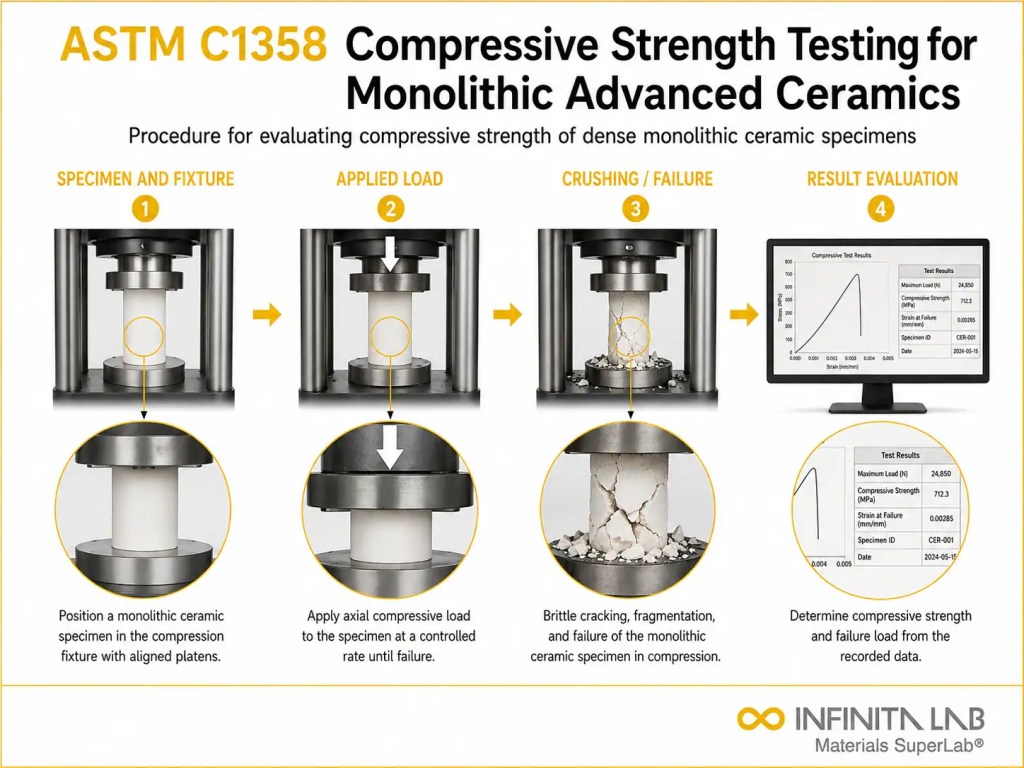


What Is ASTM C1358 Advanced Ceramic Compressive Strength?
ASTM C1358 is a standardized test method for the determination of the compressive strength and stress-strain characteristics of advanced ceramic matrix composites under conditions of monotonic uniaxial loading at ambient temperatures.
This test method is mainly relevant to continuous fiber-reinforced composites, which include unidirectional (1D), bidirectional (2D), tri-directional (3D), and other multidirectional types of reinforcement. It is also relevant to glass (amorphous) matrix composites with similar types of reinforcement. Although the test method does not specifically mention discontinuous fibers, whiskers, or particulate reinforcement, it can be used for those types of composites as well.
Applications and Benefits of ASTM C1358 Advanced Ceramic Compressive Strength Testing
Scope
The standard that governs testing of continuous fiber reinforced ceramic matrix composites (CFCCs), such as glass matrix composites with continuous fibers, is ASTM C1358. This standard addresses various reinforcement configurations such as unidirectional 1D, bidirectional 2D, tri-directional 3D, and multidirectional reinforcement configurations. The standard emphasizes testing of fundamental mechanical properties under monotonic uniaxial compression, such as compressive strength, how the material strains and yields under stress, modulus of elasticity, and fracture behavior.
Applications
- Structural ceramic components
- High-temperature engineering components
- Defence systems
- Energy and turbine components
- Research and development of advanced ceramics
- Material qualification and certification
- Failure analysis studies
Benefits
- Determines compressive strength under controlled loading
- Provides complete stress–strain response
- Evaluates stiffness (modulus of elasticity)
- Supports material comparison and selection
- Enables performance validation for structural applications
- Provides standardized mechanical characterization
Our ASTM C1358 Testing Procedure
Specimen Preparation
Mount the rectangular specimen in the load train and measure dimensions to determine cross-sectional area.
1Test Setup
Select test mode and loading rate, then apply and record preload to remove slack.
2Compression Testing
Apply continuous uniaxial compression until fracture while recording stress–strain data and maximum load.
3Post-Test Handling
Collect fractured pieces for analysis and compile test data.
4ASTM C1358 Test Parameters and Requirements
| Parameter | Details |
|---|---|
| Loading Type | Continuous, non-reversing (monotonic) |
| Specimen Shape | Solid rectangular cross-section |
| Minimum Gauge Length | 25 mm |
| Minimum Grip Length (each end) | 50 mm |
| Minimum Width | 10 mm |
| Minimum Thickness | 3 mm |
| Measured Outputs | Compressive strength, stress–strain curve, modulus of elasticity |


- Universal testing machine (compression capable)
- Load cell (calibrated)
- Compression fixtures and grips
- Extensometer or strain measurement device
- Data acquisition system
- Dimensional measurement tools (callipers, micrometre)
Equipment and Instrumentation Used for ASTM C1358 Testing
What You Receive: Test Report, Data, and Certification
- Compressive strength value
- Stress–strain curve
- Modulus of elasticity
- Maximum load at fracture
- Failure mode documentation
- Specimen fracture analysis
- Test report with dimensional data
ASTM C1358 Advanced Ceramic Compressive Strength FAQs
ASTM C1358 is intended for brittle advanced ceramics with very high compressive strength. The test determines the maximum value of compressive stress before failure, which is essential for components subjected to high pressures and crushing forces.
Parasitic bending can be minimized by ensuring highly axial loading during the test. Precision-aligned platens and concentricity of loading can help to distribute the compressive force evenly, thus avoiding failures due to misalignment rather than material properties.
ASTM C1358 specifies the use of small cylindrical or prismatic specimens with precisely defined aspect ratios. The requirements for parallelism and surface finish are stringent in order to avoid stress concentrations and reduce the variability of the measured compressive strength.
Care must be taken with advanced ceramics, as they are sensitive to the rate of loading, with slow crack growth affecting the measured strength. ASTM C1358 requires controlled strain rates to ensure that the fracture is due to intended mechanical loading and not environmentally assisted subcritical cracking.
The compressive strength is determined by dividing the maximum load at fracture by the original cross-sectional area. Statistical analysis is sometimes added to take into account the natural strength variation in brittle ceramic materials.
Ceramic compressive strength testing measures a material’s ability to withstand crushing forces before failure. A prepared ceramic specimen is placed between compression platens, and a testing machine applies a steadily increasing load until the specimen fails. The maximum load and specimen dimensions are used to calculate compressive strength, helping evaluate material durability and load-bearing performance. ASTM C1424 covers advanced ceramics, while ASTM C773 applies to fired whiteware materials.
A ceramic compression test evaluates how a ceramic specimen responds to uniaxial compressive loading. The specimen is prepared to specified dimensions, aligned between loading surfaces, and compressed at a controlled rate. The force and deformation are recorded to determine compressive strength and stress-strain behavior. The appropriate test method depends on the ceramic type and application.
Mechanical testing of ceramics evaluates properties such as compressive strength, flexural strength, hardness, fracture toughness, and elastic modulus. Specimens are subjected to controlled mechanical loads using suitable testing equipment, and their deformation or failure is measured. The results help assess material reliability, compare ceramic formulations, and verify performance for engineering applications.
Why Choose Infinita Lab for Advanced Ceramic Compressive Strength Testing
When your Advanced Ceramic Compressive Strength results have to hold up - for compliance, a customer audit, or an engineering decision - ASTM C1358 accuracy and an unbiased third-party report matter more than price. Infinita Lab routes your ASTM C1358 advanced ceramic compressive strength testing to ISO/IEC 17025-accredited U.S. partner labs with hands-on method experience, so you get defensible data, transparent reporting, and turnaround times built around your project deadline - not ours.

Need ASTM C1358 Advanced Ceramic Compressive Strength Testing You Can Rely On?
Send query us at hello@infinitalab.com or call us at (888) 878-3090 to learn more about our services and how we can support you.



