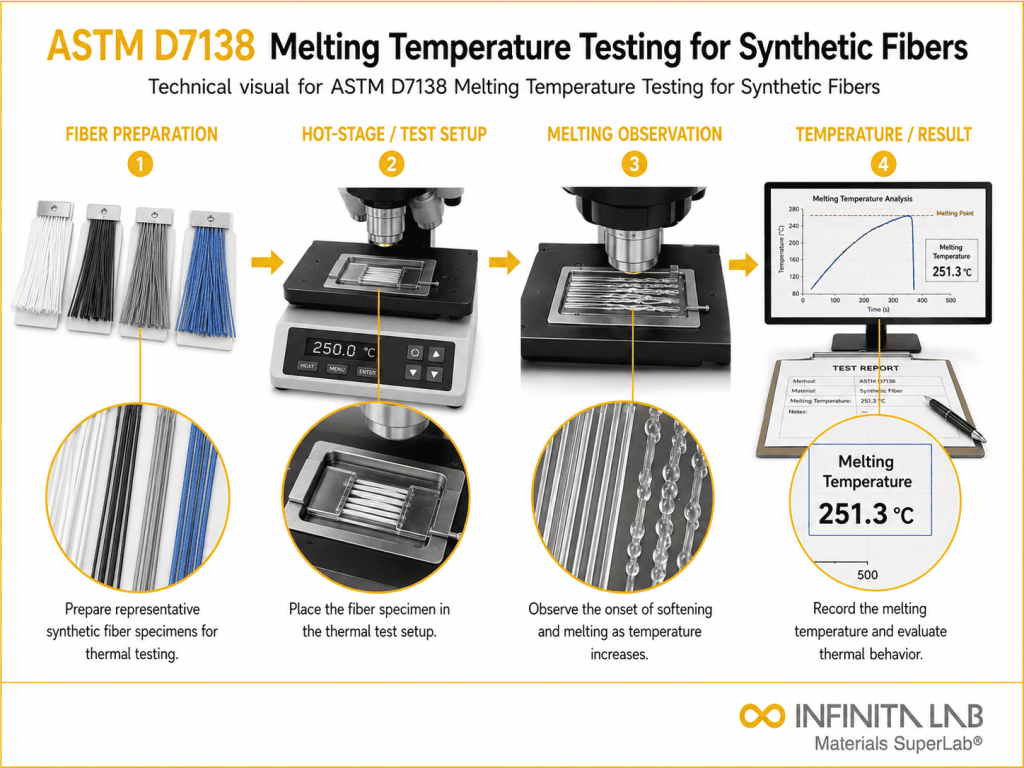


What Is ASTM D7138 Synthetic Fiber Melting Temperature?
ASTM D7138 describes a test method for determining the melting temperature of synthetic fibers using differential scanning calorimetry (DSC). The melting point is a fundamental thermal property that defines processing windows, maximum use temperatures, and fiber identification for synthetic fiber manufacturers and users.
Accurate melting temperature data is essential for fiber producers, textile manufacturers, and quality laboratories characterizing nylon, polyester, polypropylene, and other thermoplastic fiber materials.
Applications and Benefits of ASTM D7138 Synthetic Fiber Melting Temperature Testing
Scope
ASTM D7138 applies to synthetic thermoplastic fibers and measures:
- Onset melting temperature (Tonset)
- Peak melting temperature (Tm)
- Heat of fusion (ΔHm) related to crystallinity
- Multiple melting peaks indicate different crystal populations
Applications
- Synthetic fiber identification and characterization (PET, PA, PP, PE)
- Quality control in fiber production and extrusion
- Fiber blend composition estimation
- Textile thermal processing window determination
- Research on fiber crystallinity and orientation effects
Benefits
- Precise, reproducible measurement of melting behavior
- Enables fiber identification without complex spectroscopy
- Detects blend components or contamination by unexpected melting peaks
- Provides crystallinity data relevant to fiber mechanical properties
- Small sample requirement suitable for single filaments or fiber bundles
Our ASTM D7138 Testing Procedure
Sample Preparation
A small fiber sample (5–10 mg) is cut, weighed, and encapsulated in an aluminum DSC pan.
1DSC Temperature Program
The sample is heated at a controlled rate (typically 10°C/min) through and above the expected melting temperature.
2Melting Peak Analysis
The DSC thermogram is analyzed to identify onset, peak, and endset temperatures of the melting endotherm.
3Reporting
Melting temperatures and heat of fusion are reported; results are compared to reference values for the expected fiber type.
4ASTM D7138 Test Parameters and Requirements
| Parameter | Details |
|---|---|
| Test Principle | Differential scanning calorimetry (DSC) |
| Applicable Materials | Synthetic thermoplastic fibers (PET, PA6, PA66, PP, PE, etc.) |
| Sample Mass | 5–10 mg |
| Heating Rate | 10°C/min (default) |
| Measured Outputs | Tonset (°C), Tm peak (°C), ΔHm (J/g) |


- Differential scanning calorimeter (DSC) with nitrogen purge
- Precision analytical balance (0.01 mg resolution) | Hermetically sealed or crimped aluminum DSC pans
- Indium and other certified melting point standards for calibration
- Data analysis software for peak integration and baseline subtraction
Equipment and Instrumentation Used for ASTM D7138 Testing
What You Receive: Test Report, Data, and Certification
- DSC thermogram with labeled melting peak
- Onset, peak, and endset melting temperatures (°C)
- Heat of fusion and estimated crystallinity (%)
- Fiber identification based on melting temperature
- Test report with calibration traceability
ASTM D7138 Synthetic Fiber Melting Temperature FAQs
PET melts at approximately 250–255°C, nylon 66 at 255–265°C, nylon 6 at 215–225°C, and polypropylene at 160–170°C — these ranges guide identification.
Melting temperature is a strong indicator of fiber identity, but FTIR or other complementary analysis may be needed to definitively distinguish chemically similar fiber types.
A higher heat of fusion indicates a more crystalline fiber structure, which correlates with higher tensile strength, modulus, and reduced elongation in the final fiber product.
Multiple melting peaks can result from different crystal populations, recrystallization during heating, or blended fibers with different compositions — each case requires specific interpretation.
Calibration is performed using certified reference materials with known melting points (e.g., indium at 156.6°C, tin at 231.9°C) to verify temperature accuracy and heat flow calibration.
Melting point testing of polyester fiber determines the temperature at which the fiber transitions from a solid structure into a molten state. The test is commonly performed using a differential scanning calorimeter (DSC), which measures the heat absorbed by the polyester sample as its temperature increases under controlled conditions. A small fiber specimen is placed in a sample pan and heated at a specified rate alongside a reference pan. The instrument records the thermal response and generates a thermogram showing the melting endothermic peak. The peak temperature is generally reported as the melting temperature, while the onset temperature may also be recorded to characterize the melting behavior. This testing helps manufacturers evaluate polymer identity, thermal stability, crystallinity, processing suitability, and consistency in polyester fiber production.
Most conventional polyester textile fibers made from polyethylene terephthalate (PET) melt at approximately 250–265°C (482–509°F). The exact melting temperature depends on the polymer composition, crystallinity, molecular structure, manufacturing process, and thermal history. Polyester may begin softening at lower temperatures, typically around 230–245°C, before reaching its melting range. At higher temperatures, prolonged exposure can cause thermal degradation and changes in the polymer's mechanical properties. Knowing the melting temperature is important for textile processing, heat setting, fiber manufacturing, recycling, and quality control.
Why Choose Infinita Lab for Synthetic Fiber Melting Temperature Testing?
When your Synthetic Fiber Melting Temperature results have to hold up - for compliance, a customer audit, or an engineering decision - ASTM D7138 accuracy and an unbiased third-party report matter more than price. Infinita Lab routes your ASTM D7138 synthetic fiber melting temperature testing to ISO/IEC 17025-accredited U.S. partner labs with hands-on method experience, so you get defensible data, transparent reporting, and turnaround times built around your project deadline - not ours.

Need ASTM D7138 Synthetic Fiber Melting Temperature Testing You Can Rely On?
Send query us at hello@infinitalab.com or call us at (888) 878-3090 to learn more about our services and how we can support you.