

Overview
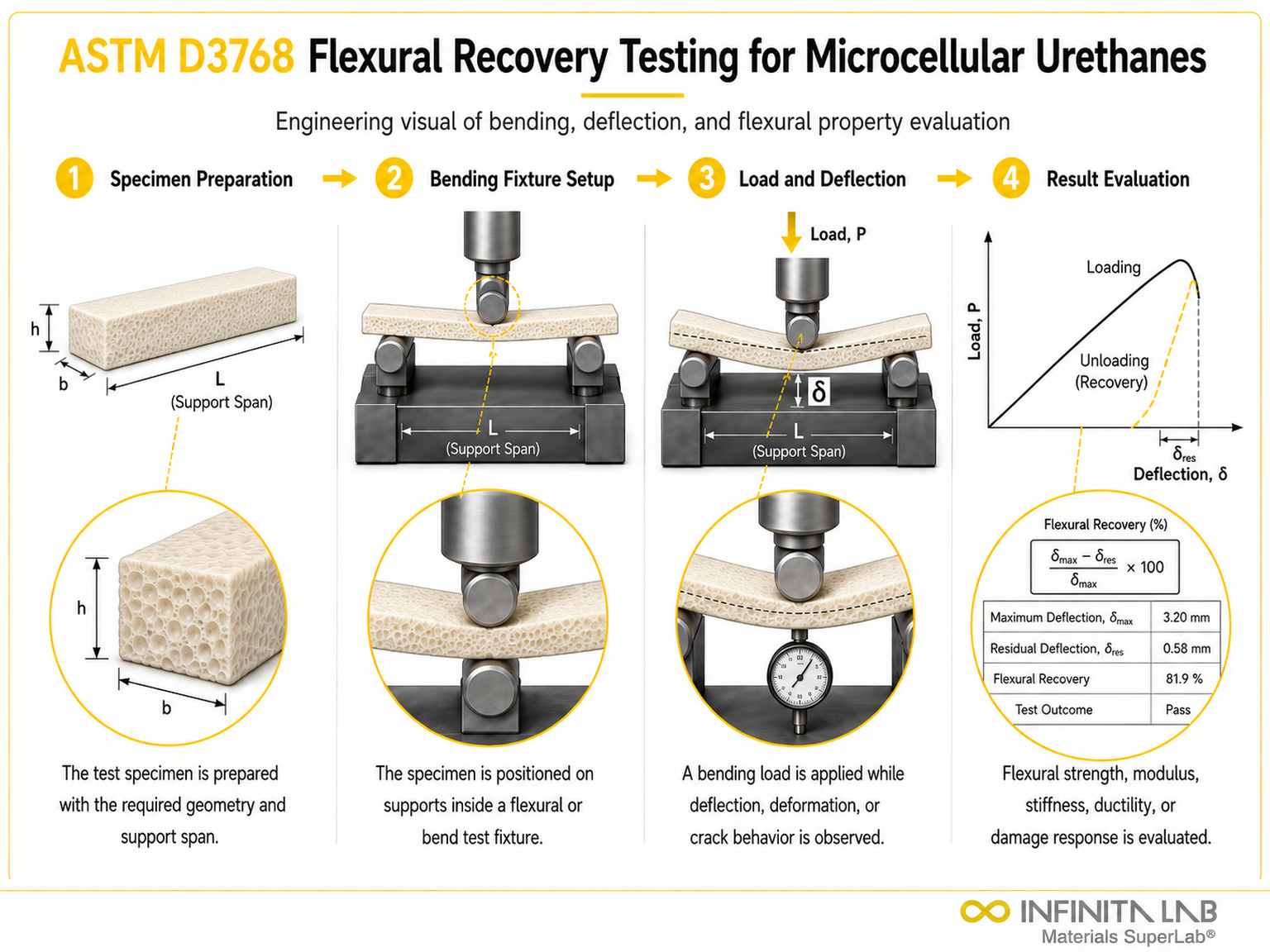
ASTM D3768 evaluates the flexural recovery properties of microcellular urethane materials by measuring their ability to return to original shape after bending deformation. This test is essential for understanding resilience, elasticity, and long-term performance under repeated flexural stress conditions.
The method is widely used to assess material behavior in applications where flexibility and recovery are critical. It helps ensure consistent product quality, supports material selection, and provides insight into durability and resistance to permanent deformation in microcellular urethane components.

Scope, Applications, and Benefits
Scope
ASTM D3768 defines procedures for determining the flexural recovery characteristics of microcellular urethane materials under controlled bending conditions.
- Applicable to microcellular urethane materials
- Measures flexural recovery after deformation
- Evaluates resilience and elasticity
- Uses controlled bending and recovery cycles
- Suitable for quality control and research
- Supports material comparison and development
- Assesses resistance to permanent deformation
Applications
- Automotive interior components
- Footwear and cushioning products
- Industrial flexible parts
- Consumer goods
- Material performance testing
Benefits
- Evaluates recovery and resilience properties
- Helps improve material durability
- Supports product design optimization
- Ensures consistent performance
- Enables comparison between materials
Test Process
Sample Preparation
Specimens are cut to specified dimensions and conditioned under standard conditions.
1Flexural Deformation
Sample is bent to a defined angle or strain under controlled conditions.
2Recovery Phase
Load is removed and the specimen is allowed to recover over a set time period.
3Measurement
Degree of recovery is measured and compared to original dimensions.
4Technical Specifications
| Parameter | Details |
|---|---|
| Material Type | Microcellular urethane |
| Property | Flexural recovery |
| Method | Controlled bending and recovery |
| Units | Percentage recovery (%) |
| Deformation | Defined strain or angle |
| Conditioning | Standard temperature and humidity |
| Output | Recovery percentage |


- Flexural testing apparatus
- Bending fixtures
- Measurement scale or gauge
- Conditioning chamber
- Specimen cutting tools
Instrumentation Used for Testing
Results and Deliverables
- Flexural recovery percentage
- Deformation and recovery data
- Test conditions and observations
- Comparison with specifications
- Compliance statement with ASTM D3768
Frequently Asked Question
ASTM D3768 is used to evaluate the flexural recovery of microcellular urethane materials after bending. It helps determine resilience and elasticity, ensuring materials can return to their original shape and maintain performance under repeated flexural stress conditions.
Flexural recovery indicates how well a material can regain its original shape after deformation. High recovery ensures durability, comfort, and long-term performance in applications involving repeated bending.
A high recovery percentage indicates excellent elasticity and resilience, meaning the material can withstand repeated deformation without permanent damage.
Repeated bending can lead to fatigue and reduced recovery, making this test important for evaluating long-term durability.
It provides a standardized method to assess flexural recovery, ensuring materials meet performance requirements for flexibility and durability.
Why Choose Infinita Lab for Advanced Materials Testing and Characterization?
At the core of this breadth is our network of 2,000+ accredited laboratories across the USA, offering access to over 10,000 testing methods and analytical services. From advanced materials characterization (SEM, TEM, RBS, XPS) to mechanical, chemical, environmental, biological, and standardized ASTM/ISO-compliant testing, we deliver unmatched flexibility, specialization, and scale. You are never limited by geography, facility, or methodology — Infinita Lab connects you to the right expertise and testing solution, every time.

Looking for a Trusted Partner for Accurate and Reliable Testing Services?
Send query us at hello@infinitalab.com or call us at (888) 878-3090 to learn more about our services and how we can support you.





