


ASTM D7249 Flexural Stiffness Testing for Sandwich Panel Facings
ASTM D7249 measures the tensile and compressive strength of various materials. A sandwich flexural test, generally used to determine the flexural strength or modulus of the material, comprises four-point flexure of flat sandwich constructions and is performed by using a universal testing machine.
TRUSTED BY


Precision-driven testing for dimensional accuracy and compliance
- Overview
- Scope, Applications, and Benefits
- Test Process
- Specifications
- Instrumentation
- Results and Deliverables
Overview
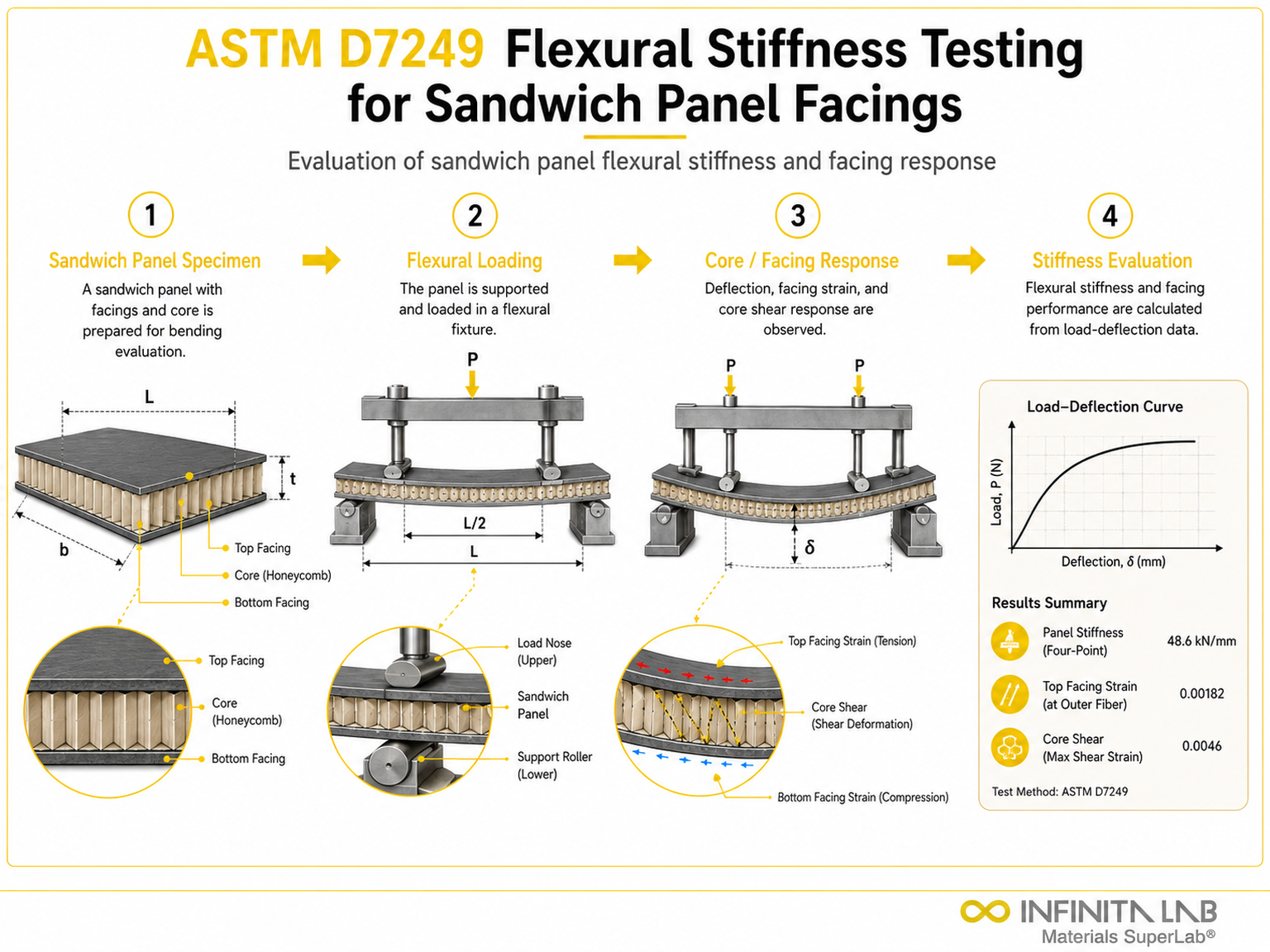
ASTM D7249 describes a test method for determining the facing properties and flexural stiffness of structural sandwich construction using wide sandwich panel specimens. Unlike narrow beam methods, wide panel specimens better represent the stiffness behavior of panels with large aspect ratios, such as those used in aerospace, marine, and building structures.
This method enables accurate determination of facing tensile and compressive properties as well as total panel bending stiffness, which are critical inputs for sandwich structural design.

Scope, Applications, and Benefits
Scope
ASTM D7249 applies to flat structural sandwich panels with metallic or composite facings and various core types. It determines:
- Sandwich panel bending stiffness (EI per unit width)
- Facing tensile and compressive modulus
- Facing stress at failure
- Core contribution to panel shear stiffness (via complementary shear test)
Applications
- Aerospace fuselage and wing panel design characterization
- Marine deck and hull sandwich panel qualification
- Wind turbine blade sandwich construction verification
- Building insulated composite panel structural rating
- Transportation vehicle lightweight floor and wall panel testing
Benefits
- More representative of wide panel structural behavior than narrow beam specimens
- Provides both stiffness and facing strength data in a single test
- Applicable to a variety of facing and core material combinations
- Supports design allowable generation for sandwich structure certification
- Minimizes anticlastic bending effects that can distort narrow beam results
Test Process
Specimen Preparation
Wide sandwich panel specimens are cut to size, and strain gauges or deflection sensors are attached to the facing surfaces.
1Four-Point Bending Setup
Specimens are placed in a four-point bending fixture with defined support and loading span geometry.
2Loading
Flexural load is applied at a controlled rate; load, deflection, and facing strains are continuously recorded.
3Stiffness and Strength Calculation
Panel bending stiffness (EI) and facing stresses are calculated from load-deflection data and strain measurements.
4Technical Specifications
| Parameter | Details |
|---|---|
| Standard | ASTM D7249 |
| Test Principle | Four-point flexural loading of wide sandwich panel |
| Applicable Materials | Structural sandwich panels with composite or metal facings |
| Specimen Width | Minimum 4× core cell size or 50 mm, typically 150–300 mm |
| Measured Outputs | EI (bending stiffness), facing modulus, facing stress at failure |
| Strain Measurement | Strain gauges or DIC on tension and compression facings |


- Universal testing machine with four-point bending fixture
- Load cell of appropriate capacity for panel failure
- Linear variable differential transducers (LVDTs) or dial gauges for deflection
- Strain gauges bonded to facing surfaces
- Data acquisition system with multi-channel capability
Instrumentation Used for Testing
Results and Deliverables
- Sandwich panel bending stiffness (EI) per unit width
- Facing tensile and compressive modulus values
- Facing stress at panel failure
- Load-deflection and load-strain curves
- Test report for sandwich design or qualification documentation
Frequently Asked Question
Wide panels reproduce real structural boundary conditions more accurately; narrow beams can exhibit edge effects, anticlastic curvature, and shear lag that reduce the accuracy of panel stiffness predictions.
Foam, honeycomb (aluminum, Nomex, thermoplastic), balsa wood, and syntactic foam cores are all applicable, provided the specimen width exceeds the minimum core cell size requirement.
EI (elastic modulus × area moment of inertia per unit width) is the fundamental sandwich structural parameter controlling deflection under lateral load; it is directly used in beam and plate bending design calculations.
Yes — facing/core interface debonding appears as a characteristic load drop or change in load-deflection slope; the failure mode and location are documented for each specimen.
ASTM D7249 is designed for flat panels; separate test methods and corrections are needed for curved or thermally formed sandwich panels.
Why Choose Infinita Lab for Advanced Materials Testing and Characterization?
At the core of this breadth is our network of 2,000+ accredited laboratories across the USA, offering access to over 10,000 testing methods and analytical services. From advanced materials characterization (SEM, TEM, RBS, XPS) to mechanical, chemical, environmental, biological, and standardized ASTM/ISO-compliant testing, we deliver unmatched flexibility, specialization, and scale. You are never limited by geography, facility, or methodology — Infinita Lab connects you to the right expertise and testing solution, every time.

Looking for a Trusted Partner for Accurate and Reliable Testing Services?
Send query us at hello@infinitalab.com or call us at (888) 878-3090 to learn more about our services and how we can support you.



Request a Quote
Submit your material details and receive testing procedures, pricing, and turnaround time within 24 hours.
 Quick Turnaround and Hasslefree process
 Confidentiality Guarantee
 Free, No-obligation Consultation
 100% Customer Satisfaction
