


ASTM D2584: Frp Composite Ignition Loss Testing Services
Accredited ASTM D2584 frp composite ignition loss testing from Infinita Lab, performed to the exact standard requirements - accurate, reproducible results with full documentation for compliance, R&D, and quality control programs.
TRUSTED BY


Get ASTM D2584 compliant results - request your frp composite ignition loss testing quote
- Overview
- Scope, Applications, and Benefits
- Test Process
- Specifications
- Instrumentation
- Results and Deliverables
What Is ASTM D2584 Frp Composite Ignition Loss?
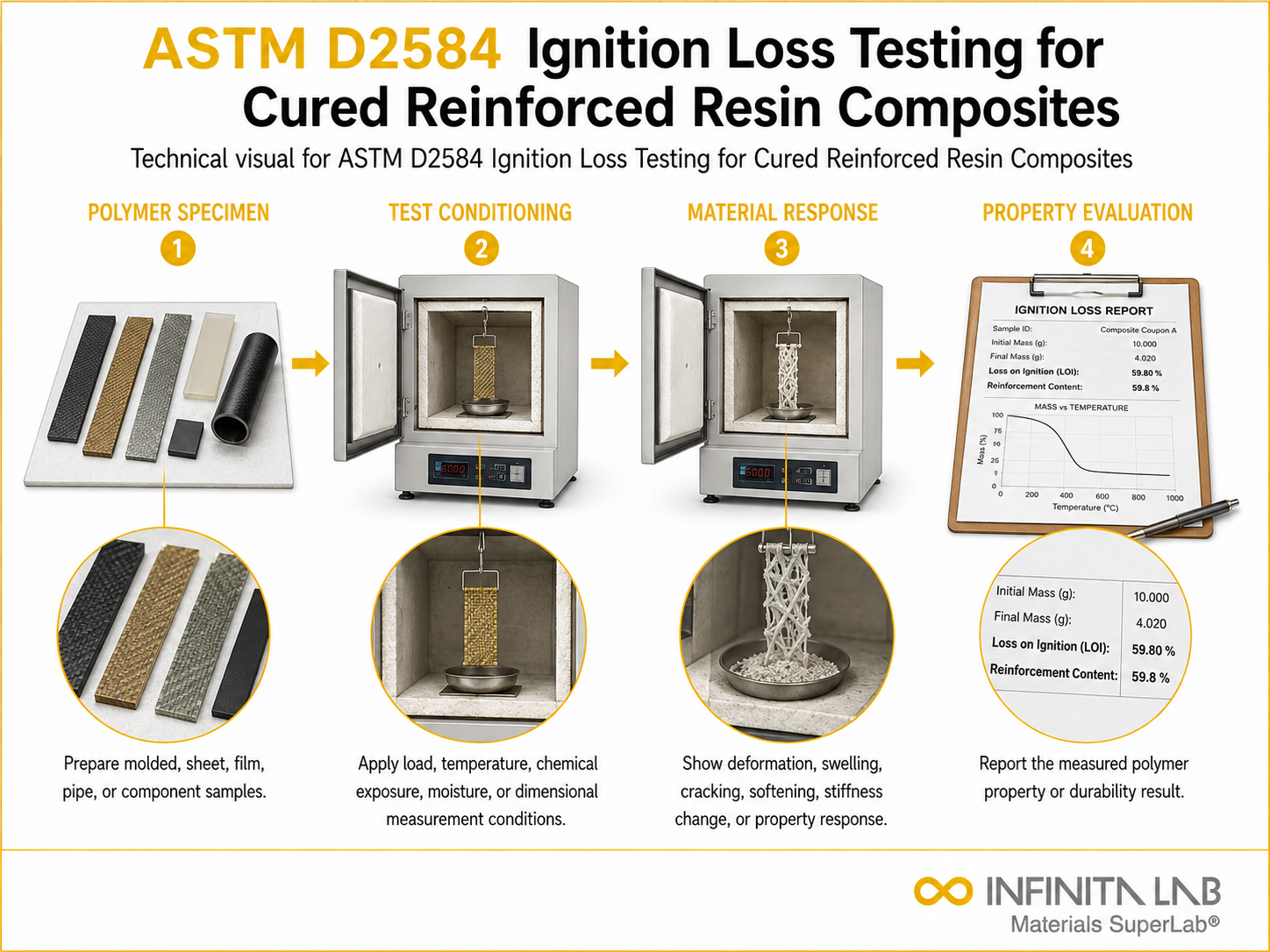
ASTM D2584, Standard Test Method for Ignition Loss of Cured Reinforced Resins, is the accepted laboratory procedure for determining the resin content and reinforcement content of cured fibre-reinforced plastic (FRP) composites by weight. The method is built on a straightforward burn-off principle: a conditioned specimen of cured composite is weighed, placed in a muffle furnace, and heated at a controlled high temperature until the organic resin matrix fully combusts and only the inorganic reinforcing material, typically glass fibre, remains. The specimen is then cooled in a desiccator to prevent moisture pickup and reweighed. The difference between the initial and final weights represents the ignition loss, which under the conditions specified by the standard is treated as the resin content of the composite. In contrast, the residual weight represents the reinforcement, or glass, content.
This relationship matters because the resin-to-reinforcement ratio is one of the most fundamental variables governing the performance of a fibreglass-reinforced part. Too little reinforcement can leave a laminate under-strengthened and prone to premature failure, while too much resin adds unnecessary weight and cost without a corresponding gain in mechanical performance. Because ASTM D2584 quantifies this ratio directly and repeatably, it is widely used to verify that composite parts, panels, pipes, tanks, and laminates are manufactured to the fibre-to-resin proportions specified in their design and material specifications.
Infinita Lab performs ASTM D2584 ignition loss testing through its accredited laboratory network, supporting composite manufacturers, fabricators, and quality assurance teams that need confirmed, standards-based resin and reinforcement content data for incoming inspection, in-process quality control, supplier qualification, and product certification of cured reinforced plastic materials.

Applications and Benefits of ASTM D2584 Frp Composite Ignition Loss Testing
Scope
- ASTM D2584 determines the percentage of resin content and reinforcement (fibre) content by weight in a cured, fibre-reinforced plastic composite.
- The test method is based on controlled combustion, in which the organic resin matrix is burned off in a muffle furnace. Meanwhile, the inorganic reinforcement remains largely unaffected by the heat.
- A specimen is conditioned, weighed before ignition, heated until all carbonaceous material has burned off, cooled in a desiccator, and then weighed again to determine the ignition loss.
- Specimens are typically prepared to a mass of about 5 grams and dimensions of roughly 2.5 inches by 2.5 inches, with multiple specimens tested per sample to improve result reliability.
- The method applies to cured reinforced resin systems, most commonly glass fibre reinforced plastics (GFRP). However, it is used more broadly across thermoset composite materials containing an organic matrix and an inorganic reinforcement.
- Industries relying on this test include composite manufacturing, FRP pipe and tank production, marine construction, transportation, and general reinforced plastics fabrication.
- Typical use cases include verifying resin-to-glass ratios during production, confirming compliance with material or design specifications, and investigating deviations in laminate performance or appearance.
- Testing under ASTM D2584 supports quality control programs, incoming material inspection, supplier and process qualification, and documentation for regulatory or customer specification compliance.
Applications
- Quality control verification of resin content in fibreglass-reinforced plastic (FRP) laminates and parts.
- Confirmation of fibre-to-resin ratio during composite manufacturing process validation
- Testing of FRP pipe, duct, and tank products for compliance with resin and reinforcement content specifications
- Evaluation of marine composite structures, including hulls and structural laminates
- Support for aerospace and transportation composite component qualification
- Investigation of laminate defects, inconsistencies, or performance issues linked to resin or fibre content
- Research and development of new reinforced resin formulations and reinforcement architectures
Benefits
- Provides a direct, standardised measurement of resin and reinforcement content for objective quality decisions
- Uses a simple, well-established combustion principle that is repeatable across laboratories
- Helps manufacturers confirm that composite parts meet design and specification requirements for strength and weight
- Supports early detection of process drift or material inconsistency in composite production
- Generates documented, traceable data suitable for supplier qualification and customer or regulatory submittals
- Applicable across a broad range of cured reinforced resin systems and industries
Our ASTM D2584 Testing Procedure
Specimen Preparation
Condition three ~5 g specimens for at least 40 hours at laboratory conditions. Prepare pre-weighed, pre-dried crucibles.
1Initial Weighing
Weigh each specimen to the nearest 0.1 mg and record the initial weight.
2Ignition & Cooling
Place specimens in crucibles and heat at 565°C ± 28°C until all ორგანics are burned off. Cool in a desiccator.
3Final Weighing & Calculation
Measure the residue weight and calculate ignition loss percentage from the weight difference.
4ASTM D2584 Test Parameters and Requirements
| Parameter | Details |
|---|---|
| Applicable Materials | Cured reinforced resins (typically glass fiber composites) |
| Furnace Temperature | 565°C ± 28°C |
| Specimen Weight | Approximately 5 g |
| Specimen Dimensions | Approx. 2.5 in × 2.5 in × required thickness |
| Number of Specimens | Three |
| Measurement Accuracy | 0.1 mg (analytical balance) |


- Muffle furnace – provides a controlled high-temperature environment to combust the specimen’s organic resin matrix.
- Analytical balance – weighs specimens and crucibles before and after ignition with the precision required for accurate resin and reinforcement content calculations.
- Ceramic or metal crucibles – hold the specimen during ignition and withstand the sustained furnace temperature without contaminating the sample.
- Desiccator – cools ignited specimens in a moisture-free environment before final weighing to prevent inaccurate weight gain.
- Specimen preparation and cutting tools – size and prepare composite specimens to the dimensions and mass required by the test method.
- Laboratory conditioning equipment – maintains standard temperature and humidity conditions during the specimen conditioning period before testing.
Equipment and Instrumentation Used for ASTM D2584 Testing
What You Receive: Test Report, Data, and Certification
- Calculated per cent resin content of the cured reinforced resin specimen
- Calculated per cent reinforcement (fibre) content of the specimen
- Individual and averaged results across multiple tested specimens
- Documentation of specimen preparation, conditioning, and test conditions used
- A comprehensive test report suitable for quality control records, supplier qualification, and customer or specification submittals
- Supporting data to help identify process variation or deviation from target resin-to-reinforcement ratios
Frequently Asked Question
ASTM D2584 is a test method used to determines resin, fiber, and filler content of cured reinforced plastics using ignition loss procedure.
ASTM D2584 is primarily used for glass fiber reinforced thermoset composites such as polyester, vinyl ester, and epoxy resins where the matrix can be safely burned off.
The standard recommends heating the specimen to approximately 565°C (1050°F) to ensure complete resin burn-off while preventing damage or degradation of the glass fiber reinforcement.
The standard measures Barcol hardness, which indicates resistance to surface indentation and provides an indirect evaluation of stiffness and cure condition.
It ensures correct glass fiber content, which directly influences strength, stiffness, durability, and structural performance of composite material.
ASTM D2584 is the Standard Test Method for Ignition Loss of Cured Reinforced Resins. It determines ignition loss, which can represent resin content when the reinforcement and resin meet the method’s limitations. Carbon fiber is generally not applicable for direct resin-content determination under ASTM D2584 because carbon reinforcement can oxidize and lose mass during ignition.
A weighed composite specimen is heated under controlled ignition conditions to remove the resin matrix. The specimen is then cooled and weighed again, and the mass loss is used to determine ignition loss; the result may be interpreted as resin content when applicable.
Why Choose Infinita Lab for Frp Composite Ignition Loss Testing
When your Frp Composite Ignition Loss results have to hold up - for compliance, a customer audit, or an engineering decision - ASTM D2584 accuracy and an unbiased third-party report matter more than price. Infinita Lab routes your ASTM D2584 frp composite ignition loss testing to ISO/IEC 17025-accredited U.S. partner labs with hands-on method experience, so you get defensible data, transparent reporting, and turnaround times built around your project deadline - not ours.

Need ASTM D2584 Frp Composite Ignition Loss Testing You Can Rely On?
Send query us at hello@infinitalab.com or call us at (888) 878-3090 to learn more about our services and how we can support you.



Request a Quote
Submit your material details and receive testing procedures, pricing, and turnaround time within 24 hours.
 Quick Turnaround and Hasslefree process
 Confidentiality Guarantee
 Free, No-obligation Consultation
 100% Customer Satisfaction
