


ASTM D1709: Plastic Film Dart Impact Testing Services
TRUSTED BY


Get ASTM D1709 compliant results — request your plastic film dart impact testing quote
- Overview
- Scope, Applications, and Benefits
- Test Process
- Specifications
- Instrumentation
- Results and Deliverables
What Is ASTM D1709 Plastic Film Dart Impact?
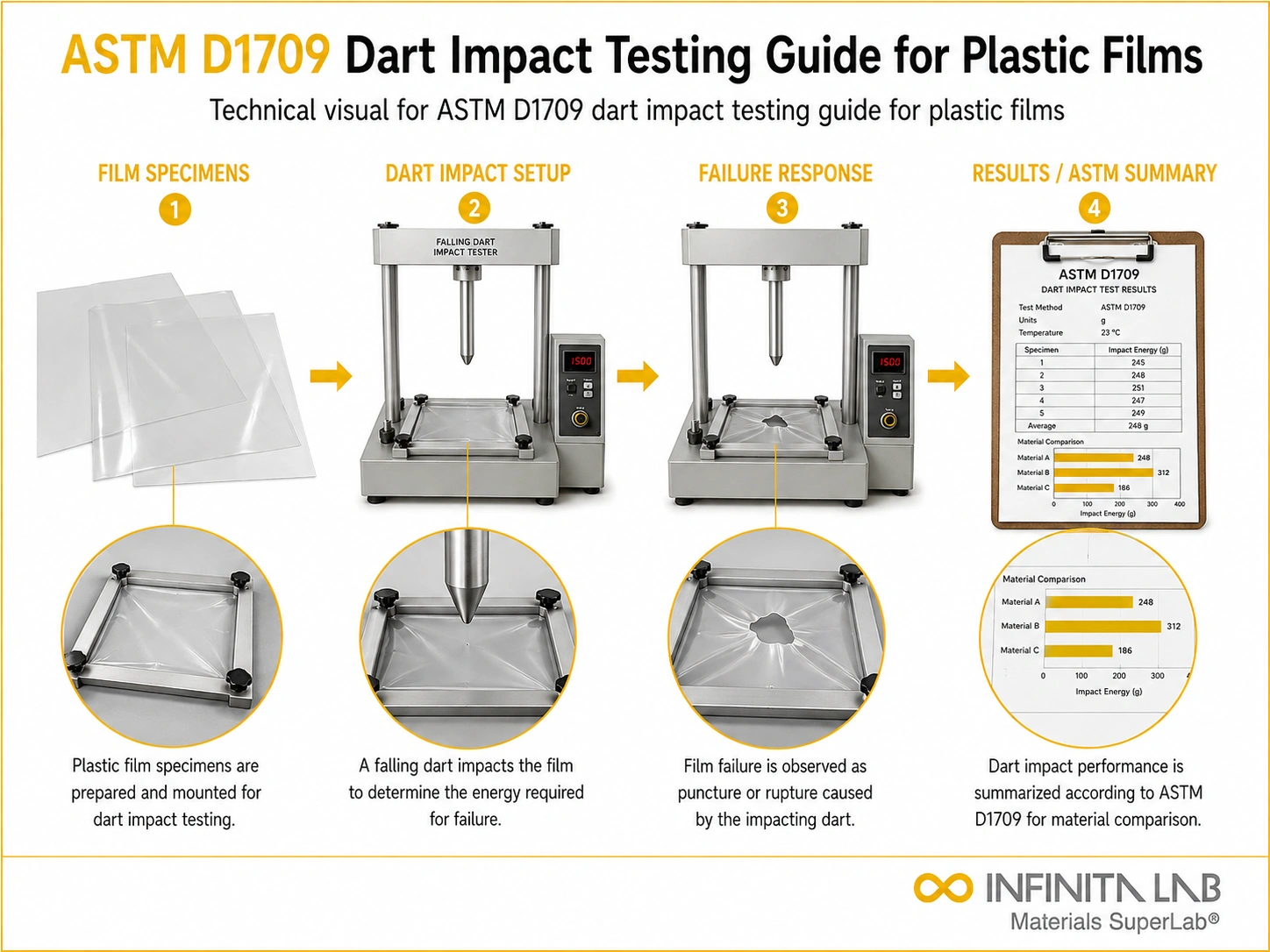
ASTM D1709 determines the impact resistance of plastic films using a free-falling dart method, measuring the energy required to cause failure. The test evaluates the toughness and durability of thin plastic films by dropping a hemispherical dart from a specified height onto the specimen.
This method is widely used to assess film strength, predict handling performance, and ensure resistance to sudden impacts during packaging, transportation, and use. It provides critical data for material selection, quality control, and product development of flexible plastic films.

Applications and Benefits of ASTM D1709 Plastic Film Dart Impact Testing
Scope
ASTM D1709 defines procedures for measuring the impact resistance of plastic films using a controlled free-falling dart. It provides a statistical determination of the mass required to cause failure in 50% of tested specimens.
- Applicable to plastic films and thin sheets
- Determines impact resistance using dart drop method
- Includes Method A and Method B based on energy range
- Measures failure at 50% probability (F50 value)
- Suitable for quality control and comparative analysis
- Helps evaluate film toughness and durability
- Supports material development and performance validation
Applications
- Packaging films and flexible materials
- Industrial plastic film production
- Agricultural films and covers
- Consumer product packaging evaluation
- Material research and development
Benefits
- Provides reliable impact resistance data
- Helps predict film durability during handling
- Supports product quality and consistency
- Enables comparison between film types
- Assists in optimizing material formulations
Our ASTM D1709 Testing Procedure
Specimen Mounting
Film specimen is clamped securely in the test apparatus.
1Dart Selection
Appropriate dart weight and drop height are selected based on method.
2Impact Testing
Dart is released to strike the specimen under controlled conditions.
3Result Determination
Multiple trials are conducted to determine F50 failure value.
4ASTM D1709 Test Parameters and Requirements
| Parameter | Details |
|---|---|
| Material Type | Plastic films and thin sheets |
| Methods | Method A (lower energy), Method B (higher energy) |
| Measurement | F50 impact failure mass |
| Dart Shape | Hemispherical head |
| Drop Height | Fixed per method specification |
| Result Unit | Mass (grams) |
| Failure Criteria | Break or rupture of film |


- Dart impact tester
- Clamping ring fixture
- Standardized darts and weights
- Release mechanism
- Measurement and recording system
Equipment and Instrumentation Used for ASTM D1709 Testing
What You Receive: Test Report, Data, and Certification
- F50 impact value (grams)
- Test method used (A or B)
- Number of trials conducted
- Failure observations
- Compliance statement with ASTM D1709
ASTM D1709 Plastic Film Dart Impact FAQs
ASTM D1709 is used to determine the impact resistance of plastic films and sheeting by measuring the energy required to cause failure from a free-falling dart. It helps assess a film’s toughness, flexibility, and resistance to puncture under simulated drop or impact conditions.
The dart drop impact test measures the energy absorbed by a plastic film before rupture when impacted by a falling dart of specified weight and diameter. The result, expressed as 50% failure weight (Wf), indicates the film’s impact strength.
Impact resistance determines how well packaging films withstand handling, filling, drops, and transport stresses. Poor impact resistance can lead to film puncture or leakage, compromising product safety and shelf life. ASTM D1709 helps ensure durability and reliability in real-world use.
Method A is used for lower energy impacts with a smaller dart, while Method B is designed for higher energy impacts using a larger dart. Selection depends on the strength and thickness of the film.
Factors include film thickness, material composition, temperature, clamping conditions, and testing method. Proper control of these variables ensures consistent and reliable results.
Why Choose Infinita Lab for Plastic Film Dart Impact Testing?
At the core of this breadth is our network of 2,000+ accredited laboratories across the USA, offering access to over 10,000 testing methods and analytical services. From advanced materials characterization (SEM, TEM, RBS, XPS) to mechanical, chemical, environmental, biological, and standardized ASTM/ISO-compliant testing, we deliver unmatched flexibility, specialization, and scale. You are never limited by geography, facility, or methodology — Infinita Lab connects you to the right expertise and testing solution, every time.

Need ASTM D1709 Plastic Film Dart Impact Testing You Can Rely On?
Send query us at hello@infinitalab.com or call us at (888) 878-3090 to learn more about our services and how we can support you.



Request a Quote
Submit your material details and receive testing procedures, pricing, and turnaround time within 24 hours.
 Quick Turnaround and Hasslefree process
 Confidentiality Guarantee
 Free, No-obligation Consultation
 100% Customer Satisfaction
