


ASTM C729: Glass Density Sink Float Comparator Testing Services
ASTM C729 measures the density of non-porous solids or glass typically with densities ranging from 1.1 to 3.3 g/cm³. This test is used for comparing the density of the specimen with a standard specimen of known density. ASTM C729 helps measure densities of small specimens of glass by a single-tube sink-float apparatus, and density values are in g/cm³.
TRUSTED BY


Get ASTM C729 compliant results — request your glass density sink float comparator testing quote
- Overview
- Scope, Applications, and Benefits
- Test Process
- Specifications
- Instrumentation
- Results and Deliverables
What Is ASTM C729 Glass Density Sink Float Comparator?
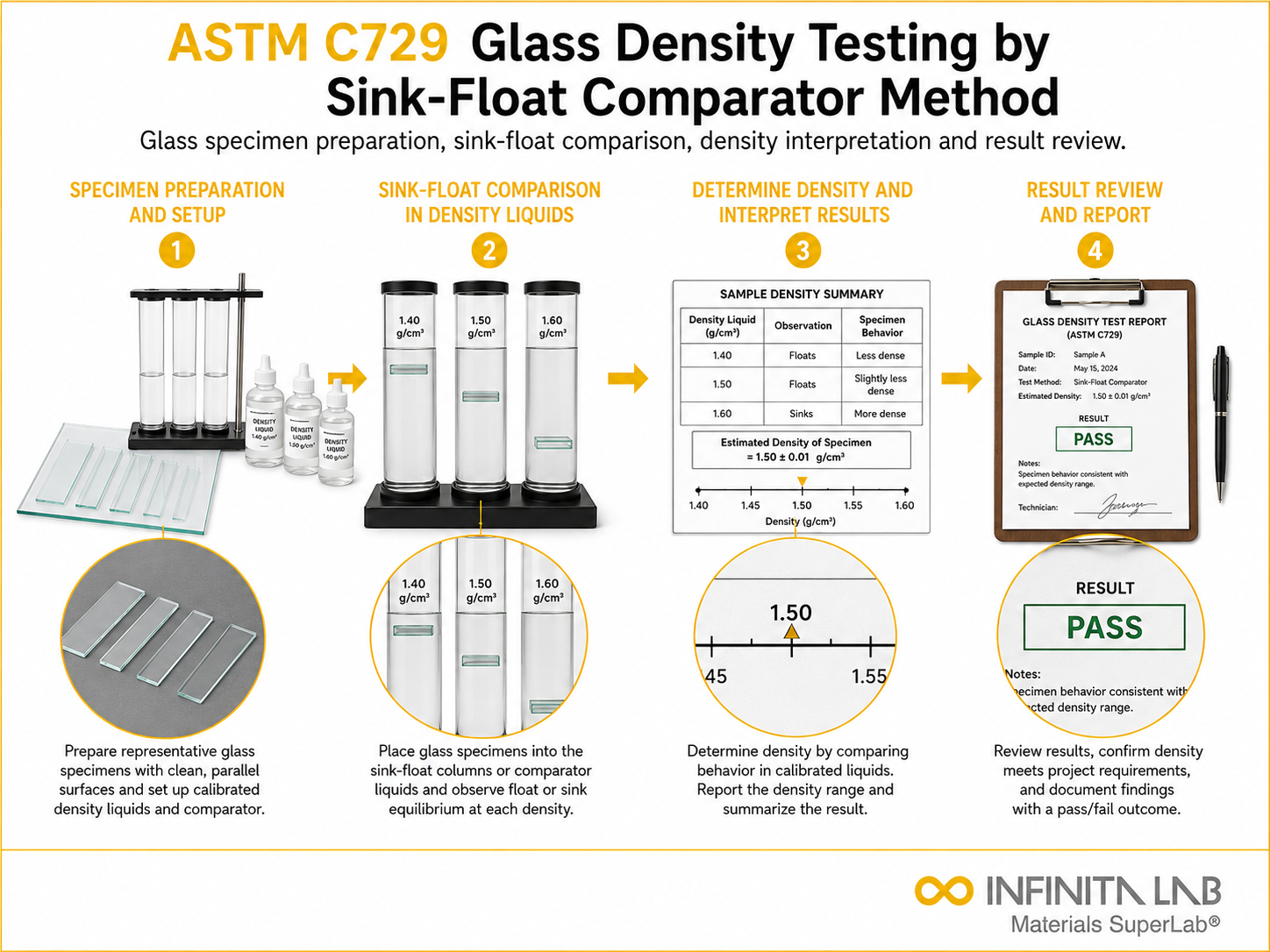
ASTM C729 determines the density of glass using the sink-float comparator method, where the specimen is immersed in liquids of known densities to observe whether it sinks, floats, or remains suspended. This method allows precise density matching without complex calculations.
The test is widely used in glass manufacturing and material identification. It helps evaluate composition, uniformity, and quality by comparing density against calibrated reference liquids.

Applications and Benefits of ASTM C729 Glass Density Sink Float Comparator Testing
Scope
ASTM C729 evaluates the density of glass by comparing buoyancy behavior in liquids of controlled density. The test identifies the density at which the specimen remains neutrally buoyant.
The test evaluates:
- Density of glass materials
- Material uniformity and consistency
- Variations in composition
- Presence of defects or inclusions
- Suitability for specific applications
Applications
- Flat and container glass
- Optical and specialty glass
- Glass manufacturing and processing
- Material identification and comparison
- Research and development
- Quality control in production
Benefits
- Provides accurate density determination
- Simple and effective comparison method
- Helps detect inconsistencies in glass
- Supports material characterization
- Enables quick density matching
Our ASTM C729 Testing Procedure
Sample Preparation
Glass specimens are cleaned and prepared for testing.
1Liquid Preparation
Liquids of known densities are prepared and calibrated.
2Immersion Testing
Specimen is placed in liquids to observe sink or float behavior.
3Data Recording & Evaluation
Density is determined when the specimen remains suspended.
4ASTM C729 Test Parameters and Requirements
| Parameter | Details |
|---|---|
| Applicable Materials | Glass materials |
| Density Range | ~2.2 to 3.5 g/cm³ |
| Liquid Medium | Heavy liquids or calibrated solutions |
| Temperature Control | ~20°C to 25°C |
| Measurement Accuracy | ±0.002 g/cm³ |
| Measured Outputs | Density (g/cm³) |


- Sink-float comparator setup
- Density-controlled liquid solutions
- Temperature control system
- Sample handling tools
- Calibration standards
- Data recording system
Equipment and Instrumentation Used for ASTM C729 Testing
What You Receive: Test Report, Data, and Certification
- Density values (g/cm³)
- Sink-float comparison results
- Material uniformity assessment
- Comparative density analysis
- Test condition summary
- ASTM compliance report
ASTM C729 Glass Density Sink Float Comparator FAQs
ASTM C729 determines density of glass using the sink-float comparator method. It identifies whether a sample sinks or floats in liquids of known density, helping evaluate composition and material consistency.
Key parameters include density of comparison liquids, temperature control, specimen size, and observation accuracy. Proper calibration of liquids is essential to ensure reliable and repeatable density determination.
The test determines approximate density by matching the sample with a liquid of equal density. Results indicate material composition and help differentiate between various glass types.
ASTM C729 is used for glass materials such as soda-lime, borosilicate, and specialty glasses. It is particularly useful for quick comparative density evaluation in laboratories.
ASTM C729 provides approximate density values and depends on accurate liquid preparation and temperature control. It may not be suitable for highly precise measurements or materials with very similar densities.
Why Choose Infinita Lab for Glass Density Sink Float Comparator Testing?
At the core of this breadth is our network of 2,000+ accredited laboratories across the USA, offering access to over 10,000 testing methods and analytical services. From advanced materials characterization (SEM, TEM, RBS, XPS) to mechanical, chemical, environmental, biological, and standardized ASTM/ISO-compliant testing, we deliver unmatched flexibility, specialization, and scale. You are never limited by geography, facility, or methodology — Infinita Lab connects you to the right expertise and testing solution, every time.

Looking for an Accredited Partner for ASTM C729 Glass Density Sink Float Comparator Testing?
Send query us at hello@infinitalab.com or call us at (888) 878-3090 to learn more about our services and how we can support you.



Request a Quote
Submit your material details and receive testing procedures, pricing, and turnaround time within 24 hours.
 Quick Turnaround and Hasslefree process
 Confidentiality Guarantee
 Free, No-obligation Consultation
 100% Customer Satisfaction
