


ASTM C518: Thermal Conductivity Testing Services
ASTM C518 is a standard test method for measuring the steady-state thermal transmission properties of insulation materials using a heat flow meter apparatus. This test method is used to determine the thermal conductivity and resistance of insulation materials, such as foams, fibers, and rigid boards, under steady-state conditions.
TRUSTED BY


Get ASTM C518 compliant results — request your thermal conductivity testing quote
- Overview
- Scope, Applications, and Benefits
- Test Process
- Specifications
- Instrumentation
- Results and Deliverables
What Is ASTM C518 Thermal Conductivity?
ASTM C518 defines the test method for measuring the steady-state thermal transmission properties of flat slab specimens using a heat flow meter apparatus. The method determines thermal conductance, thermal resistance (R-value), and thermal conductivity by establishing a steady temperature difference across the specimen and measuring the heat flux passing through it. The heat flow meter apparatus uses a calibrated heat flux transducer positioned between the specimen and one of the temperature-controlled plates to measure heat flux without requiring a reference specimen of known conductivity.
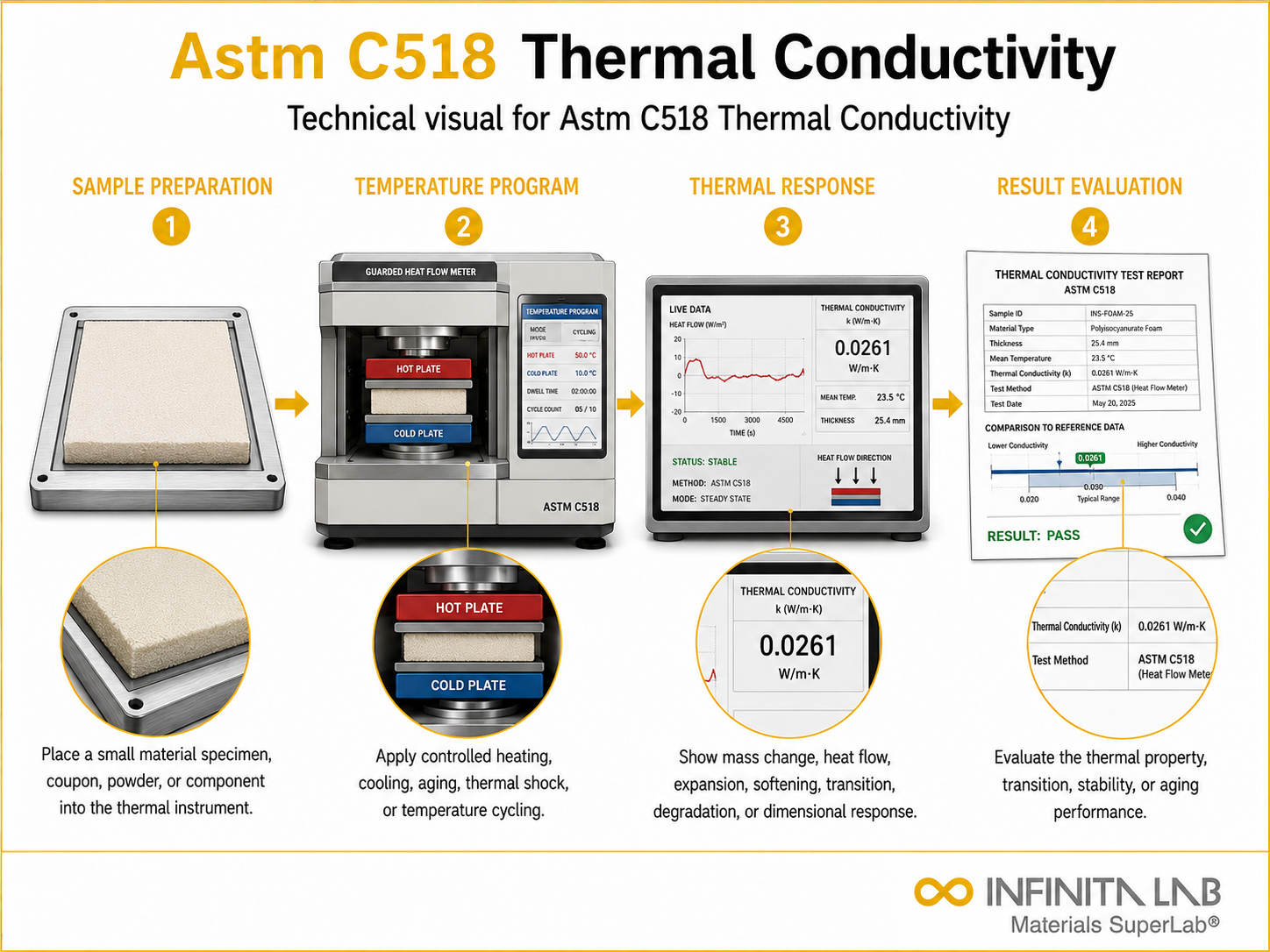
In the test setup, the specimen is sandwiched between two temperature-controlled plates – one hot and one cold – and the system is allowed to reach thermal equilibrium. At steady state, the temperature of each plate surface is measured with embedded sensors, and the heat flow meter transducer outputs a voltage proportional to heat flux. Thermal conductance is calculated from the measured heat flux and temperature difference, and thermal conductivity is derived by multiplying conductance by specimen thickness. ASTM C518 specifies calibration requirements for the heat flux transducer and verification procedures using reference materials.
ASTM C518 is the standard test for thermal insulation materials including mineral wool, fiberglass, foam boards, and aerogels used in building envelopes, industrial equipment insulation, and refrigerated transport. The R-value (thermal resistance per unit area) generated by this test is the value labeled on building insulation products and specified in energy codes. It is also used for thermal characterization of composite materials, circuit board laminates, phase change materials, and other flat specimens where bulk thermal conductivity is the quantity of interest.

Applications and Benefits of ASTM C518 Thermal Conductivity Testing
Scope
ASTM C518 applies to flat slab specimens of homogeneous or quasi-homogeneous materials where the thermal conductivity is in the range approximately 0.02 to 2.0 W/m-K. The method is most accurate for thermal insulators and moderately conducting materials. Highly conductive metals require different methods. Evaluation areas include:
- Thermal conductivity of insulation boards, batts, and blankets
- Thermal resistance (R-value) of building envelope materials
- Thermal conductivity of polymer foams and cellular materials
- Conductivity of composite laminates and printed circuit board base materials
- Effect of density, moisture content, and temperature on thermal conductivity
- Batch-to-batch consistency of thermal conductivity in production insulation products
Applications
- Building insulation product R-value labeling and specification
- Energy code compliance documentation for building envelope materials
- Industrial pipe and vessel insulation qualification
- Aerospace and cryogenic insulation thermal performance characterization
- PCB and electronic substrate thermal conductivity determination
- Thermal management material characterization for product development
Benefits
- Measures both conductivity and R-value in a single test
- Heat flow meter apparatus does not require a reference specimen during measurement
- Steady-state method provides accurate absolute values without transient corrections
- Directly generates R-value in units matching building energy code specifications
- Applicable to a wide range of insulating and moderately conducting materials
- Traceable calibration through reference specimens ensures inter-laboratory comparability
Our ASTM C518 Testing Procedure
Specimen Preparation
Specimens are cut to fit the test area, conditioned to the specified moisture content, and thickness is measured
1Apparatus Setup
Specimen is placed between the hot and cold plates.
2Steady State Confirmation
The system runs until thermal equilibrium is confirmed by stable heat flux meter readings and plate temperature readings
3Data Acquisition and Calculation
Heat flux, plate temperatures, and specimen thickness are recorded.
4ASTM C518 Test Parameters and Requirements
| Parameter | Details |
|---|---|
| Standard | ASTM C518 |
| Measurement Principle | Steady-state heat flow meter with calibrated flux transducer |
| Applicable Conductivity Range | Approximately 0.02 to 2.0 W/m-K |
| Specimen Thickness Range | 6 mm to 300 mm (instrument dependent) |
| Test Temperature Range | -20 degrees Celsius to +75 degrees Celsius typical |
| Output Units | W/m-K (conductivity), m2-K/W (resistance), h-ft2-degrees F/BTU (R-value) |


- Heat flow meter apparatus with temperature-controlled hot and cold plates
- Calibrated heat flux transducer (primary measurement element)
- Resistance temperature detectors or thermocouples in the plate surfaces
- Reference calibration specimens traceable to national standards
- Specimen thickness measurement device (micrometer or mechanical gauge)
- Data acquisition and calculation software
Equipment and Instrumentation Used for ASTM C518 Testing
What You Receive: Test Report, Data, and Certification
- Thermal conductivity (W/m-K)
- Thermal resistance per unit area (m2-K/W)
- R-value in imperial units where required
- Mean test temperature and temperature differential used
- Specimen density and thickness records
- Quality assurance documentation
ASTM C518 Thermal Conductivity FAQs
The ASTM C518 test provides valuable information about a material's thermal performance. The results obtained include Thermal conductivity, which indicates how effectively the material conducts heat, and thermal resistance, which signifies the material's ability to resist heat flow.
Specimens of ASTM C518 should have a parallel surface with a size of 150-300 mm2.
The method has been used at ambient conditions of 10 to 40°C with thicknesses up to approximately 250 mm and with plate temperatures from –195°C to 540°C at 25-mm thickness.
Why Choose Infinita Lab for Thermal Conductivity Testing
At the core of this breadth is our network of 2,000+ accredited laboratories across the USA, offering access to over 10,000 testing methods and analytical services. From advanced materials characterization (SEM, TEM, RBS, XPS) to mechanical, chemical, environmental, biological, and standardized ASTM/ISO-compliant testing, we deliver unmatched flexibility, specialization, and scale. You are never limited by geography, facility, or methodology — Infinita Lab connects you to the right expertise and testing solution, every time.

Need ASTM C518 Thermal Conductivity Testing You Can Rely On?
Send query us at hello@infinitalab.com or call us at (888) 878-3090 to learn more about our services and how we can support you.



Request a Quote
Submit your material details and receive testing procedures, pricing, and turnaround time within 24 hours.
 Quick Turnaround and Hasslefree process
 Confidentiality Guarantee
 Free, No-obligation Consultation
 100% Customer Satisfaction
