


ASTM B311: Powder Material Density Testing Services
Accredited ASTM B311 powder material density testing from Infinita Lab, performed to the exact standard requirements - accurate, reproducible results with full documentation for compliance, R&D, and quality control programs.
TRUSTED BY


Get ASTM B311 compliant results - request your powder material density testing quote
- Overview
- Scope, Applications, and Benefits
- Test Process
- Specifications
- Instrumentation
- Results and Deliverables
What Is ASTM B311 Powder Material Density?
ASTM B311 is the ASTM International test method used to determine the density of powder metallurgy (PM) materials with less than two per cent porosity, and it covers cemented carbides as well. The approach rests on Archimedes’ principle: weigh a specimen dry in air, then weigh it again fully submerged in water, and use the difference between those two readings – together with the known density of water at the measured test temperature – to calculate the material’s density. Because the parts this standard applies to are already nearly fully dense, water immersion introduces only negligible error. That means no oil impregnation or surface-sealing step is needed before testing, which sets B311 apart from other Archimedes-based methods built for more porous sintered parts.
Density matters more in powder metallurgy than almost any other single quality indicator, since it ties directly to mechanical strength, hardness, wear resistance, and how the finished part actually performs. For structural PM components, confirming density against spec is really confirming that compaction and sintering were dialled in correctly. Cemented carbide grades are a bit different: density measurement here helps flag deviations in constituent composition, though it’s worth noting that density alone can’t guarantee grade accuracy, since compensating errors in composition can still land an in-spec reading.
There’s one limitation worth calling out up front. If a specimen actually gains mass when immersed in water, that’s a sign of surface-connected porosity, and B311 simply doesn’t apply – an alternative Archimedes-based method like ASTM B962 is the right call instead. Infinita Lab connects manufacturers, machine shops, and materials engineers with accredited partner laboratories equipped to run ASTM B311 density testing accurately, efficiently, and with full traceability to the standard’s requirements.

Applications and Benefits of ASTM B311 Powder Material Density Testing
Scope
- ASTM B311 governs density determination for powder metallurgy materials with less than two per cent porosity.
- It also applies to cemented carbide materials, not just conventional sintered PM parts.
- Density is determined using water displacement – Archimedes’ principle, applied directly.
- Two mass measurements are required: specimen weight in air (dry) and specimen weight suspended in water.
- Water temperature has to be recorded, since it determines which reference density value gets applied in the calculation.
- The method is built for near fully dense specimens, where open, surface-connected porosity is minimal or absent.
- If a specimen gains mass during immersion, that’s a red flag for surface-connected porosity, and the method no longer applies to that part.
- No oil impregnation or pore-sealing is required beforehand, unlike Archimedes-based methods designed for more porous sintered products.
- The resulting data confirms whether a part hits its specified density target relative to mechanical property requirements.
- B311 sits alongside – but is distinct from – other Archimedes-principle standards written for PM products with higher or more variable porosity.
Applications
- Verifying density on sintered structural automotive parts – PM gears, sprockets, connecting rods, that sort of component.
- Evaluating bearings, bushings, and other near-net-shape sintered parts for consistent densification.
- Assessing cemented carbide inserts and tooling grades for composition and quality control.
- Aerospace and industrial QA programs rely on it to support structural PM component requirements.
- Confirming that compaction and sintering process controls are actually producing high-density parts as intended.
- Validating material quality on both the supplier and OEM purchasing side of PM components.
- Investigating field or warranty issues where insufficient part density is the suspected culprit.
Benefits
- A well-established, accurate method for characterising density in materials that are already close to fully dense.
- The equipment involved is simple and widely available, which keeps testing efficient and reasonably priced.
- Gives manufacturers a way to confirm compaction and sintering parameters are holding steady, run after run.
- Useful for root-cause work when PM component performance problems trace back to insufficient densification.
- Covers both conventional structural PM parts and cemented carbides under one standard.
- Produces objective, standardised data you can compare across suppliers, lots, and production runs.
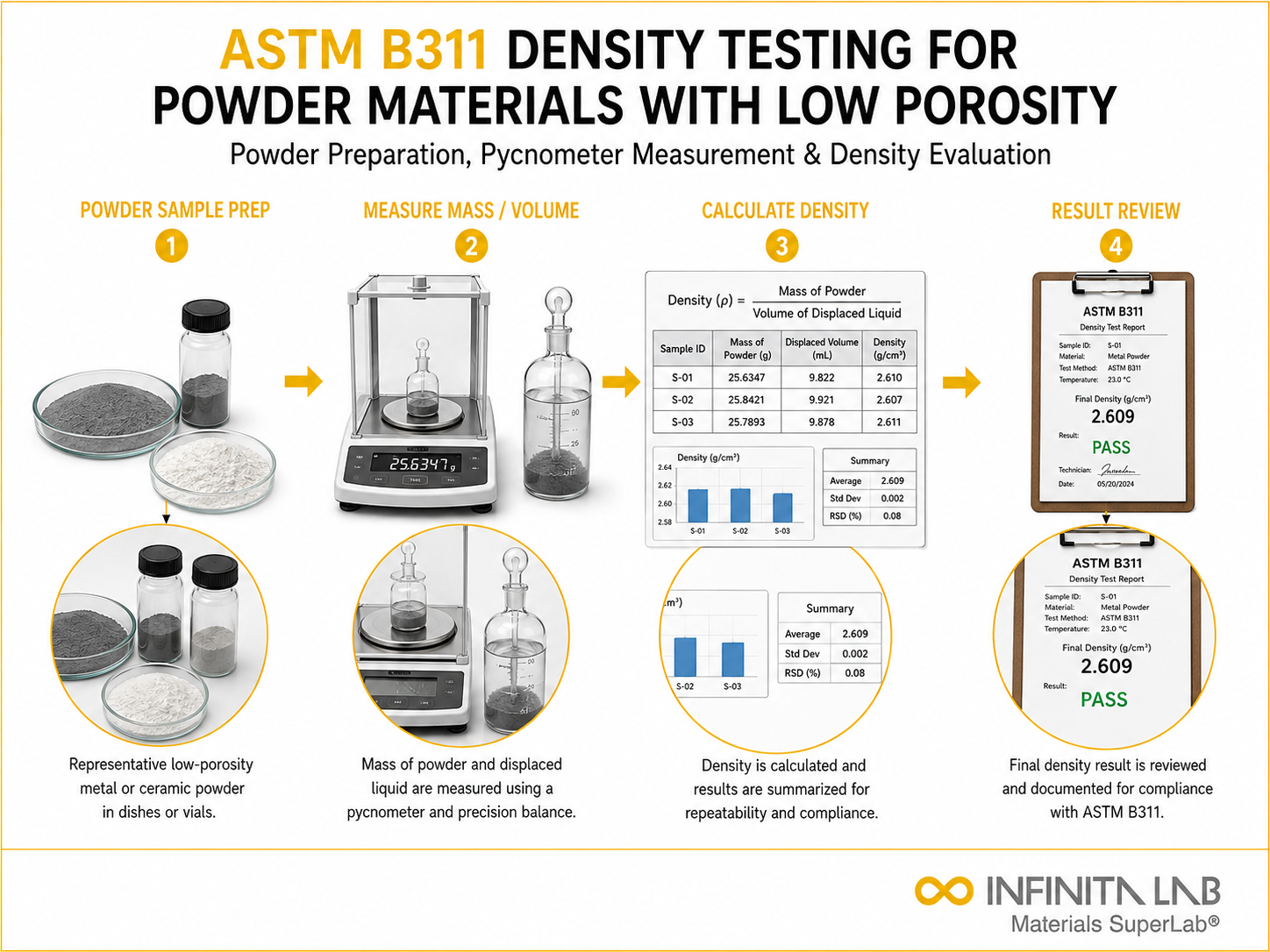
Our ASTM B311 Testing Procedure
Sample Preparation
Specimens are cleaned and prepared with regular geometry to enable accurate dimensional measurement.
1Dimensional Measurement
Dimensions such as length, width, and height are measured precisely to calculate specimen volume.
2Mass Measurement
Specimen mass is measured using a calibrated balance to ensure accurate weight determination.
3Density Calculation
Density is calculated by dividing mass by measured volume and compared with specified requirements.
4ASTM B311 Test Parameters and Requirements
| Parameter | Details |
|---|---|
| Material Type | Powder metallurgy materials with <2% porosity |
| Test Method | Geometric density determination (mass/volume) |
| Porosity Limit | Applicable for materials below 2% porosity |
| Specimen Shape | Regular geometry required for accurate measurement |
| Measurement Accuracy | High precision dimensional and mass measurement required |
| Density Calculation | mass/volume |
| Units | g/cm³ or kg/m³ |
| Temperature Conditions | Ambient laboratory conditions |


- Precision analytical balance – The core instrument; delivers the accurate dry-mass and suspended-mass readings the density calculation depends on.
- Immersion vessel and specimen support apparatus – Keeps the specimen fully submerged in water without introducing measurement error.
- Distilled or deionised water bath – Serves as the reference immersion medium for the water displacement measurement.
- Wetting agent – Cuts surface tension between the specimen and water, helping eliminate trapped air bubbles during immersion.
- Thermometer – Tracks water temperature so the correct reference density value gets applied in calculations.
- Calibration standards and reference weights – Keep the balance verified and accurate throughout testing.
- Specimen cleaning and preparation tools – Make sure specimens are free of oils, debris, or residue before that first dry-mass measurement.
Equipment and Instrumentation Used for ASTM B311 Testing
What You Receive: Test Report, Data, and Certification
- A formal test report covering dry mass, suspended mass, water temperature, and calculated density for each specimen.
- Final density values in grams per cubic centimetre (g/cm³), ready for direct comparison against specification limits.
- Notes on any specimens that failed the mass-gain check, flagging surface-connected porosity and method inapplicability.
- Traceable calibration records for the balance and reference standards used during testing.
- A compliance summary weighing measured density against customer- or drawing-specified requirements.
- Raw data records suitable for inclusion in supplier quality files or engineering documentation.
ASTM B311 Powder Material Density FAQs
ASTM B311 is used to determine the density of powder metallurgy materials with less than two percent porosity by measuring mass and volume, ensuring accurate evaluation of near fully dense components for quality and performance requirements.
The method requires near fully dense materials because higher porosity can introduce inaccuracies in geometric volume measurement, affecting the reliability of calculated density values.
Density is critical because it directly influences mechanical properties such as strength, hardness, and wear resistance, making it an essential parameter for evaluating performance and quality of powder metallurgy components.
No, ASTM B311 is not suitable for highly porous materials because internal voids cannot be measured geometrically, resulting in inaccurate density calculations and unreliable test results.
The primary limitation is its applicability only to materials with less than two percent porosity and regular shapes, restricting its use for irregular or highly porous specimens.
ASTM B311 determines the density of powder metallurgy products by measuring their mass and volume. It is used to evaluate the density and uniformity of sintered metal components.
Why Choose Infinita Lab for Powder Material Density Testing
When your Powder Material Density results have to hold up - for compliance, a customer audit, or an engineering decision - ASTM B311 accuracy and an unbiased third-party report matter more than price. Infinita Lab routes your ASTM B311 powder material density testing to ISO/IEC 17025-accredited U.S. partner labs with hands-on method experience, so you get defensible data, transparent reporting, and turnaround times built around your project deadline - not ours.

Need ASTM B311 Powder Material Density Testing You Can Rely On?
Send query us at hello@infinitalab.com or call us at (888) 878-3090 to learn more about our services and how we can support you.



Request a Quote
Submit your material details and receive testing procedures, pricing, and turnaround time within 24 hours.
 Quick Turnaround and Hasslefree process
 Confidentiality Guarantee
 Free, No-obligation Consultation
 100% Customer Satisfaction
