

What Is ASTM A342 Feebly Magnetic Material Permeability?
Every alloy carries some degree of magnetic response, and for certain applications even a trace of ferromagnetism can be a problem. ASTM A342/A342M, officially titled “Standard Test Methods for Permeability of Weakly Magnetic Materials,” gives manufacturers and end users a standardized way to measure just how magnetically responsive a metal really is. Older editions of the standard used the term “feebly magnetic materials,” and that phrase still circulates widely in industry conversation even though current editions favor “weakly magnetic.” The standard covers materials with a relative permeability of roughly 1.0 to 6.0, a range that includes many grades of austenitic stainless steel along with other paramagnetic and weakly ferromagnetic alloys. Depending on the permeability level expected and the shape of the material being tested, a lab can choose from four distinct procedures laid out in the standard.
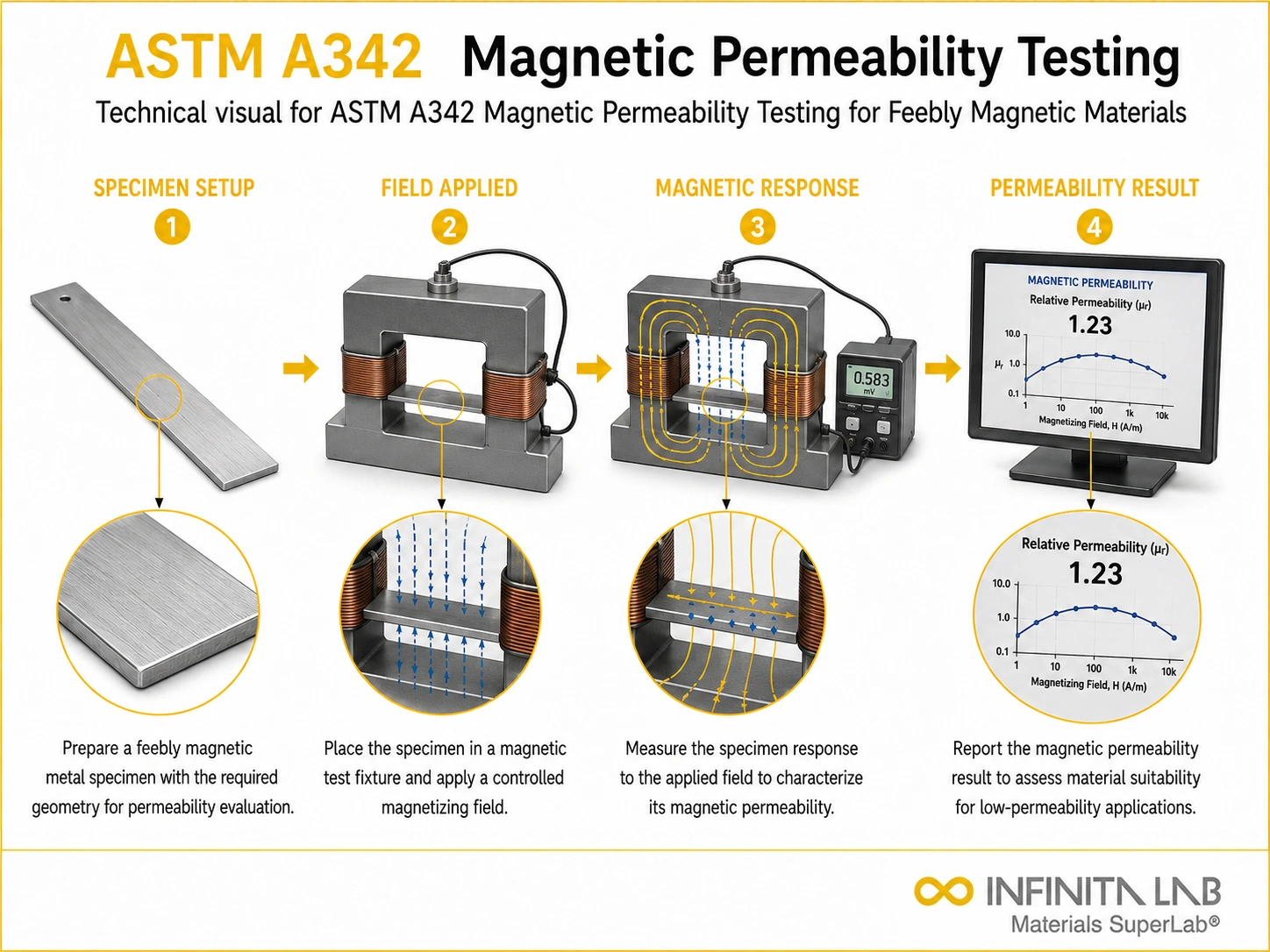
So what does testing under A342 actually look like? It means exposing a prepared specimen to a controlled magnetic field and measuring how the material responds, whether through flux readings captured with a fluxmeter and search coil, a calibrated low-mu indicator that brackets the specimen against known reference standards, a flux-distortion setup built for very low permeability ranges, or vibrating sample magnetometry for more sensitive, field-selectable measurements. Because permeability in these materials can shift with the strength of the applied field, the standard requires that field strength be documented alongside the result rather than reported as a single fixed number, so two labs testing the same coupon under different conditions can still be compared fairly.
This matters because even a small ferromagnetic response can compromise performance or safety in applications where magnetic interference isn’t acceptable. At Infinita Lab, we connect manufacturers, fabricators, and material suppliers with accredited laboratories equipped to run A342 testing accurately, so we confirm specification compliance before a part ever leaves the shop floor.

Applications and Benefits of ASTM A342 Feebly Magnetic Material Permeability Testing
Scope
ASTM A342 measures the permeability of feebly magnetic materials by applying a magnetic field to a specific sample under set conditions and measuring its response to the magnetic flux. This enables accurate measurement of the permeability of low-permeability metallic materials.
ASTM A342 permeability testing evaluates:
- ASTM A342/A342M establishes four standardized test procedures for determining the relative permeability of weakly magnetic, historically termed “feebly magnetic,” metallic materials.
- The standard applies to materials with a relative permeability that does not exceed approximately 6.0, a range that covers most commercially produced austenitic stainless steels.
- Both paramagnetic materials and weakly ferromagnetic materials fall under its scope, since their magnetic response can vary noticeably with the strength of the applied field.
- Four procedures are covered in total: the Flux Metric Method, the Low Mu Permeability Indicator method, the Flux Distortion method, and Vibrating Sample Magnetometry, each suited to a different portion of the permeability range.
- Because permeability in these materials is field-dependent, the standard requires that applied magnetic field strength be recorded and reported alongside every value obtained through the Flux metric or Vibrating Sample Magnetometry methods.
- Semifinished products such as bar, rod, plate, and forgings also fall within the scope, and these are typically evaluated before final machining or fabrication into a finished part.
- Test specimens are generally prepared as machined rings, rods, or flat coupons, with dimensions chosen to suit the selected procedure and the lab’s available instrumentation.
- The standard itself doesn’t set acceptance criteria; instead, they come from the purchase specification, design drawing, or product standard that invokes A342 testing.
- Results are intended to support specification acceptance, design verification, service evaluation, regulatory documentation, manufacturing quality control, and research and development work.
- While the current edition supersedes earlier versions issued under the standard’s former title referencing feebly magnetic materials, the underlying test philosophy has stayed consistent across editions.
Applications
- Non-magnetic stainless steel components used in MRI suites and other medical imaging environments where magnetic interference can’t be tolerated.
- Aerospace and defense hardware, including fasteners, brackets, and structural parts installed near sensitive avionics or magnetic sensors.
- Marine and offshore equipment, where non-magnetic stainless fittings are specified near compasses, sonar systems, and other magnetically sensitive instrumentation.
- Oil and gas drilling components, such as non-magnetic drill collars that shield directional-drilling and measurement-while-drilling sensors from magnetic interference.
- Electronics enclosures and shielding hardware, needed wherever instrumentation calls for a magnetically neutral housing.
- Nuclear and research facility components, where stray magnetic fields could disrupt sensitive measurement or containment equipment.
- Material supplier verification and incoming-inspection programs, confirming that purchased stainless alloys meet a buyer’s non-magnetic specification.
Benefits
- Confirms a material actually meets its non-magnetic or low-permeability specification instead of relying on a mill certificate alone.
- Delivers objective, field-strength-referenced data that can be compared consistently across suppliers, heats, and production lots.
- Cuts down the risk of costly rework or field failures caused by parts that turn out more magnetic than expected once installed.
- Supports documentation needed for regulatory submissions, customer specifications, and internal quality audits.
- Gives engineers a defensible basis for accepting or rejecting incoming material before it moves further down the production line.
- Helps manufacturers select the most appropriate grade or heat treatment for magnetically sensitive applications early in the design process.
Our ASTM A342 Testing Procedure
Sample Preparation
Feebly magnetic specimens prepared to defined geometry per ASTM A 342 requirements.
1Magnetic Field Application
Defined magnetic field applied to specimen using calibrated permeability measurement apparatus.
2Flux Response Measurement
Magnetic flux response measured and permeability calculated from field and flux data.
3Data Analysis & Reporting
Permeability data assessed against defined criteria to determine test compliance result.
4ASTM A342 Test Parameters and Requirements
| Parameter | Details |
|---|---|
| Applicable Materials | Austenitic stainless steels, non-magnetic alloys, and paramagnetic metallic materials |
| Specimen Geometry | Defined specimen dimensions per ASTM A 342 test apparatus requirements |
| Magnetizing Conditions | Defined applied field strength per ASTM A 342 measurement requirements |
| Measured Parameters | Magnetic permeability and flux response under defined applied field conditions |
| Measured Outputs | Permeability values, flux response data, and test compliance result |


- Permeameter / Fluxmeter – measures magnetic flux density in the specimen under a controlled applied field for the Flux Metric Method.
- Search Coil – positioned around or against the specimen to sense flux changes and feed a signal back to the fluxmeter.
- Low Mu Permeability Indicator – a calibrated comparator instrument that brackets a specimen’s permeability against reference standard inserts.
- Vibrating Sample Magnetometer (VSM) – oscillates a small specimen within a magnetic field to generate a precise, field-selectable magnetization response.
- Flux Distortion Test Apparatus – detects how a specimen distorts a reference magnetic field, used for very low permeability ranges.
- Helmholtz Coil / Magnetizing Coil – generates the controlled, uniform magnetic field applied to the specimen during testing.
- Gaussmeter / Field Strength Meter – verifies and documents the actual magnetic field strength applied during each test, as the standard requires.
Equipment and Instrumentation Used for ASTM A342 Testing
What You Receive: Test Report, Data, and Certification
- A detailed test report stating the relative permeability value obtained, the test method used, and the magnetic field strength applied.
- Specimen identification, including material heat or lot number and the specification the material was tested against.
- A comparison of results against the buyer’s or design specification’s acceptance criteria, where applicable.
- Supporting calibration and traceability records for the instrumentation used during testing.
- A findings summary noting whether the material meets its non-magnetic or low-permeability requirements for the intended application.
- Digital and hard-copy report formats suitable for quality files, regulatory submissions, and customer documentation.
ASTM A342 Feebly Magnetic Material Permeability FAQs
ASTM A342 measures the magnetic permeability of weakly magnetic materials. This helps to determine how easily magnetic fields pass through them. It is useful for evaluating materials used in situations where low magnetic interference is needed.
Permeability testing helps find materials with low magnetic response. This ensures that components work well in sensitive settings, where magnetic interference might disrupt instruments or equipment.
ASTM A342 is often used for stainless steels, nonmagnetic alloys, and special materials in aerospace equipment, electronic devices, and scientific instruments that need controlled magnetic behavior.
ASTM A342 testing measures how materials respond to magnetic forces. It uses specialized magnetic tools to find relative permeability and assess how weakly magnetic materials behave in applied magnetic fields.
ASTM A342 assesses magnetic permeability in controlled lab conditions. It may not reflect performance under various magnetic field strengths, temperatures, or mechanical stresses found in actual uses.
A magnetic permeability test measures how easily a material responds to an applied magnetic field. The material is magnetized under controlled conditions, and its magnetic response is measured to determine its relative permeability.
Why Choose Infinita Lab for Feebly Magnetic Material Permeability Testing
When your Feebly Magnetic Material Permeability results have to hold up - for compliance, a customer audit, or an engineering decision - ASTM A342 accuracy and an unbiased third-party report matter more than price. Infinita Lab routes your ASTM A342 feebly magnetic material permeability testing to ISO/IEC 17025-accredited U.S. partner labs with hands-on method experience, so you get defensible data, transparent reporting, and turnaround times built around your project deadline - not ours.

Need ASTM A342 Feebly Magnetic Material Permeability Testing You Can Rely On?
Send query us at hello@infinitalab.com or call us at (888) 878-3090 to learn more about our services and how we can support you.





