


ASTM A268: Ferritic Martensitic Stainless Tube Testing Services
Accredited ASTM A268 ferritic martensitic stainless tube testing from Infinita Lab, performed to the exact standard requirements - accurate, reproducible results with full documentation for compliance, R&D, and quality control programs.
TRUSTED BY


Get ASTM A268 compliant results - request your ferritic martensitic stainless tube testing quote
- Overview
- Scope, Applications, and Benefits
- Test Process
- Specifications
- Instrumentation
- Results and Deliverables
What Is ASTM A268 Ferritic Martensitic Stainless Tube?
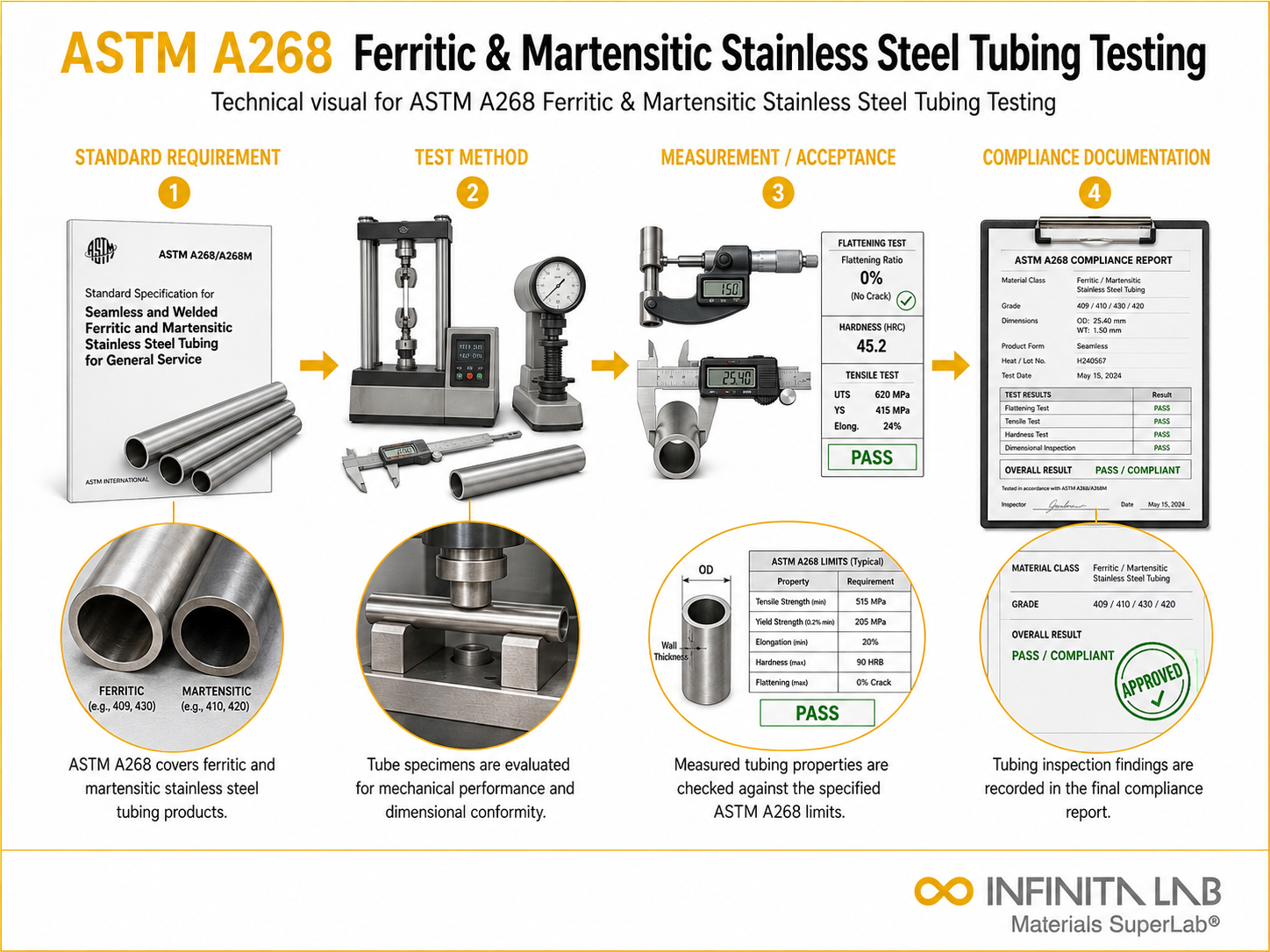
ASTM A268/A268M, Standard Specification for Seamless and Welded Ferritic and Martensitic Stainless Steel Tubing for General Service, is a product specification rather than a test method. It defines what a tube must be. It also lists the checks a producer must pass before selling the tube as conforming. ASTM Subcommittee A01.10 maintains the standard, and the 2024 edition, A268/A268M-24, is currently active. The scope covers nominal-wall-thickness tubing for general corrosion resistance and high-temperature service, and it is written in both inch-pound and SI units. Most of the grades it lists are straight-chromium, ferromagnetic steels. Two of them, TP410 and UNS S41500, can be hardened by heat treatment. The specification also cautions that high-chromium ferritic alloys can become notch-brittle when cooled slowly. Table 1 sets chemical composition limits for each grade, including TP405, TP409, TP430, TP439, TP446-1, and higher-alloy ferritic types such as S44400 and 29-4 or 26-3-3 compositions. Further clauses address manufacture by seamless or welded processes, final heat treatment, tensile properties, and hardness limits. Mechanical tests include flaring for seamless tubes, flange tests for welded tubes, and reverse flattening. Every tube has to pass either a hydrostatic test or a nondestructive electric test. General delivery requirements come from Specification A1016/A1016M unless A268 says otherwise. Infinita Lab helps manufacturers, distributors, fabricators and buyers confirm that tubing lots meet these written requirements. The work runs through a network of accredited partner laboratories. Results are reported against the grade, product form, and edition named on the purchase order, so every conclusion traces back to a clause of the specification.

Applications and Benefits of ASTM A268 Ferritic Martensitic Stainless Tube Testing
Scope
ASTM A268 covers tubing made from ferritic and martensitic stainless steels, produced by either the seamless or the welded process. The specification ensures compliance with chemical composition, mechanical properties, and heat treatment requirements.
The standard evaluates:
- ASTM A268/A268M covers seamless and welded ferritic and martensitic stainless steel tubing of nominal wall thickness for general corrosion-resisting and high-temperature service.
- This is a material and product specification. It sets requirements for the tubing and its testing, not a single laboratory test procedure.
- Each grade is identified by a type designation and a UNS number, with chemical composition limits listed in a dedicated table.
- Straight-chromium steels make up most of the listed grades, and they’re ferromagnetic in service.
- Only two types, TP410 and UNS S41500, respond to hardening by heat treatment.
- Welded tubing is made with no filler metal added during welding.
- Final heat treatment applies to every tube. Martensitic grade S41500 gets a lower minimum temperature than the other grades.
- Limits for tensile strength, yield strength, elongation, and hardness apply by grade. Hardness may be expressed on the Brinell or Rockwell scale.
- Mechanical tests include tension, flaring for seamless tubes, flange testing for welded tubes, and reverse flattening for welded product.
- Tolerances, certification, and finish, among other general requirements, come from A1016/A1016M unless the specification states otherwise.
Applications
- Heat exchanger and condenser tubing in service where chloride stress corrosion cracking is a concern for austenitic grades.
- Automotive exhaust, plus other high-temperature gas-handling components made from ferritic grades.
- Hot-water tanks and similar equipment; a stabilized grade such as TP439 avoids post-weld heat treatment.
- Piping and tubing for general industrial use, exposed to mildly corrosive process or atmospheric conditions.
- Boiler, feedwater heater and power-generation auxiliary tubing at moderately elevated temperatures.
- Architectural and structural tubular products, provided a magnetic, corrosion-resisting finish is acceptable.
Benefits
- Verification against the specification gives buyers documented proof that composition, heat treatment, and mechanical properties match the grade ordered.
- Catching out-of-grade material early cuts the chance of costly tube failures, rework, or returns.
- Flaring, flange and flattening results show whether a tube can survive downstream forming and installation operations.
- Hardness and tensile data confirm the heat treatment was done correctly for the grade.
- Producer and purchaser can lean on independent results for incoming inspection, supplier qualification, and dispute resolution.
- One report against one named edition makes traceability simpler for audits and project files.
Our ASTM A268 Testing Procedure
Material Identification
Tubing grade and specifications are verified based on ASTM requirements.
1Mechanical Testing
Tensile and hardness tests are performed to evaluate strength and durability.
2Chemical Analysis
Elemental composition is analyzed to confirm compliance with specified grades.
3Data Recording & Evaluation
Results are compared against ASTM A268 requirements for acceptance.
4ASTM A268 Test Parameters and Requirements
| Parameter | Details |
|---|---|
| Applicable Materials | Ferritic and martensitic stainless steels |
| Product Forms | Seamless and welded tubing |
| Outer Diameter Range | ~6 mm to 250 mm |
| Wall Thickness | ~0.5 mm to 25 mm |
| Tensile Strength | ~415 MPa to 760 MPa |
| Hardness Range | ~150 to 300 HB |


- Optical Emission Spectrometer – determines alloy chemistry for comparison with the Table 1 limits for the grade.
- Combustion Carbon and Sulfur Analyzer – picks up carbon and sulfur accurately where spark analysis falls short.
- Universal Testing Machine – records tensile strength, yield strength, and elongation of longitudinal tube specimens.
- Brinell and Rockwell Hardness Testers – verify hardness against the limits that apply to the grade and condition.
- Flaring and Flattening Fixtures – expand, flange or flatten tube sections to evaluate ductility and weld integrity.
- Hydrostatic Test Equipment and Eddy Current Test Systems – confirm soundness tube by tube, through pressure or nondestructive electric testing.
- Calibrated Micrometers and Calipers – check outside diameter, wall thickness, and related dimensions.
Equipment and Instrumentation Used for ASTM A268 Testing
What You Receive: Test Report, Data, and Certification
- A conformance report that compares each result with the A268/A268M requirement for the stated grade and edition.
- Element-by-element chemical composition results, set against the Table 1 limits.
- Tensile, yield, elongation and hardness data with specimen identification and test conditions.
- Pass or fail records. These cover flaring, flange, reverse flattening and tube-level soundness tests.
- Heat and lot traceability and calibration references, plus photographs of tested specimens when requested.
- Clear notes on any nonconformance, so the producer, buyer, or inspector can decide on retest or rejection.
ASTM A268 Ferritic Martensitic Stainless Tube FAQs
ASTM A268 includes chemical composition, mechanical properties, heat treatment, dimensional tolerances, surface finish, and corrosion resistance, ensuring seamless and welded ferritic and martensitic stainless steel tubing meets general service requirements.
ASTM A268 covers ferritic and martensitic stainless steels in seamless and welded tubing forms, used for applications requiring moderate corrosion resistance and mechanical strength.
ASTM A268 defines tensile strength, yield strength, elongation, and hardness requirements, ensuring tubing materials meet performance criteria for structural and industrial applications.
ASTM A268 tubing is used in heat exchangers, boilers, condensers, and general industrial piping systems requiring stainless steel materials with corrosion resistance and strength.
ASTM A268 defines properties under controlled conditions and may not account for welding effects, fabrication processes, or service environments influencing long-term performance of stainless steel tubing.
Why Choose Infinita Lab for Ferritic Martensitic Stainless Tube Testing
When your Ferritic Martensitic Stainless Tube results have to hold up - for compliance, a customer audit, or an engineering decision - ASTM A268 accuracy and an unbiased third-party report matter more than price. Infinita Lab routes your ASTM A268 ferritic martensitic stainless tube testing to ISO/IEC 17025-accredited U.S. partner labs with hands-on method experience, so you get defensible data, transparent reporting, and turnaround times built around your project deadline - not ours.

Need ASTM A268 Ferritic Martensitic Stainless Tube Testing You Can Rely On?
Send query us at hello@infinitalab.com or call us at (888) 878-3090 to learn more about our services and how we can support you.



Request a Quote
Submit your material details and receive testing procedures, pricing, and turnaround time within 24 hours.
 Quick Turnaround and Hasslefree process
 Confidentiality Guarantee
 Free, No-obligation Consultation
 100% Customer Satisfaction
