


ASTM A1061: Multi Wire Prestressing Strand Testing Services
ASTM A1061 test method covers the procedural testing of mechanical properties of multi-wire steel prestressing strands for evaluation purposes. The strength and elongation of the strand are also determined. The test results are to be presented in either inch-pound units or SI units.
TRUSTED BY


Get ASTM A1061-compliant results - request your multi-wire prestressing strand testing quote
- Overview
- Scope, Applications, and Benefits
- Test Process
- Specifications
- Instrumentation
- Results and Deliverables
What Is ASTM A1061: Multi Wire Prestressing Strand Testing?
ASTM A1061/A1061M, the Standard Test Methods for Testing Multi-Wire Steel Prestressing Strand, defines the mechanical test procedures used to characterise seven-wire and three-wire steel strand manufactured for prestressed and post-tensioned concrete construction. Unlike a material specification such as ASTM A416 or A910, which sets the chemical and mechanical requirements a strand must meet, ASTM A1061 defines exactly how those properties – breaking strength, yield strength, elongation, modulus of elasticity, length of lay, and stress relaxation – are to be measured, so that results from different laboratories and manufacturers can be directly and reliably compared.
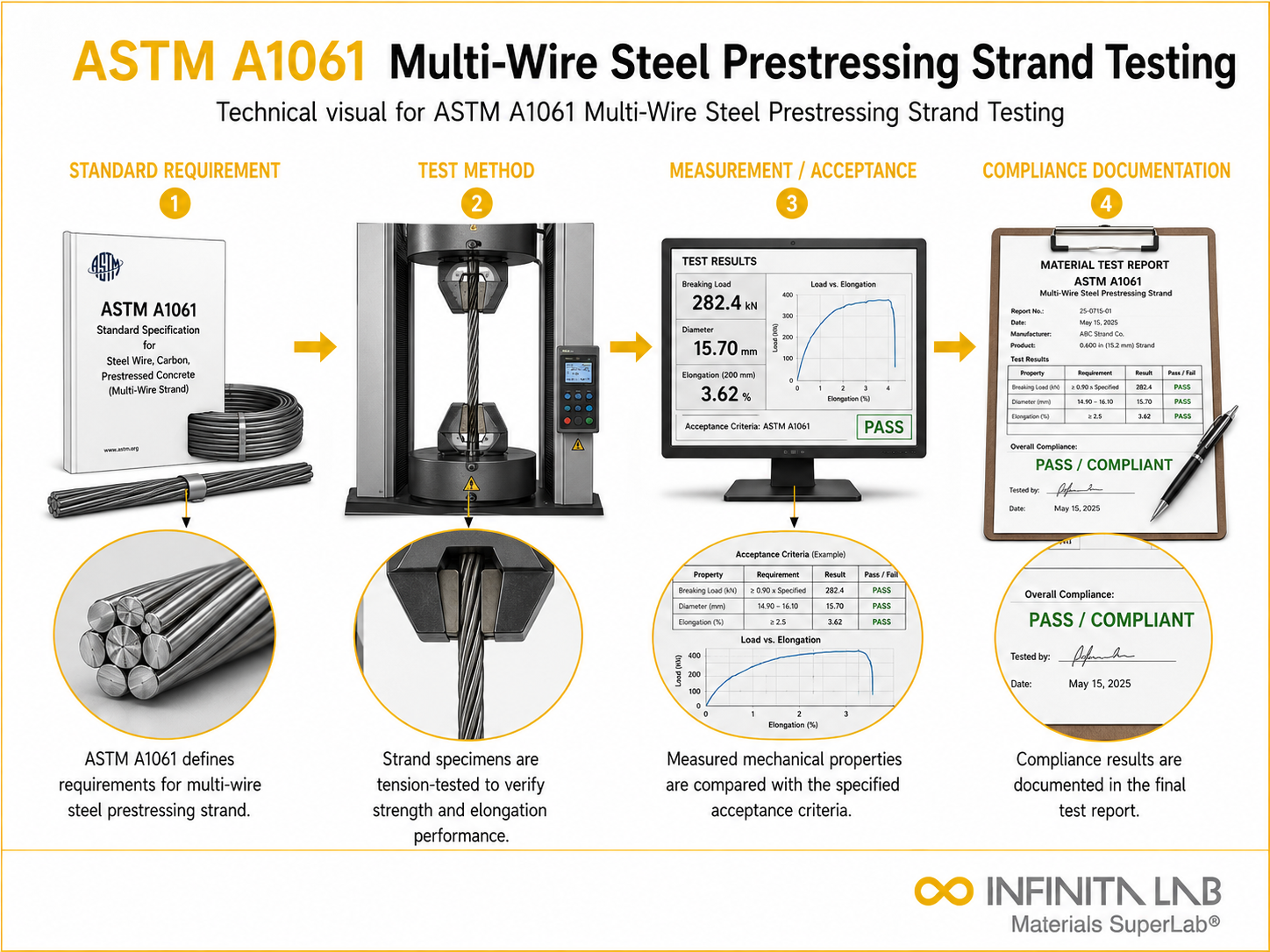
At a high level, testing begins with a full-length strand specimen mounted in a tensile testing machine using wedge-style grips designed to prevent the individual wires from slipping under load. The strand is loaded to failure while an extensometer with a gauge length of at least 60 times the nominal strand diameter continuously records elongation, allowing the machine’s computerised data-acquisition system to calculate the breaking strength, the yield strength at 1% extension, and the modulus of elasticity from the resulting load-elongation curve. Where specified, additional strands are tested for stress relaxation – the gradual loss of load a strand experiences over time while held at constant elongation – and for length of lay, which verifies that the outer wires are wound consistently around the strand’s centre wire.
Testing to ASTM A1061 is important because a prestressing strand carries sustained, safety-critical tension loads inside bridges, parking structures, buildings, and other concrete elements for decades after installation. Verifying that a strand’s actual mechanical behaviour meets its specified grade before stressing protects against premature failure, excessive long-term prestress loss, and costly structural remediation, which is why manufacturers, fabricators, and construction quality-assurance programs rely on this standard for acceptance testing.

Applications and Benefits of ASTM A1061: Multi Wire Prestressing Strand Testing
Scope
- Establishes standardised test methods for determining the mechanical properties of multi-wire steel prestressing strand, independent of the material specification (such as ASTM A416 or A910) that sets the acceptance limits for those properties.
- Covers seven-wire and three-wire strand construction used in prestressed and post-tensioned concrete applications.
- Defines procedures for measuring breaking strength (ultimate tensile load), yield strength at 1% extension under load, elongation at rupture, and modulus of elasticity.
- Specifies stress-relaxation testing procedures for evaluating the gradual loss of stress a strand experiences while held at constant elongation over an extended period.
- Defines length-of-lay measurement procedures to confirm consistent helical winding of the outer wires around the strand’s centre wire.
- Specifies extensometer classes – Class B-1 for yield strength and Class D for elongation – along with gauge-length requirements and permissible loading-rate ranges for consistent, repeatable results.
- Applicable to strand diameters commonly ranging from about 3 mm to 20 mm (0.25 in. to 0.6 in. and larger), covering the sizes used in structural pre-tensioning and post-tensioning applications.
- Provides the basis for acceptance testing, quality control, and third-party verification of strand supplied to construction and precast concrete projects.
- Supports comparison of test results across manufacturers, testing laboratories, and countries, given its methodological alignment with related international methods such as ISO 15630-3.
Applications
- Prestressed and post-tensioned concrete bridges, girders, and box-girder segments.
- Precast and prestressed concrete building elements, including slabs, beams, and columns.
- Parking structures and stadiums that use post-tensioned slab systems.
- Water and liquid-containment tanks constructed with circumferential or vertical post-tensioning.
- Anchorages, tendons, and cable-stay systems in specialised structural applications.
- Quality control and incoming inspection for strand manufacturers, fabricators, and construction contractors.
Benefits
- Confirms that strand delivers the breaking strength and yield strength required by its specified grade before it is installed in a structure.
- Verifies the modulus of elasticity values engineers rely on to calculate prestress losses and structural deflection.
- Detects excessive stress relaxation that could compromise long-term prestress force retention.
- Confirms consistent strand construction through length-of-lay measurement, reducing the risk of manufacturing defects.
- Provides standardised, repeatable test data that can be compared across suppliers, projects, and countries.
- Supports the documented certification required for structural quality assurance and code compliance.
Our ASTM A1061 Testing Procedure
Specimen Selection & Preparation
Select a representative strand and prepare it with the required gauge length.
1Tensile Testing
Mount the strand, apply initial load, and perform controlled tensile testing.
2Property Measurement & Evaluation
Measure breaking strength, yield strength, elongation, and modulus of elasticity.
3Additional Testing & Reporting
Evaluate stress relaxation and lay length when required, then report results.
4ASTM A1061 Test Parameters and Requirements
| Parameter | Details |
|---|---|
| Strand Construction | Seven-wire and three-wire helically wound steel strand |
| Strand Diameter Range | Approximately 3 mm to 20 mm (commonly 0.25 in. to 0.6 in. and larger), per the specified grade |
| Properties Determined | Breaking strength, yield strength at 1% extension, elongation at rupture, modulus of elasticity, stress relaxation, and length of lay |
| Extensometer Classes | Class B-1 (24 in. [600 mm] gauge length) for yield strength; Class D (24 in. [600 mm] minimum gauge length, 2.0 mm precision) for elongation |
| Gauge Length | At least 60 times the nominal strand diameter |
| Initial Load | Approximately 10% of the specified minimum breaking strength |
| Test Temperature | 68°F ± 3.5°F [20°C ± 2°C] |
| Loading Rate | Crosshead speed, stress rate, or strain rate maintained between one-tenth and one-half of the specified maximum rate |


- Universal Testing Machine (UTM) – Applies tensile load to the strand specimen until fracture, with capacities commonly up to 600 kN or more for larger strand sizes.
- Wedge-Style Grips – Serrated, conical grips that secure all wires of the strand evenly and prevent slippage during loading.
- Class B-1 Extensometer – Measures elongation for yield-strength determination at 1% extension.
- Class D Extensometer – Measures elongation at rupture over a minimum 24-inch gauge length.
- Computerised Data Acquisition System – Records load and elongation continuously to generate the load-elongation curve.
- Stress-Relaxation Test Frame – Holds specimens at constant elongation to measure long-term load loss, where specified.
- Precision Measuring Instruments – Callipers and gauges used to measure strand diameter, cross-sectional area, and length of lay.
Equipment and Instrumentation Used for ASTM A1061 Testing
What You Receive: Test Report, Data, and Certification
- Breaking strength (ultimate tensile load) for each tested strand specimen.
- Yield strength at 1% extension under load.
- Elongation at rupture, measured over the specified gauge length.
- Modulus of elasticity calculated from the load-elongation curve.
- Stress-relaxation results, when specified, documenting load loss over the test duration.
- Length-of-lay measurement confirming consistent wire winding, when specified.
- A certified test report comparing results against the applicable strand grade and specification.
ASTM A1061: Multi Wire Prestressing Strand Testing FAQs
ASTM A1061 defines standardized test methods for determining the mechanical properties of multi-wire steel prestressing strand, including breaking strength, yield strength, elongation, modulus of elasticity, stress relaxation, and length of lay.
ASTM A416 (and A910) sets the material and mechanical property requirements that prestressing strand must meet. At the same time, ASTM A1061 defines the test procedures used to measure whether a given strand actually meets those requirements.
The extensometer gauge length must be at least sixty times the nominal strand diameter, with both Class B-1 and Class D extensometers requiring a minimum 24-inch (600 mm) gauge length.
Stress relaxation is the gradual loss of load a strand experiences over time while held at constant elongation; testing it helps engineers predict how much prestress force a structure will retain over its service life.
Length of lay is the distance required for an outer wire to complete one full helical turn around the strand's center wire; verifying it confirms consistent strand construction and manufacturing quality.
Why Choose Infinita Lab for Advanced Materials Testing and Characterization?
At the core of this breadth is our network of 2,000+ accredited laboratories across the USA, offering access to over 10,000 testing methods and analytical services. From advanced materials characterization (SEM, TEM, RBS, XPS) to mechanical, chemical, environmental, biological, and standardized ASTM/ISO-compliant testing, we deliver unmatched flexibility, specialization, and scale. You are never limited by geography, facility, or methodology — Infinita Lab connects you to the right expertise and testing solution, every time.

Looking for a Trusted Partner for Accurate and Reliable Testing Services?
Send query us at hello@infinitalab.com or call us at (888) 878-3090 to learn more about our services and how we can support you.



Request a Quote
Submit your material details and receive testing procedures, pricing, and turnaround time within 24 hours.
 Quick Turnaround and Hasslefree process
 Confidentiality Guarantee
 Free, No-obligation Consultation
 100% Customer Satisfaction
