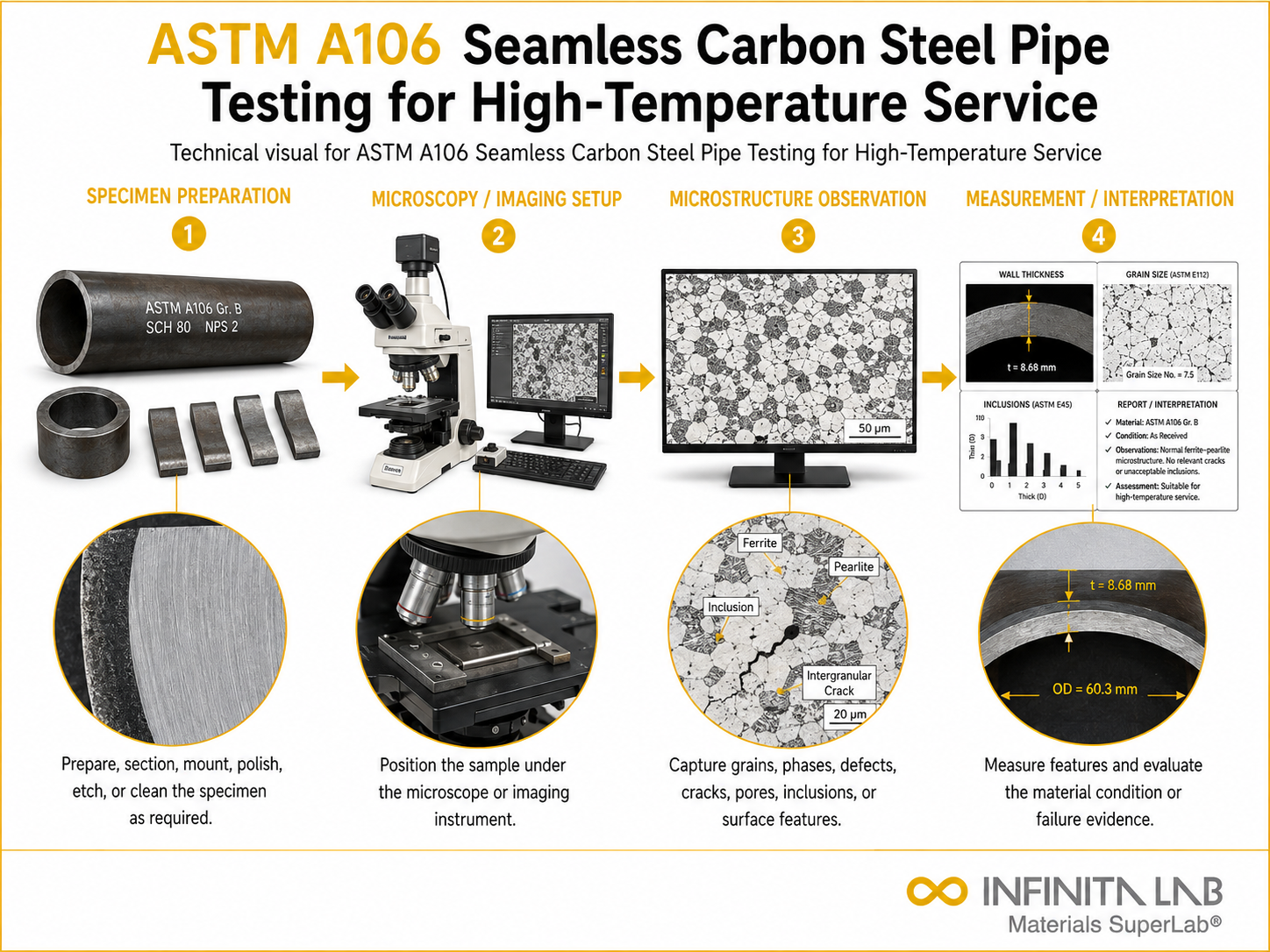


What Is ASTM A106 High Temperature Carbon Steel Pipe?
ASTM A106 is a standard specification that covers seamless carbon steel pipes used for high-temperature services. These pipes are produced using hot-working methods and are used for bending, flanging, and other such operations. ASTM A106 ensures that the seamless carbon steel pipes have enough strength, composition, and structural properties to withstand high temperatures and pressures, which are generally seen in industries such as power plants, refineries, and petrochemical plants.
ASTM A106 pipes are available in three grades, namely Grade A, Grade B, and Grade C, each having different levels of strength. Among these grades, Grade B is the most widely used grade for industrial applications.

Applications and Benefits of ASTM A106 High Temperature Carbon Steel Pipe Testing
Scope
Seamless carbon steel pipes are the preferred choice for applications that require high performance under hot and challenging working conditions. Seamless pipes are made without welds, so they are strong, have a uniform structure, and are more resistant to changes in pressure and temperature.
The manufacturing of seamless pipes can be achieved by hot finishing or cold drawing, depending on the precise size, mechanical properties, and surface finishes that are required. Seamless pipes are normally used for applications like power plants, petrochemical plants, oil and gas plants, and boilers, etc., where high performance and safety are not compromised at any cost.
Applications
- High-temperature fluid transport systems
- Power plant piping systems
- Oil and gas pipelines
- Refineries and chemical plants
- Boiler and pressure piping systems
- Steam lines and heat exchangers
- Industrial process piping
Benefits
- High strength at elevated temperatures
- Excellent pressure resistance
- Reliable performance in critical piping systems
- Uniform mechanical properties
- Compatibility with welding and fabrication processes
- Improved durability in harsh operating environments
- Widely accepted in global industrial standards
Our ASTM A106 Testing Procedure
Raw Material & Manufacturing
Carbon steel billets are heated and processed to produce seamless pipes.
1Heat Treatment & Inspection
Pipes are heat treated and checked for dimensional accuracy.
2Mechanical Testing
Tensile and flattening tests verify strength and ductility.
3Hydrostatic & NDT Testing
Hydrostatic pressure and optional NDT ensure integrity and detect defects.
4ASTM A106 Test Parameters and Requirements
| Parameter | Details |
|---|---|
| Manufacturing Method | Hot-finished or cold-drawn |
| Available Grades | Grade A, Grade B, Grade C |
| Typical Pipe Sizes | NPS 1/8 to NPS 48 (or larger depending on manufacturer) |
| Temperature Capability | Suitable for high-temperature service |
| Mechanical Tests | Tensile test, flattening test, bend test |
| Inspection Methods | Hydrostatic test, optional ultrasonic or eddy current testing |
| Output Units | Mechanical strength values (MPa or psi), dimensional measurements (mm or inches) |


- Universal testing machine (UTM) for tensile testing
- Hydrostatic pressure testing equipment
- Ultrasonic testing equipment
- Eddy current testing equipment
- Dimensional measurement tools (callipers, micrometres)
- Optical or visual inspection tools
- Data recording and analysis systems
Equipment and Instrumentation Used for ASTM A106 Testing
What You Receive: Test Report, Data, and Certification
- Verification of compliance with ASTM A106 specification
- Mechanical property test results
- Chemical composition verification
- Dimensional inspection reports
- Hydrostatic pressure test results
- Non-destructive testing reports
- Material test reports (MTR) for traceability
ASTM A106 High Temperature Carbon Steel Pipe FAQs
ASTM A106 pipes are designed specifically for high-temperature service, making them suitable for steam lines, boilers, heat exchangers, and other systems operating at elevated temperatures.
ASTM A106 pipes are designed primarily for high-temperature and high-pressure service, whereas ASTM A53 pipes are commonly used for general structural and low-pressure applications such as water, gas, and structural piping.
ASTM A106 pipes are typically produced in sizes ranging from NPS 1/8 to NPS 48, although larger sizes may also be manufactured depending on supplier capabilities.
Yes. ASTM A106 pipes are suitable for welding, bending, and flanging operations, making them widely used in complex piping systems.
ASTM A106 specifies seamless carbon steel pipes, typically produced through hot-working processes such as rotary piercing and rolling. Pipes may also undergo cold drawing and heat treatment depending on the required properties.
Why Choose Infinita Lab for High Temperature Carbon Steel Pipe Testing?
When your High Temperature Carbon Steel Pipe results have to hold up - for compliance, a customer audit, or an engineering decision - ASTM A106 accuracy and an unbiased third-party report matter more than price. Infinita Lab routes your ASTM A106 high temperature carbon steel pipe testing to ISO/IEC 17025-accredited U.S. partner labs with hands-on method experience, so you get defensible data, transparent reporting, and turnaround times built around your project deadline - not ours.

Looking for an Accredited Partner for ASTM A106 High Temperature Carbon Steel Pipe Testing?
Send query us at hello@infinitalab.com or call us at (888) 878-3090 to learn more about our services and how we can support you.





