


Dynamic Mechanical Analysis (DMA)
Dynamic mechanical analysis (DMA), is used to measure the viscoelastic properties of polymeric materials over a wide range of oscillatory loads, frequencies, temperatures and durations. DMA can also be used to study the glass transition of polymers, fatigue characteristics and creep recovery. The vast testing laboratories network of Infinita Lab, USA, offers this test to clients in the USA and across the world.
TRUSTED BY


Precision-driven testing for dimensional accuracy and compliance
- Overview
- Scope, Applications, and Benefits
- Test Process
- Specifications
- Instrumentation
- Results and Deliverables
Dynamic Mechanical Analysis (DMA) Overview
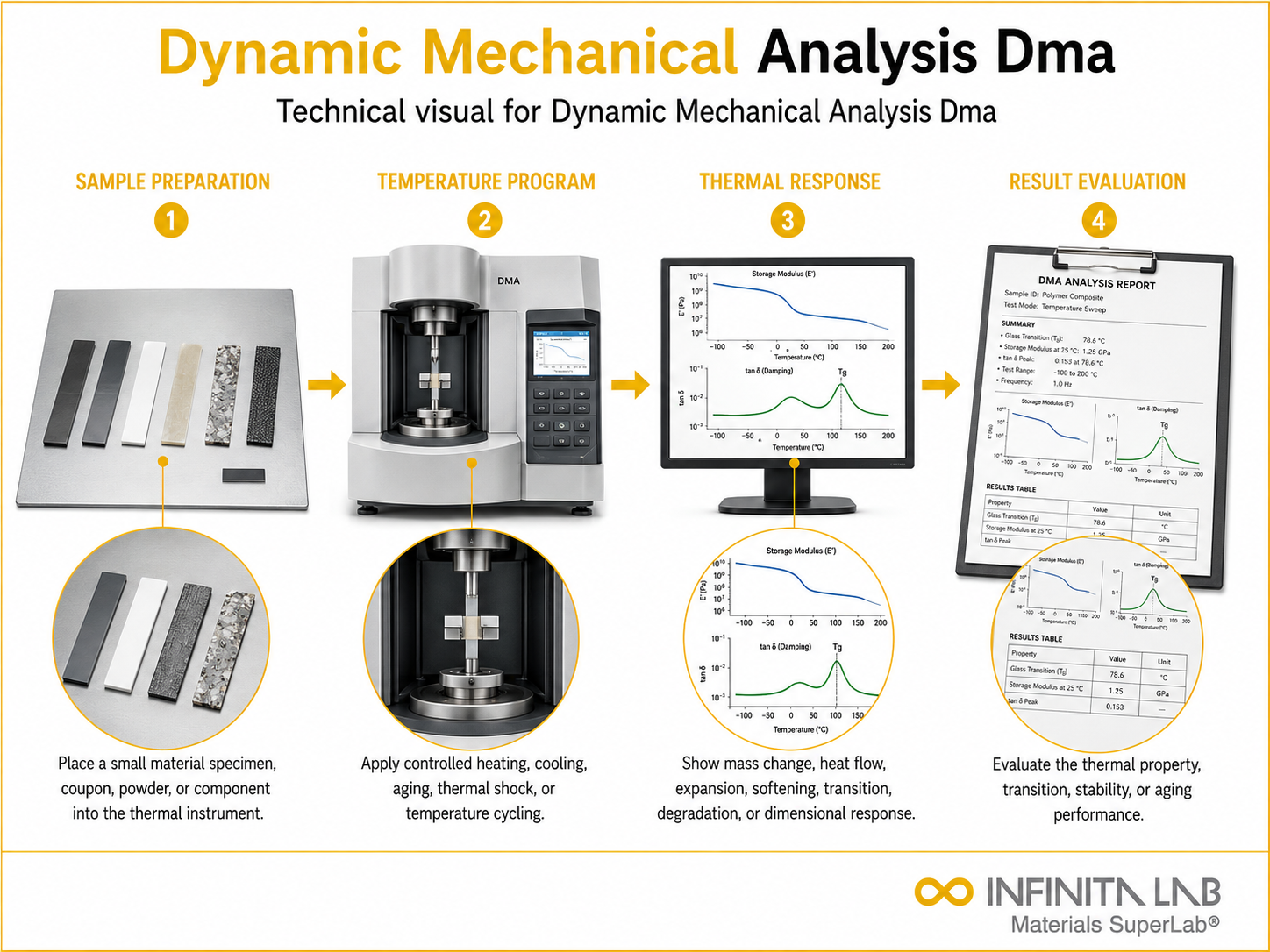
Dynamic Mechanical Analysis (DMA) measures the viscoelastic properties of materials by applying a sinusoidal oscillating stress or strain and recording the resulting response as a function of temperature, frequency, or time. Since the response of a viscoelastic material lags behind the applied load, DMA separates the material’s behavior into two components: the elastic (in-phase) component and the viscous (out-of-phase) component. This provides a much more comprehensive understanding than static mechanical tests.
The technique generates three primary parameters: the storage modulus (E′ or G′), which represents the elastic energy-storing response; the loss modulus (E″ or G″), which represents the viscous energy-dissipating response; and the tangent delta (tan δ), the ratio of the loss modulus to the storage modulus, which characterizes the material’s damping behavior. By tracking how these parameters change with temperature, DMA can accurately identify transitions, such as the glass transition temperature (Tg), which other methods may detect less sensitively.
Originally developed for metals, DMA has become one of the most important thermomechanical characterization techniques for polymers, elastomers, and composites. It is widely used to determine glass transition temperature, study damping and energy absorption, evaluate the effect of fillers and additives, and characterize creep, stress relaxation, and fatigue behavior across a material’s working temperature range.

Dynamic Mechanical Analysis (DMA) Scope, Applications, and Benefits
Scope
DMA measures the viscoelastic and thermomechanical properties of solid and semi-solid materials under oscillatory loading. Measurements are made as a function of temperature, frequency, time, or applied strain/stress amplitude, depending on the property of interest.
The technique measures and characterizes:
- Storage and loss modulus – E′/G′ (elastic component) and E″/G″ (viscous component) across temperature and frequency, giving the full viscoelastic response
- Glass transition temperature (Tg) – determined from the peak in tan delta or loss modulus, or the onset of the storage modulus drop; DMA is significantly more sensitive to Tg than DSC, particularly for highly crosslinked or filled materials
- Tan delta (damping) – the loss-to-storage modulus ratio, characterizing damping, vibration absorption, and energy dissipation behavior
- Secondary transitions – sub-Tg relaxations (beta, gamma transitions) that influence impact resistance and low-temperature behavior
- Creep and stress relaxation – time-dependent deformation under constant load (creep) or stress decay under constant strain (relaxation)
- Loading modes – tension, single/dual cantilever bending, three-point bending, shear, and compression, selected based on the material stiffness and form
Common reference standards include ASTM D4065, ASTM D5023, ASTM D5026, ASTM D5418, ASTM E1640, and ISO 6721.
Applications
- Polymer and composite characterization – determining Tg, modulus, and damping behavior of engineering plastics and fiber-reinforced composites across their service temperature range, which directly informs material selection for load-bearing applications
- Glass transition determination – DMA is the preferred method for measuring Tg in thermosets, adhesives, and filled systems where the transition is weak or broad and difficult to resolve by DSC
- Cure characterization – tracking modulus development during cure of thermosets, adhesives, and coatings to determine degree of cure and optimal cure schedules
- Elastomer and rubber evaluation – damping, dynamic stiffness, and temperature-dependent behavior of rubber components such as seals, mounts, dampers, and tires
- Damping and vibration applications – characterizing tan delta to select or develop materials for vibration isolation, acoustic damping, and energy absorption
- Aerospace and automotive composites – verifying that composite structural materials retain stiffness and stay below their Tg across the operating temperature envelope
- Quality control and incoming inspection – verifying batch-to-batch consistency of modulus and Tg for polymer raw materials and molded parts
- Failure analysis and aging studies – detecting changes in viscoelastic behavior due to degradation, aging, plasticizer loss, or environmental exposure
Benefits
- Far more sensitive to transitions than static or thermal methods – DMA resolves glass transitions and secondary relaxations that DSC or static mechanical testing miss entirely, particularly in highly filled or crosslinked materials
- Separates elastic and viscous behavior – by resolving the response into storage and loss components, DMA gives insight into both stiffness and damping in a single measurement, which static testing cannot provide
- Maps properties across the full service temperature range – a single temperature-sweep run shows how modulus and damping change from below to above Tg, directly informing whether a material is suitable across its intended operating range
- Frequency dependence reveals real-world loading behavior – running multiple frequencies shows how the material responds at different loading rates, which is critical for dynamic and impact applications
- Small samples and multiple loading modes – DMA works with small specimens and offers tension, bending, shear, and compression geometries, allowing characterization of films, fibers, bars, and bulk materials on one instrument
Dynamic Mechanical Analysis (DMA) Test Process
Prepare the Sample
Cut or mould the specimen to the required geometry and measure its dimensions accurately.
1Set Up the Instrument
Mount the sample, select the loading mode, and set the amplitude, frequency, and temperature programme.
2Perform the Test
Apply oscillatory loading while recording storage modulus, loss modulus, and tan delta.
3Analyse and Report
Determine Tg, modulus values, and other transitions, then report the results with test conditions and curves.
4Dynamic Mechanical Analysis (DMA) Technical Specifications
| Parameter | Details |
|---|---|
| Measured Parameters | Storage modulus (E′/G′), loss modulus (E″/G″), tan delta, Tg |
| Loading Modes | Tension, single/dual cantilever, three-point bend, shear, compression |
| Temperature Range | Typically −150°C to +600°C (instrument-dependent) |
| Frequency Range | Typically 0.01 to 200 Hz (instrument-dependent) |
| Applicable Materials | Polymers, elastomers, composites, films, fibers, adhesives, coatings |
| Applicable Standards | ASTM D4065, D5023, D5026, D5418, E1640; ISO 6721 |
| Measurement Modes | Temperature sweep, frequency sweep, time sweep, creep, stress relaxation |
| Reported Output | Modulus and tan delta curves, Tg, modulus at specified temperatures, transition temperatures |
| Atmosphere | Air or inert gas (nitrogen) purge as required |


Instrumentation Used for Dynamic Mechanical Analysis (DMA)
- Dynamic Mechanical Analyzer (DMA) with force/displacement transducers
- Interchangeable clamps for tension, bending, shear, and compression modes
- Temperature-controlled furnace/chamber with liquid nitrogen cooling for sub-ambient work
- Inert gas (nitrogen) purge system
- Precision calipers/micrometer for specimen dimensioning
- Data acquisition and viscoelastic analysis software
Dynamic Mechanical Analysis (DMA) Results and Deliverables
- DMA test report – storage modulus, loss modulus, and tan delta as a function of temperature and/or frequency, with the test conditions and loading mode documented
- Glass transition temperature (Tg) – reported from the tan delta peak, loss modulus peak, and/or storage modulus onset, with the method of determination stated
- Modulus values – storage and loss modulus at specified temperatures or frequencies of interest
- Transition analysis – identification of primary (Tg) and any secondary relaxations observed in the scan
- Data curves – full modulus and tan delta plots versus temperature/frequency, with raw data tables
- Sample records – material description, specimen dimensions, loading mode, and lot/batch information
Frequently Asked Questions
Storage modulus represents the elastic or energy-storing portion of a material’s response. A higher value generally indicates greater stiffness.
Loss modulus represents the viscous portion of the material response and the energy lost as heat. It provides information about internal molecular movement.
Tan delta is the ratio of loss modulus to storage modulus. It indicates damping behaviour and is often used to identify material transitions.
The glass transition temperature is the range where an amorphous material changes from a rigid, glassy state to a softer, rubber-like state. DMA can detect this transition with high sensitivity.
Glass transition may be identified from the onset or change in storage modulus, the loss-modulus peak or the tan-delta peak. The reported value depends on the selected method.
Why Choose Infinita Lab for Advanced Materials Testing and Characterization?
At the core of this breadth is our network of 2,000+ accredited laboratories across the USA, offering access to over 10,000 testing methods and analytical services. From advanced materials characterization (SEM, TEM, RBS, XPS) to mechanical, chemical, environmental, biological, and standardized ASTM/ISO-compliant testing, we deliver unmatched flexibility, specialization, and scale. You are never limited by geography, facility, or methodology — Infinita Lab connects you to the right expertise and testing solution, every time.

Looking for a Trusted Partner for Accurate and Reliable Testing Services?
Send query us at hello@infinitlab.com or call us at (888) 878-3090 to learn more about our services and how we can support you.



Request a Quote
Submit your material details and receive testing procedures, pricing, and turnaround time within 24 hours.
 Quick Turnaround and Hasslefree process
 Confidentiality Guarantee
 Free, No-obligation Consultation
 100% Customer Satisfaction
