IP Rating & Ingress Protection Testing: Complete IEC 60529 Guide

Written by Dr. Bhargav Raval | Updated: April 9, 2026

IP Rating & Ingress Protection Testing: Complete IEC 60529 Guide

Written by Dr. Bhargav Raval |  Updated: April 9, 2026

What Is the IP Code?

The IP Code (Ingress Protection Code) is an international classification system defined by IEC 60529 that rates the degree of protection provided by the enclosures of electrical and electronic equipment against the intrusion of solid objects (including dust) and liquids. The IP rating system gives engineers, buyers, and regulators an unambiguous, standardized way to specify and verify the environmental sealing performance of products — replacing vague claims like “waterproof” or “dust-resistant” with quantitative, testable criteria.

IP ratings are mandatory or practically required across the consumer electronics, industrial automation, automotive, telecommunications, and medical device industries, wherever equipment must operate reliably in wet, dusty, or otherwise challenging environments.

How to Read an IP Code

An IP code takes the form IP XY, where:

  • X = First digit: Protection against solid particle ingress (0–6)
  • X = First digit: Protection against solid particle ingress (0–6, or “X” if not specified)
  • Y = Second digit: Protection against liquid ingress (0–9K, or “X” if not specified)

Optional additional letters (A, B, C, D for hand/tool/wire contact; H for high-voltage; M for moving during water test; S for stationary during water test; W for weather conditions) may be appended for specific applications.

IP Code First Digit: Solid Particle Protection

First Digit

Protection Level

Test Condition

0

No protection

1

Objects >50 mm (hand)

Large surface contact

2

Objects >12.5 mm (finger)

Finger probe

3

Objects >2.5 mm (tools)

Tooling probe

4

Objects >1 mm (wires)

Wire probe

5

Dust-protected

Partial dust ingress allowed; no harmful deposit

6

Dust-tight

Complete protection; vacuum test

IP Code Second Digit: Liquid Ingress Protection

Second Digit

Protection Level

Test Condition

0

No protection

1

Dripping water (vertical)

1 mm/min rainfall for 10 minutes

2

Dripping water (tilted 15°)

Tilted at 15°

3

Spraying water

60° cone spray for 5 minutes

4

Splashing water

All directions

5

Water jets (12.5 mm nozzle)

12.5 mm nozzle, 2.5 bar, 3 min

6

Powerful water jets (100 bar)

100 bar equivalent

7

Immersion up to 1 m, 30 min

1 m depth test

8

Continuous immersion beyond 1 m

Depth specified bythe  manufacturer

9K

High-pressure hot water jets

Steam cleaning jet test

Most Commonly Specified IP Ratings

IP44

  • Dust-protected (>1 mm particles excluded) + splashing water protection
  • Common applications: Outdoor lighting fixtures, junction boxes, weatherproof outlets

IP54

  • Dust-protected + splashing water
  • Common applications: Industrial motor enclosures, handheld power tools

IP65

  • Dust-tight + low-pressure water jets
  • Common applications: LED street lighting, outdoor cameras, industrial control panels

IP67

  • Dust-tight + temporary immersion (1 m, 30 minutes)
  • Common applications: Smartphones, smartwatches, consumer electronics, portable instrumentation

IP68

  • Dust-tight + continuous immersion beyond 1 m (depth and duration specified by manufacturer)
  • Common applications: Submersible pumps, professional diving equipment, fully sealed underwater electronics

IP69K

  • Dust-tight + high-pressure hot water jet resistance
  • Common applications: Hygienic environments requiring steam cleaning — food processing equipment, dairy machinery

IP Testing Standards and Procedures

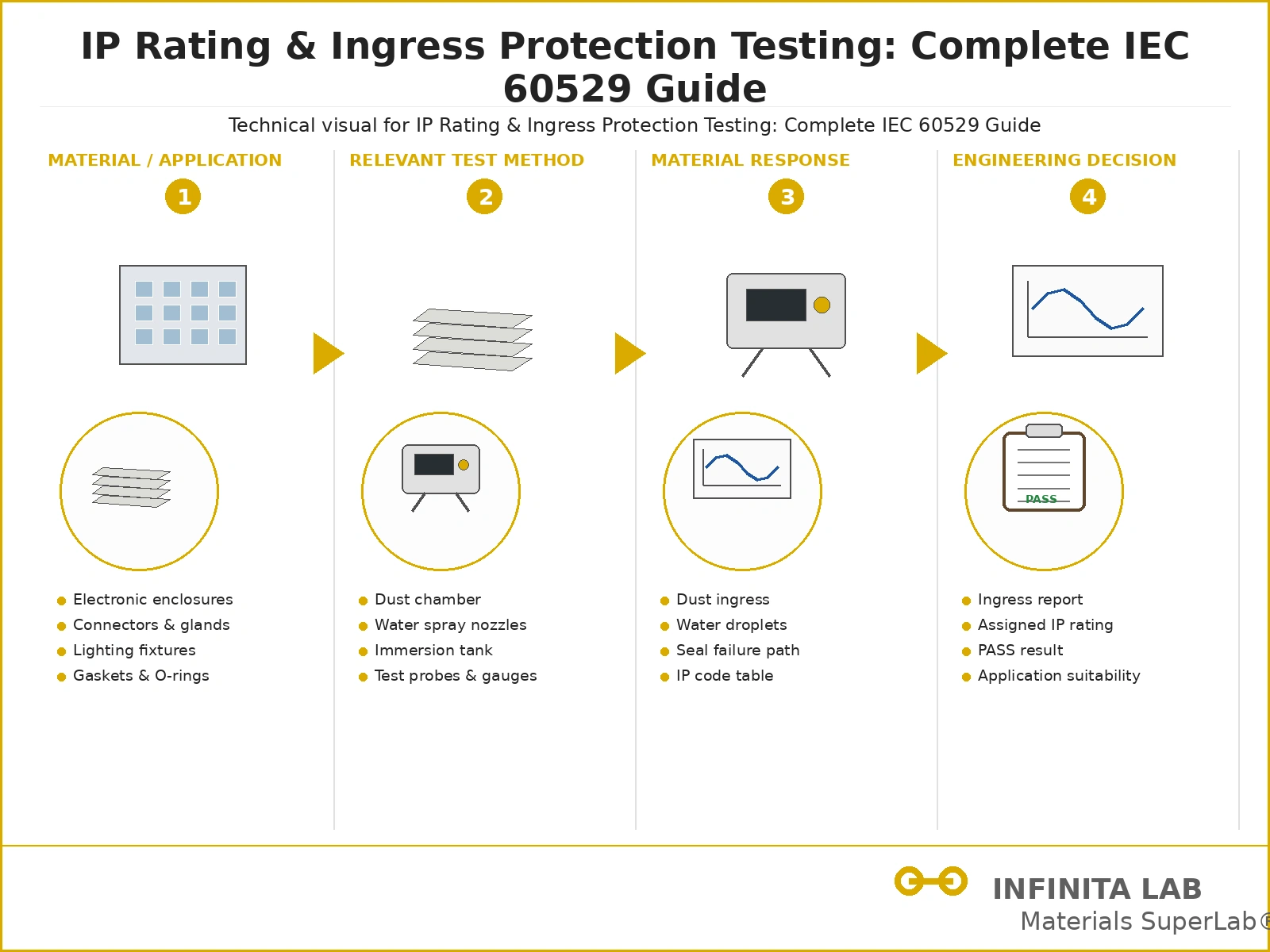
IEC 60529 defines complete test procedures for each IP digit level. Testing is conducted by accredited test laboratories using defined test equipment — standard dust chambers, water-jet nozzles, immersion tanks, and high-pressure steam generators — with pass/fail criteria based on the absence of harmful ingress or loss of functionality after exposure.

Conclusion

IP code ratings provide a transparent, internationally recognized language for specifying and verifying enclosure protection performance. For product designers, selecting the right IP target rating for the intended use environment — and then verifying it through accredited IEC 60529 testing — is the essential step that transforms a sealing design into a demonstrated and certifiable product claim.

Why Choose Infinita Lab for IP Code and Environmental Ingress Testing?

Infinita Lab is a leading provider of IP ingress protection testing and environmental product testing services. With access to a vast network of 2,000+ accredited partner labs, Infinita Lab ensures rapid, accurate, and cost-effective IP certification testing, backed by comprehensive project management and a Single Point of Contact model that eliminates testing complexity.

Looking for a trusted partner to achieve your research goals? Schedule a meeting with us, send us a request, or call us at (888) 878-3090 to learn more about our services and how we can support you. Request a Quote

Frequently Asked Questions (FAQs)

What is Ingress Protection (IP) Code testing?

Ingress Protection testing evaluates the degree of protection provided by enclosures against the entry of solid objects such as dust and liquids like water, classifying performance using standardized IP ratings.

What do IP ratings represent?

An IP rating consists of two digits: the first indicates protection against solid objects or dust, while the second indicates protection against water ingress under defined test conditions.

Why is IP testing important for products?

IP testing ensures that electrical and electronic enclosures provide adequate protection against environmental factors such as dust and water, improving product reliability, safety, and suitability for specific operating environments.

Which products typically require IP testing?

Common products include electrical enclosures, consumer electronics, lighting fixtures, industrial equipment, automotive components, and outdoor devices designed to operate in harsh environmental conditions.

How is IP testing conducted?

Testing involves controlled exposure of products to dust chambers, water jets, immersion tanks, or spray conditions depending on the specified IP rating to verify enclosure sealing effectiveness.

ABOUT AUTHOR

Dr. Bhargav Raval is a Materials Scientist and Client Engagement Engineer with expertise in nanomaterials, polymers, and advanced material characterization. He holds a Ph.D. in Nanosciences from the Central University of Gujarat, where his research focused on graphene-based materials for flexible electronics.... Read More

Home / Blog / IP Rating & Ingress Protection Testing: Complete IEC 60529 Guide

Discover more from Infinita Lab

Subscribe now to keep reading and get access to the full archive.

Continue reading

×

Talk to an Expert

    Connect Instantly

    (888) 878-3090
    Ensure Quality with the Widest Network of Accredited Labs
    • ddd
      Quick Turnaround and Hasslefree process
    • ddd
      Confidentiality Guarantee
    • ddd
      Free, No-obligation Consultation
    • ddd
      100% Customer Satisfaction

      ddd

      Start Material Testing