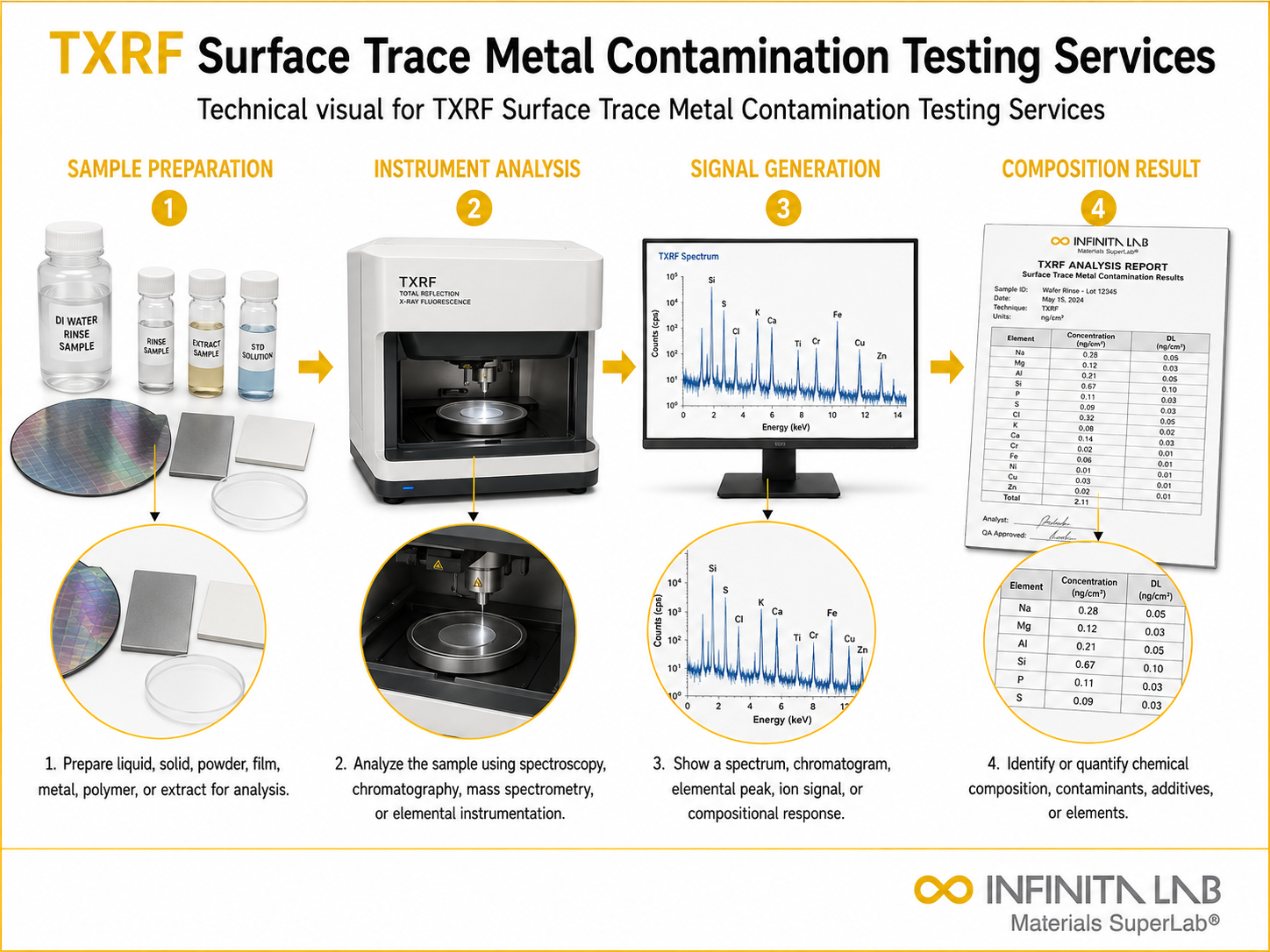


What Is TXRF Total Reflection X Ray Fluorescence?
Total Reflection X-ray Fluorescence (TXRF) is a highly sensitive analytical technique used for trace elemental analysis of liquids, solids, and thin films. It operates on the principle of total external reflection of X-rays at very low incident angles, minimizing background noise and enabling detection of elements at ultra-trace levels.
TXRF is widely used in environmental analysis, semiconductor manufacturing, pharmaceuticals, and material science for accurate quantification of elemental composition. Its ability to analyze very small sample volumes with minimal preparation makes it an efficient and reliable method for high-precision elemental characterization.

Applications and Benefits of TXRF Total Reflection X Ray Fluorescence Testing
Scope
Total Reflection X-ray Fluorescence enables qualitative and quantitative elemental analysis at trace levels using low-angle X-ray excitation and fluorescence detection.
- Applicable to liquids, solids, and thin films
- Detects trace and ultra-trace elemental concentrations
- Supports multi-element analysis simultaneously
- Requires minimal sample preparation
- Ensures compliance with analytical standards
Applications
- Environmental water and soil analysis
- Semiconductor contamination analysis
- Pharmaceutical elemental testing
- Food and beverage analysis
- Material purity and trace element detection
Benefits
- Extremely high sensitivity for trace elements
- Requires very small sample volume
- Minimal sample preparation needed
- Non-destructive analytical technique
- Enables multi-element detection in a single run
Our Testing Procedure
Sample Preparation
A small amount of sample is deposited onto a sample carrier and dried to form a thin layer.
1Instrument Setup
The TXRF instrument is calibrated and aligned for low-angle X-ray incidence.
2X-ray Excitation
The sample is irradiated with X-rays under total reflection conditions to generate fluorescence.
3Detection & Analysis
Emitted fluorescence is detected and analyzed to determine elemental composition and concentration.
4Test parameters and requirements
| Parameter | Details |
|---|---|
| Detection limit | ppb to ppm levels |
| Sample volume | Typically a few microliters |
| Elements detected | Broad range (Na to U) |
| Measurement type | Qualitative and quantitative analysis |
| Excitation source | X-ray tube |
| Angle of incidence | Below critical angle for total reflection |
| Output | Elemental spectra and concentration values |


- TXRF spectrometer
- X-ray source (X-ray tube)
- Sample carriers (quartz/glass reflectors)
- Detector (silicon drift detector)
- Data analysis software
Equipment and Instrumentation Used for Testing
What You Receive: Test Report, Data, and Certification
- Elemental composition and concentration data
- Trace element detection results
- Spectral analysis graphs
- Quantitative analysis report
- Compliance and interpretation report
TXRF Total Reflection X Ray Fluorescence FAQs
TXRF is an analytical technique used to detect and quantify trace elements in samples. It uses low-angle X-ray reflection to minimize background noise, allowing highly sensitive and accurate elemental analysis.
TXRF can analyze liquids, solids, and thin films. It is especially useful for samples requiring trace element detection with minimal preparation and very small sample volumes.
TXRF minimizes background interference by using total reflection geometry, which enhances signal detection. This allows accurate measurement of very low concentrations of elements in a sample.
An internal standard is added to the sample to improve accuracy and quantification. It helps correct variations in measurement conditions and ensures reliable concentration results.
Factors include sample preparation, uniformity of the deposited layer, calibration, and instrument settings. Proper handling ensures accurate and reproducible elemental analysis results.
A Total Aluminum X-ray Analyzer (TAXA) measures the aluminum content in a sample using X-ray fluorescence (XRF) or another X-ray-based analytical technique, depending on the instrument configuration. The analyzer directs primary X-rays onto the prepared sample, exciting aluminum atoms and causing them to emit characteristic fluorescent X-rays. A detector measures the energy and intensity of these emissions, and the instrument's software uses calibration data to calculate the aluminum concentration. The results help determine aluminum content for material characterization, process monitoring, and quality control.
Why Choose Infinita Lab for TXRF Total Reflection X Ray Fluorescence Testing?
When your TXRF Total Reflection X Ray Fluorescence results have to hold up - for compliance, a customer audit, or an engineering decision - accuracy and an unbiased third-party report matter more than price. Infinita Lab routes your TXRF total reflection x ray fluorescence testing to ISO/IEC 17025-accredited U.S. partner labs with hands-on method experience, so you get defensible data, transparent reporting, and turnaround times built around your project deadline - not ours.

Looking for an Accredited Partner for TXRF Total Reflection X Ray Fluorescence Testing?
Send query us at hello@infinitalab.com or call us at (888) 878-3090 to learn more about our services and how we can support you.





