


Residual Gas Analysis RGA Testing Services
Accredited residual gas analysis RGA testing from Infinita Lab, performed to the exact standard requirements - accurate, reproducible results with full documentation for compliance, R&D, and quality control programs.
TRUSTED BY


Get compliant results - request your residual gas analysis RGA testing quote
- Overview
- Scope, Applications, and Benefits
- Test Process
- Specifications
- Instrumentation
- Results and Deliverables
What Is Residual Gas Analysis RGA?
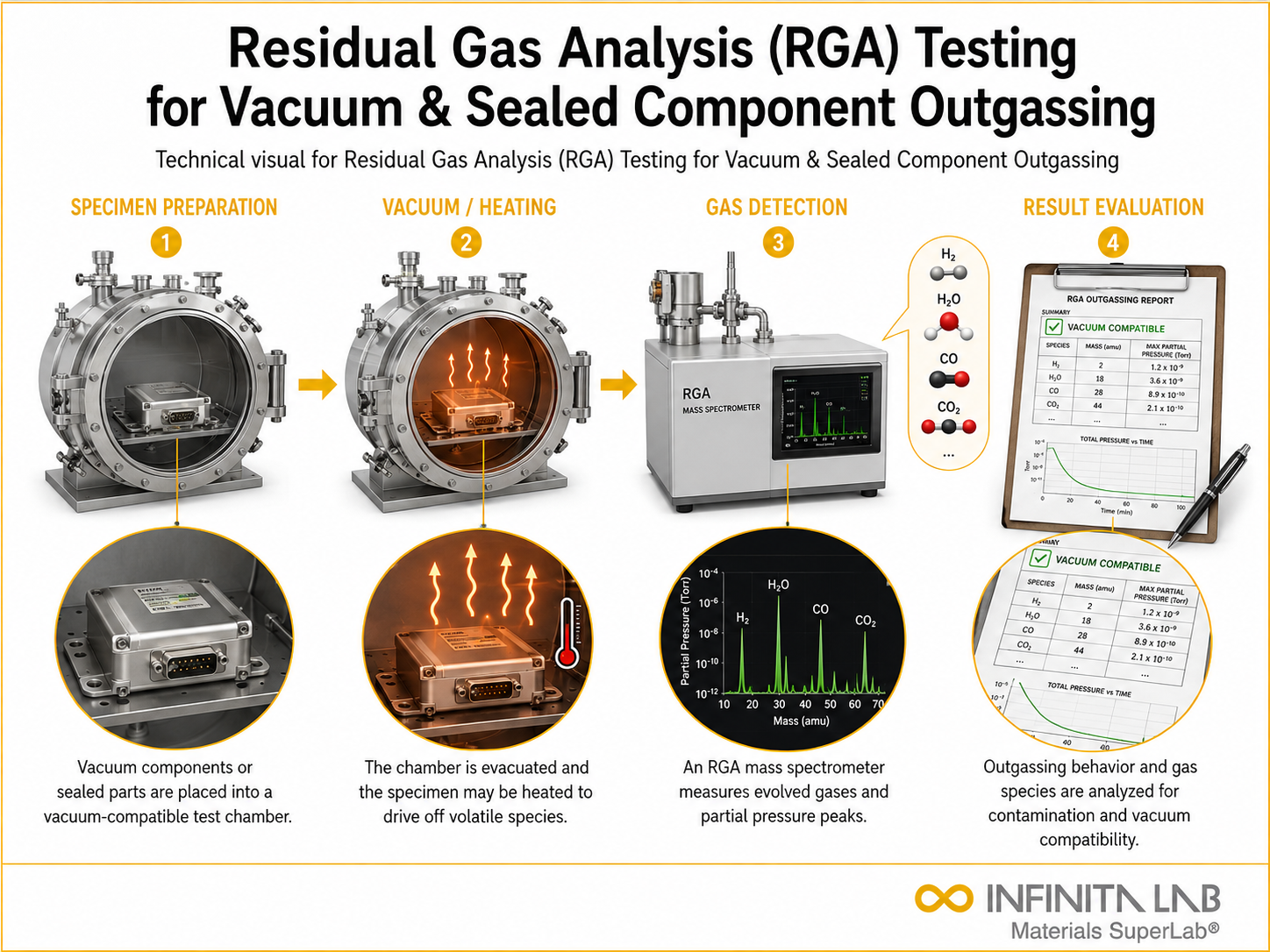
Residual Gas Analysis (RGA) is an analytical technique used to identify and quantify gases present in vacuum systems or sealed environments. It is based on mass spectrometry principles, in which gas molecules are ionized and analyzed by their mass-to-charge ratio to determine composition.
RGA is widely used for monitoring vacuum quality, detecting leaks, and identifying contaminants such as water vapor, hydrocarbons, and process gases. It provides highly sensitive detection of trace gases at very low pressures, making it essential for semiconductor, aerospace, and high-vacuum applications.

Applications and Benefits of Residual Gas Analysis RGA Testing
Scope
Residual Gas Analysis evaluates:
- Composition of gases in vacuum systems
- Partial pressure of individual gas species
- Trace contamination and impurities
- Leak detection and outgassing behavior
- Process gas monitoring and control
Applications
- Semiconductor manufacturing and vacuum chambers
- Aerospace and space systems
- Thin film deposition (PVD, CVD)
- Vacuum furnace and coating processes
- Electronics and hermetic packaging
Benefits
- High-sensitivity detection of trace gases
- Real-time monitoring of vacuum environments
- Identifies contamination sources and leaks
- Supports process control and optimization
- Improves product reliability and performance
Our Testing Procedure
Sample Introduction
Gas from vacuum chamber or sealed system is introduced into the analyzer.
1Ionization
Gas molecules are ionized using electron impact from a filament source.
2Mass Separation
Ions are separated based on mass-to-charge ratio using a quadrupole mass filter.
3Data Analysis
Ion signals are recorded to generate a mass spectrum identifying gas composition.
4Test parameters and requirements
| Parameter | Details |
|---|---|
| Standard | MIL-STD-883 Method 1018 (moisture content), internal methods |
| Pressure Range | ~10⁻⁴ to 10⁻¹⁴ Torr detection capability |
| Mass Range | Typically up to ~100–300 amu |
| Detection Limit | Trace level (sub-ppm) |
| Ionization Method | Ionization Method |
| Measured Outputs | Partial pressure, gas composition |
| Applicable Systems | Vacuum chambers, sealed devices |


- Residual Gas Analyzer (quadrupole mass spectrometer)
- Ion source (hot cathode filament)
- Quadrupole mass filter
- Electron multiplier/detector
- Vacuum system and pumps
- Data acquisition and analysis software
Equipment and Instrumentation Used for Testing
What You Receive: Test Report, Data, and Certification
- Mass spectrum of gases (amu vs intensity)
- Identification of gas species
- Partial pressure distribution
- Contamination and leak detection analysis
- Process monitoring and diagnostic report
Residual Gas Analysis RGA FAQs
RGA, or Residual Gas analysis, testing is commonly performed on hermetically sealed microelectronic devices to detect moisture and other damaging volatile or gaseous compounds in the device cavity.
The common uses of RGA are: It can perform moisture and gaseous component analysis of hermetically sealed microelectronic devices, It can also perform vacuum leak testing and residual gas analysis on ultra-high vacuum equipment.
Mass spectrometry analyzes the gaseous components released from the device in RGA. It also measures the mass-to-charge ratio of ions to identify and quantify different gases present in the sample.
Industries such as semiconductors, aerospace, electronics, vacuum coating, and research laboratories use RGA testing to monitor gas composition, detect leaks, and ensure clean and controlled environments.
RGA testing helps detect contamination, identify leaks, and monitor vacuum quality, ensuring reliable process control and improved performance in high-precision manufacturing and research applications.
Residual Gas Analysis (RGA) identifies and measures gases inside vacuum systems or sealed components using mass spectrometry. Gas molecules are ionized and separated according to their mass-to-charge ratio, allowing gases such as nitrogen, oxygen, hydrogen, and water vapor to be detected and quantified.
Micro-RGA testing analyzes the gas composition inside very small sealed packages, such as microelectronic devices and MEMS components. The package is opened inside a controlled analysis chamber, releasing its internal gases for mass spectrometric measurement. This helps detect trace moisture and contaminants that may affect device reliability.
Internal Vapor Analysis (IVA) measures the types and concentrations of gases and vapors trapped inside hermetically sealed components. The package is opened under controlled conditions, and the released gases are analyzed using mass spectrometry. Results help evaluate moisture levels, sealing quality, and potential reliability issues such as corrosion.
Why Choose Infinita Lab for Residual Gas Analysis RGA Testing
When your Residual Gas Analysis RGA results have to hold up - for compliance, a customer audit, or an engineering decision - accuracy and an unbiased third-party report matter more than price. Infinita Lab routes your residual gas analysis RGA testing to ISO/IEC 17025-accredited U.S. partner labs with hands-on method experience, so you get defensible data, transparent reporting, and turnaround times built around your project deadline - not ours.

Looking for an Accredited Partner for Residual Gas Analysis RGA Testing?
Send query us at hello@infinitalab.com or call us at (888) 878-3090 to learn more about our services and how we can support you.



Request a Quote
Submit your material details and receive testing procedures, pricing, and turnaround time within 24 hours.
 Quick Turnaround and Hasslefree process
 Confidentiality Guarantee
 Free, No-obligation Consultation
 100% Customer Satisfaction
