


O Ring Guide Testing Services
A circular elastic loop known as an O-ring serves as a seal in both static and dynamic applications. Their primary function is to act as a seal between different types of constructions, including pipes, tubes, pistons, and cylinders. O-rings are extremely flexible and come in a variety of materials depending on how they will be utilized. They stop the leaking of liquids or gasses when placed between two surfaces.
TRUSTED BY


Get compliant results — request your o ring guide testing quote
- Overview
- Scope, Applications, and Benefits
- Test Process
- Specifications
- Instrumentation
- Results and Deliverables
What Is O Ring Guide?
O-ring testing evaluates the sealing performance, mechanical integrity, and durability of elastomeric O-rings used in static and dynamic sealing applications. These tests ensure that O-rings maintain effective sealing under pressure, temperature, and environmental variations.
The testing involves compression, tensile, hardness, and leakage assessments to determine material behavior and sealing efficiency. Proper evaluation helps ensure reliability in critical systems by preventing fluid or gas leakage and maintaining consistent performance over the service life.

Applications and Benefits of O Ring Guide Testing
Scope
O-ring testing focuses on a broad evaluation of elastomeric sealing components to ensure their mechanical performance, sealing capability, and environmental resistance under controlled and application-relevant conditions.
It includes characterization of material properties, dimensional accuracy, and functional sealing behavior to verify that O-rings perform effectively across a range of operating environments such as high pressure, temperature fluctuations, and chemical exposure.
- Evaluation of compression set and elastic recovery behavior under sustained deformation
- Measurement of tensile strength, elongation, and stress–strain characteristics
- Assessment of sealing performance under pressure and vacuum conditions
- Analysis of material compatibility with oils, fuels, and chemicals
- Verification of dimensional tolerances and surface integrity
- Study of aging effects due to heat, oxidation, and environmental exposure
- Examination of extrusion resistance and deformation under high pressure
- Comparative analysis of different elastomer formulations and grades
Applications
- Automotive sealing systems
- Aerospace and hydraulic systems
- Industrial machinery and equipment
- Oil and gas sealing applications
- Fluid and gas handling systems
- Medical and precision devices
Benefits
- Ensures reliable sealing performance
- Prevents leakage and system failure
- Supports compliance with quality standards
- Enhances durability and service life
- Improves safety in critical applications
- Enables optimized material selection
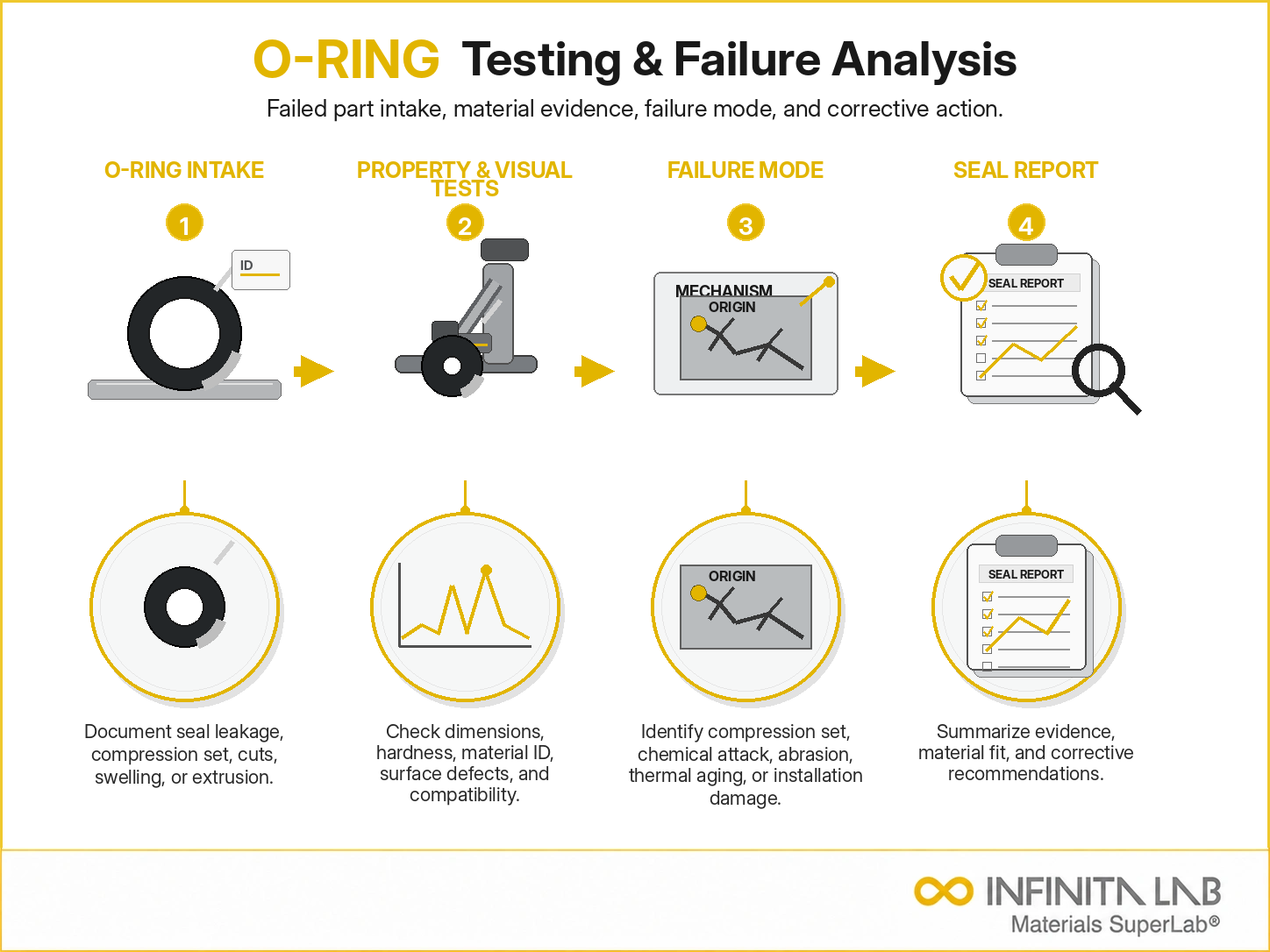
Our Testing Procedure
Sample Inspection & Conditioning
O-rings are visually inspected and conditioned under controlled temperature and humidity conditions.
1Mechanical Property Testing
Tensile strength, elongation, and hardness are measured using standardized testing methods.
2Compression & Sealing Evaluation
Compression set and sealing performance are assessed under defined pressure and deformation conditions.
3Result Analysis & Compliance Check
Test results are analyzed and compared with specified requirements for performance validation.
4Test parameters and requirements
| Parameter | Details |
|---|---|
| Test Method | Mechanical and sealing performance evaluation of elastomeric O-rings |
| Measurement Type | Stress–strain behavior, compression set, and sealing efficiency |
| Sample Type | Elastomeric O-rings of various sizes and materials |
| Loading Type | Controlled tensile and compressive loading conditions |
| Units | MPa (strength), % elongation, % compression set, N (force) |
| Temperature Range | Ambient to elevated temperatures depending on application |


- Universal testing machine (UTM)
- Compression set testing apparatus
- Hardness tester (Shore A)
- Leak testing equipment
- Environmental chamber
- Vernier caliper and thickness gauge
Equipment and Instrumentation Used for Testing
What You Receive: Test Report, Data, and Certification
- Tensile strength and elongation values
- Compression set percentage
- Hardness measurement (Shore A)
- Sealing and leakage performance results
- Compliance with relevant standards
- Detailed analytical test report
O Ring Guide FAQs
Compression set measures the ability of an O-ring to recover after deformation. High compression set indicates permanent deformation, leading to loss of sealing force and increased leakage risk over time in static sealing applications.
Different elastomers exhibit unique resistance to temperature, chemicals, and pressure. Incorrect material selection can cause swelling, hardening, or degradation, significantly affecting sealing performance and reducing service life.
Repeated temperature changes cause expansion and contraction, leading to material fatigue and potential cracking. This can reduce elasticity and sealing efficiency, especially in applications with frequent thermal fluctuations.
Hardness affects deformation under load. Softer O-rings provide better sealing at low pressure, while harder materials resist extrusion at high pressure. Proper hardness selection balances sealing efficiency and durability.
Surface roughness influences contact sealing. Excessively rough surfaces can cause leakage paths, while overly smooth surfaces may reduce friction needed to maintain position, making optimal surface finish essential.
Why Choose Infinita Lab for O Ring Guide Testing
At the core of this breadth is our network of 2,000+ accredited laboratories across the USA, offering access to over 10,000 testing methods and analytical services. From advanced materials characterization (SEM, TEM, RBS, XPS) to mechanical, chemical, environmental, biological, and standardized ASTM/ISO-compliant testing, we deliver unmatched flexibility, specialization, and scale. You are never limited by geography, facility, or methodology — Infinita Lab connects you to the right expertise and testing solution, every time.

Looking for an Accredited Partner for O Ring Guide Testing?
Send query us at hello@infinitalab.com or call us at (888) 878-3090 to learn more about our services and how we can support you.



Request a Quote
Submit your material details and receive testing procedures, pricing, and turnaround time within 24 hours.
 Quick Turnaround and Hasslefree process
 Confidentiality Guarantee
 Free, No-obligation Consultation
 100% Customer Satisfaction
