

What Is MIL-STD-883 Temperature Cycling?
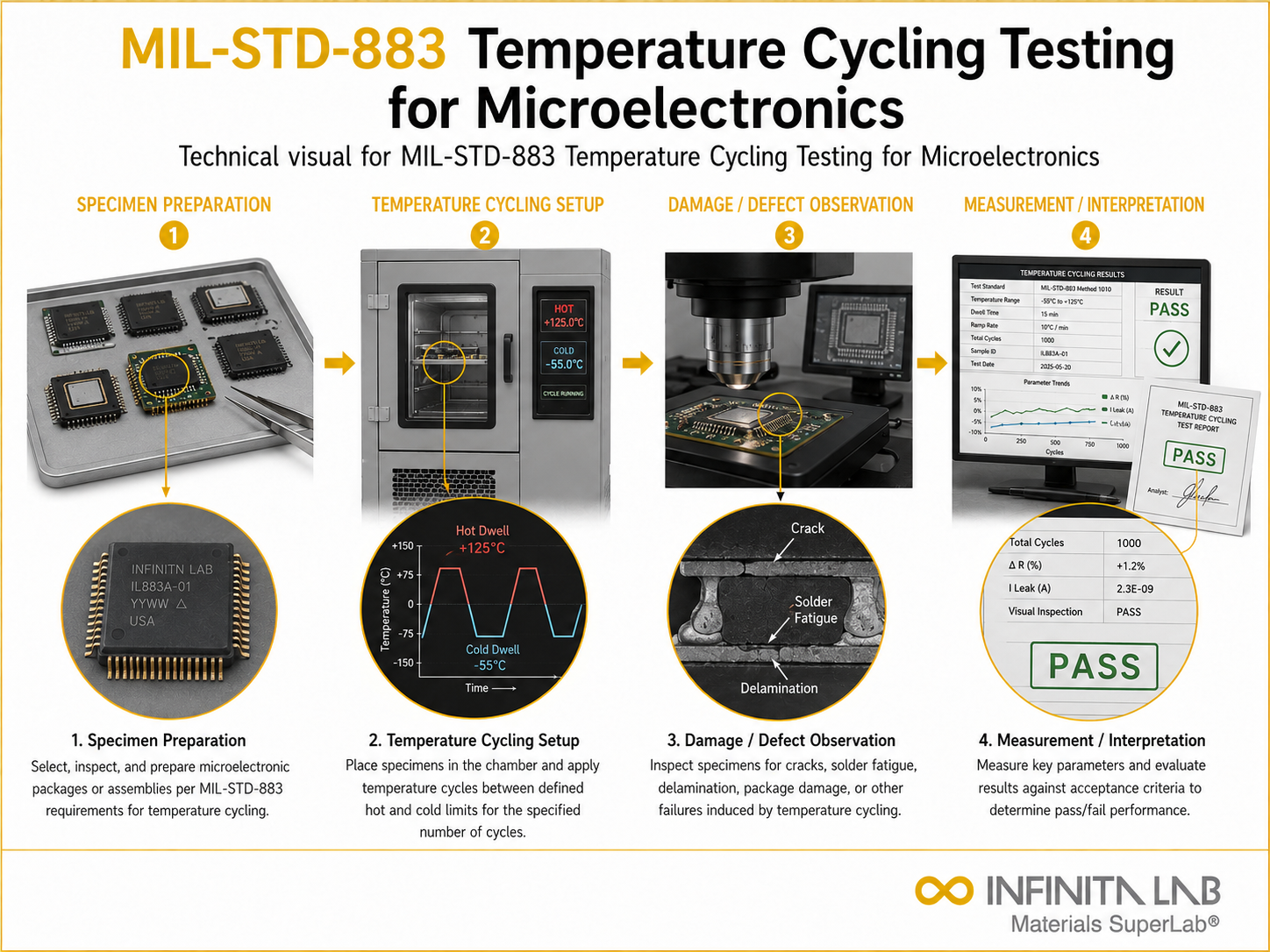
MIL-STD-883 Method 1010 is the standardized test procedure for evaluating the ability of microelectronic devices and semiconductor components to withstand repeated exposure to extreme temperature conditions. The test subjects devices to alternating high and low temperature extremes across a defined number of cycles, simulating the cumulative thermal stress experienced during service life, storage, and transportation. It is a mandatory qualification and screening test for military-grade and high-reliability electronic components, and is widely referenced in defense, aerospace, and space electronics procurement specifications.
The test is governed by the broader MIL-STD-883 standard — the primary U.S. military standard for test methods and procedures for microelectronics — under which Method 1010 specifically addresses temperature cycling as distinct from thermal shock (Method 1011), which uses liquid-to-liquid transfer. Method 1010 uses air-to-air cycling chambers where temperature transition rates are controlled, making it suitable for evaluating the cumulative fatigue behavior of packaging materials, interconnects, and die-attach interfaces over extended test durations. Results are used for design validation, lot acceptance screening, and failure analysis following field returns.

Applications and Benefits of MIL-STD-883 Temperature Cycling Testing
Scope
MIL-STD-883 Method 1010 covers temperature cycling testing for microelectronic devices, semiconductor components, and electronic assemblies intended for use in military, aerospace, and high-reliability applications. The standard defines test conditions (Conditions A through H) specifying the temperature extremes, number of cycles, dwell time at each extreme, and transfer time between temperature zones. Testing is performed in air-to-air chambers with controlled transition rates, and components may be tested in operational or non-operational states depending on the procurement specification.
MIL-STD-883 Method 1010 temperature cycling testing evaluates:
- Resistance of microelectronic packages to repeated thermal expansion and contraction stress
- Solder joint integrity and fatigue life under defined temperature cycling conditions
- Die attach and package interface adhesion stability across thermal extremes
- Wire bond mechanical integrity following cumulative thermomechanical cycling
- Hermeticity retention in sealed ceramic and metal packages after thermal stress
- Electrical performance stability (continuity, leakage, parametric drift) before and after cycling
- Structural integrity of substrates, encapsulants, and package bodies under thermal fatigue
- Conformance to MIL-STD-883 qualification and screening requirements for lot acceptance
Applications
- Military microelectronics — ICs, hybrid circuits, and semiconductor devices requiring MIL-STD-883 qualification for defense procurement
- Aerospace and space electronics — Avionics, satellite components, and launch vehicle electronics subject to wide temperature excursions and long service life requirements
- Automotive electronics — Engine control units, power modules, and safety-critical ECUs evaluated for thermal fatigue under underhood and exterior mounting conditions
- Telecommunications infrastructure — Base station electronics, power amplifiers, and network switching components operating across outdoor temperature ranges
- Industrial control systems — PLCs, motor drives, and embedded controllers deployed in thermally demanding manufacturing or energy environments
- Medical electronics — Implantable and external devices where thermal cycling qualification supports regulatory submissions and long-term reliability assurance
- Power electronics — IGBTs, MOSFETs, and power modules where solder fatigue under thermal cycling is a primary life-limiting failure mechanism
- Semiconductor packaging qualification — New package designs, die attach materials, and substrate technologies undergoing thermal fatigue characterization during development
Benefits
- Evaluates durability under repeated temperature changes
- Helps identify failures caused by thermal stress
- Supports reliability evaluation of electronic components
- Assists in product development and design validation
- Provides data for environmental performance assessment
Our MIL-STD-883 Testing Procedure
Sample Preparation
Electronic components are prepared and positioned in the temperature cycling chamber.
1High Temperature Exposure
The specimen is exposed to elevated temperature conditions for a specified duration.
2Low Temperature Exposure
The specimen is then subjected to low-temperature conditions to complete the cycle.
3Data Recording & Evaluation
After multiple cycles, the components are inspected for physical damage or performance changes.
4MIL-STD-883 Test Parameters and Requirements
| Parameter | Details |
|---|---|
| Applicable Materials | Electronic components and semiconductor devices |
| Temperature Range | -55°C to +220°C (application dependent) |
| Number of Cycles | Typically 10–100+ cycles (application dependent) |
| Transition Rate | Controlled (typically <15°C/min for cycling) |
| Dwell Time | ~10–30 minutes per extreme (depends on mass) |
| Measured Outputs | Physical damage, functional changes, or reliability impact |
| Pre/Post Electrical Testing | Continuity, leakage current, parametric measurements per device specification |


- Temperature cycling chamber
- Environmental temperature control system
- Temperature sensors and monitoring equipment
- Specimen mounting fixtures
- Data acquisition and recording system
- Inspection and measurement tools
Equipment and Instrumentation Used for MIL-STD-883 Testing
What You Receive: Test Report, Data, and Certification
- Temperature cycling exposure records
- Observations of structural or functional changes
- Thermal stress impact assessment
- Test condition summary
- Compliance report
MIL-STD-883 Temperature Cycling FAQs
The reliability of electronic components is tested per MIL-STD-883 Method 1010, in which components are subjected to repeated temperature extremes. The test is performed to detect failures caused by thermal expansion, contraction, and stress in semiconductor devices and microelectronic packages.
Components are subjected to alternating periods in high- and low-temperature chambers. This simulates the thermal stresses to which electronic components are subjected during storage, transportation, or operation.
Temperature cycling tests are used to identify defects such as solder-joint fatigue, package cracking, wire-bond failure, and material mismatches. Identifying these weaknesses ensures that the electronic components used are reliable under temperature cycling.
MIL-STD-883 Method 1010 is typically used to test integrated circuits, semiconductor devices, microelectronic packages, hybrid circuits, and other electronic components for use in aerospace, defense, telecommunications, and high-reliability industrial applications.
Method 1010 uses air-to-air cycling chambers with controlled transition rates, evaluating cumulative fatigue damage over many cycles. Method 1011 (thermal shock) uses rapid liquid-to-liquid or air-to-air transfer with near-instantaneous temperature transitions, targeting brittle fracture and immediate mechanical failure. Method 1010 is more representative of operational thermal cycling; Method 1011 simulates sudden environmental changes.
Why Choose Infinita Lab for Temperature Cycling Testing
At the core of this breadth is our network of 2,000+ accredited laboratories across the USA, offering access to over 10,000 testing methods and analytical services. From advanced materials characterization (SEM, TEM, RBS, XPS) to mechanical, chemical, environmental, biological, and standardized ASTM/ISO-compliant testing, we deliver unmatched flexibility, specialization, and scale. You are never limited by geography, facility, or methodology — Infinita Lab connects you to the right expertise and testing solution, every time.

Need MIL-STD-883 Temperature Cycling Testing You Can Rely On?
Send query us at hello@infinitalab.com or call us at (888) 878-3090 to learn more about our services and how we can support you.





