


ASTM E1171: PV Module Cyclic Temperature Humidity Testing Services
ASTM E1171 test method determines the characteristics of photovoltaic modules by testing them in three different environmental procedures such as thermal cycling procedure, humidity freeze cycling procedure, and an extended duration damp heat procedure. The final results of this method are displayed keeping in view the international standards and inch-pound units.
TRUSTED BY


Get ASTM E1171 compliant results — request your PV module cyclic temperature humidity testing quote
- Overview
- Scope, Applications, and Benefits
- Test Process
- Specifications
- Instrumentation
- Results and Deliverables
What Is ASTM E1171 PV Module Cyclic Temperature Humidity?
ASTM E1171 defines a standardized environmental test method to evaluate the durability and performance of photovoltaic (PV) modules under cyclic temperature and humidity conditions. The method simulates real-world environmental stresses such as thermal cycling and moisture exposure, which can degrade module materials and electrical performance over time.
This test is critical for assessing long-term reliability of PV modules used in outdoor installations. By exposing modules to repeated environmental cycles, ASTM E1171 helps identify failure mechanisms such as delamination, corrosion, and insulation breakdown. It supports product qualification, reliability validation, and ensures consistent performance in varying climatic conditions.

Applications and Benefits of ASTM E1171 PV Module Cyclic Temperature Humidity Testing
Scope
ASTM E1171 establishes procedures for subjecting photovoltaic modules to controlled cyclic temperature and humidity environments to evaluate their durability and performance stability. It ensures repeatable testing through defined environmental cycles and monitoring conditions.
- Applies to photovoltaic modules and panels
- Simulates cyclic exposure to temperature and humidity variations
- Evaluates environmental durability and material stability
- Detects degradation mechanisms under accelerated conditions
- Conducted in controlled environmental chambers
Applications
- Reliability testing of photovoltaic modules
- Qualification of solar panels for outdoor deployment
- Material degradation and durability studies
- Quality control in PV manufacturing
- Performance validation under climatic stress
- Research and development of PV technologies
Benefits
- Identifies long-term degradation mechanisms
- Ensures durability under environmental stress
- Supports product qualification and certification
- Improves design and material selection
- Enhances reliability of PV installations
- Reduces risk of premature module failure
Our ASTM E1171 Testing Procedure
Sample Preparation
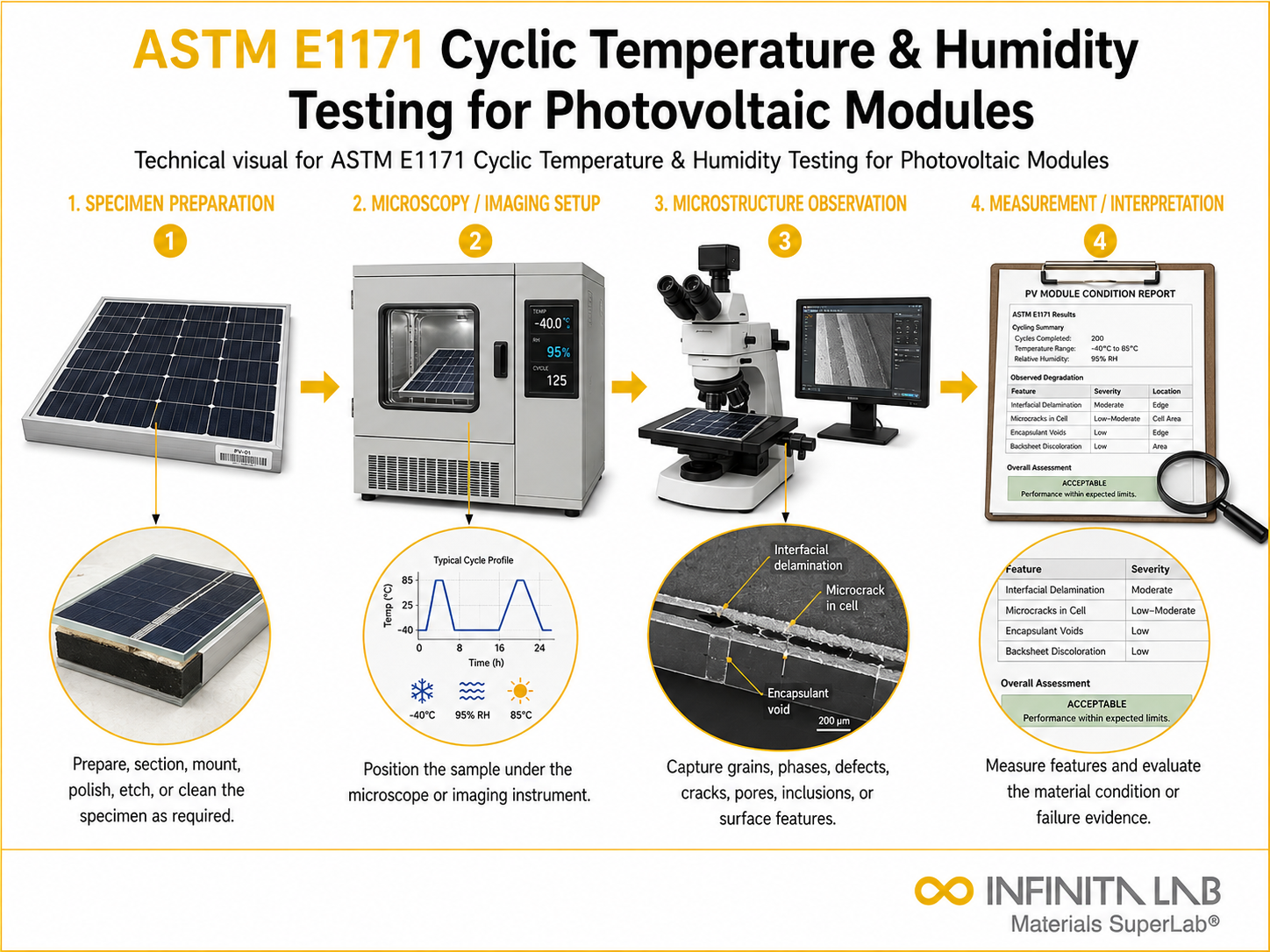
PV modules are inspected and prepared with baseline electrical measurements recorded.
1Environmental Cycling
Modules are exposed to controlled temperature and humidity cycles in a chamber.
2Performance Monitoring
Electrical and physical properties are periodically evaluated during cycling.
3Post-Test Evaluation
Final inspection and performance comparison are conducted to assess degradation.
4ASTM E1171 Test Parameters and Requirements
| Parameter | Details |
|---|---|
| Standard | ASTM E1171 |
| Test Principle | Accelerated environmental cycling of temperature and humidity to evaluate PV module durability |
| Applicable Devices | Photovoltaic modules and panels |
| Temperature Range | Typically from low sub-zero to elevated temperatures |
| Humidity Range | High relative humidity conditions (up to ~85–95% RH) |
| Cycle Duration | Defined cyclic exposure periods over multiple cycles |
| Measurement Output | Electrical performance degradation and physical damage assessment |
| Test Environment | Controlled climatic chamber with programmable cycles |
| Failure Indicators | Delamination, corrosion, insulation failure, performance loss |


- Environmental chamber (temperature and humidity controlled)
- Photovoltaic modules under test
- Solar simulator or I-V measurement system
- Temperature and humidity sensors
- Data acquisition system
- Insulation resistance tester
- Visual inspection tools
Equipment and Instrumentation Used for ASTM E1171 Testing
What You Receive: Test Report, Data, and Certification
- Electrical performance degradation data
- I-V curve comparison (pre and post test)
- Physical inspection results (cracks, delamination, corrosion)
- Environmental durability assessment
- Test report with cycle conditions and observations
- Compliance verification with ASTM E1171
ASTM E1171 PV Module Cyclic Temperature Humidity FAQs
PV modules operate in fluctuating outdoor environments. Cyclic exposure reveals long-term degradation mechanisms such as moisture ingress and thermal stress, ensuring modules maintain performance and reliability over their service life.
The test can identify failures such as delamination, corrosion, encapsulant degradation, insulation breakdown, and electrical performance loss caused by repeated environmental stress.
High humidity can lead to moisture ingress, causing corrosion of electrical contacts, degradation of encapsulation materials, and reduced insulation resistance, ultimately affecting module efficiency and lifespan.
Cyclic temperature changes create expansion and contraction stresses in materials, simulating real environmental conditions more accurately than constant exposure and revealing mechanical and thermal fatigue effects.
Comparing electrical performance before and after testing quantifies degradation, helping assess how environmental stress impacts module efficiency and reliability.
Why Choose Infinita Lab for PV Module Cyclic Temperature Humidity Testing?
At the core of this breadth is our network of 2,000+ accredited laboratories across the USA, offering access to over 10,000 testing methods and analytical services. From advanced materials characterization (SEM, TEM, RBS, XPS) to mechanical, chemical, environmental, biological, and standardized ASTM/ISO-compliant testing, we deliver unmatched flexibility, specialization, and scale. You are never limited by geography, facility, or methodology — Infinita Lab connects you to the right expertise and testing solution, every time.

Looking for an Accredited Partner for ASTM E1171 PV Module Cyclic Temperature Humidity Testing?
Send query us at hello@infinitalab.com or call us at (888) 878-3090 to learn more about our services and how we can support you.



Request a Quote
Submit your material details and receive testing procedures, pricing, and turnaround time within 24 hours.
 Quick Turnaround and Hasslefree process
 Confidentiality Guarantee
 Free, No-obligation Consultation
 100% Customer Satisfaction
