

What Is ISO 15512 Plastic Moisture Content?
ISO 15512 is an international standard for determining the water (moisture) content in plastic materials, including powders, granules, and finished products. It provides multiple analytical methods for accurately quantifying moisture levels, a critical parameter that affects processing and material performance.
Moisture content plays a significant role in polymer processing, as excess water can lead to defects such as hydrolytic degradation, reduced mechanical properties, and poor surface finish. ISO 15512 enables precise measurement using techniques such as Karl Fischer titration and vaporization methods, ensuring reliable and repeatable results.
Applications and Benefits of ISO 15512 Plastic Moisture Content Testing
Scope
ISO 15512 testing evaluates:
- Water content (% or ppm levels)
- Moisture in plastics (typically 0.001% to 0.1% range)
- Volatile-free moisture measurement
- Effect of moisture on processing and properties
- Hygroscopic behavior of polymers
Applications
- Thermoplastics (PA, PET, PC, ABS, PP, PE)
- Injection molding and extrusion processes
- Polymer granules and pellets
- Packaging and film materials
- Automotive and electrical plastic components
Benefits
- Ensures proper drying before processing
- Prevents material degradation and defects
- Improves product quality and consistency
- Enables accurate moisture control
- Supports material selection and validation
Our ISO 15512 Testing Procedure
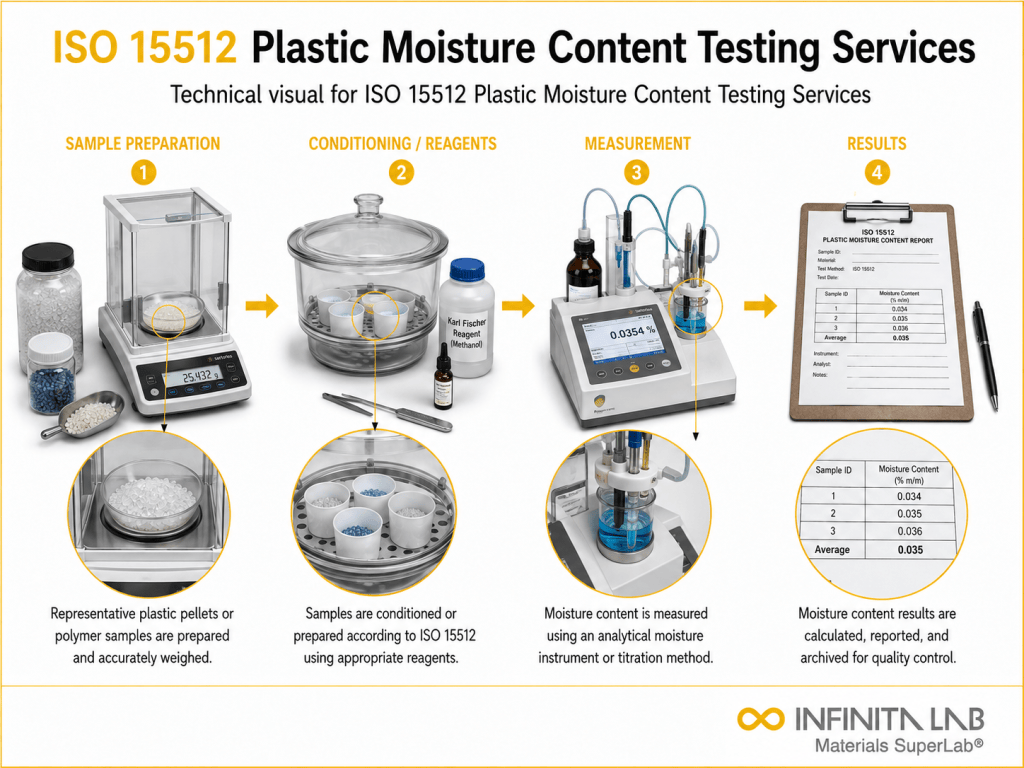
Sample Preparation
Samples are collected (~1–3 g) and handled in moisture-free conditions to prevent contamination.
1Moisture Extraction
Water is extracted using methods such as heating (vaporization) or solvent extraction.
2Detection
Moisture is measured using Karl Fischer titration or pressure-based (manometric) techniques.
3Data Analysis
Water content is calculated as % or ppm based on titration or pressure change.
4ISO 15512 Test Parameters and Requirements
| Parameter | Details |
|---|---|
| Test Type | Determination of water content using extraction, vaporization, or manometric methods |
| Applicable Materials | Plastics, polymer resins, and granules |
| Common Methods | Karl Fischer titration, gravimetric method |
| Sample Size | ~1–3 g |
| Sample Type | Granules, powders, molded plastics |
| Measured Parameter | Water content (%) |
| Detection Range | ~0.001% to 0.1% moisture |
| Output Data | Moisture percentage and analytical results |


- Karl Fischer titrator (coulometric/volumetric)
- Drying oven or vaporization unit
- Manometric moisture analyzer
- Analytical balance (±0.1 mg)
- Inert gas supply (nitrogen/air)
- Data acquisition system
Equipment and Instrumentation Used for ISO 15512 Testing
What You Receive: Test Report, Data, and Certification
- Moisture content values (% or ppm)
- Karl Fischer titration data
- Thermal/vaporization moisture analysis results
- Material suitability for processing
- Comparative moisture performance across samples
- Detailed laboratory test report
ISO 15512 Plastic Moisture Content FAQs
ISO 15512 determines the water content present in plastic materials. Measuring moisture levels is important because excess water can affect processing behavior, mechanical properties, and long-term performance of polymers.
ISO 15512 includes multiple methods such as Karl Fischer titration (extraction or vaporization) and manometric techniques, allowing accurate measurement across different plastic types and moisture levels.
Moisture in plastics can cause hydrolysis, surface defects, reduced mechanical strength, and poor molding quality, especially in moisture-sensitive polymers like polyamides and polyesters.
Industries such as automotive, electronics, packaging, aerospace, and medical device manufacturing rely on this test to ensure plastics meet strict quality and performance requirements.
ISO 15512 can measure very low levels of moisture, often from ppm levels up to several percent, depending on the method used and the sensitivity of the Karl Fischer titration system.
Moisture content in plastics refers to the amount of water present in the material, usually expressed as a percentage by mass. According to ISO 15512, water content is determined in plastic powders, granules, and finished articles using specified analytical methods. Measuring moisture is important because excessive water can affect plastic processing, product quality, and final material properties.
Moisture testing in plastics under ISO 15512 involves determining the water content using one of several methods. These include Karl Fischer titration after solvent extraction, water vaporization followed by moisture measurement, and manometric analysis. The selected method depends on the plastic type and required measurement sensitivity. Results are reported as a percentage mass fraction of water and compared with the applicable material requirements.
Why Choose Infinita Lab for Plastic Moisture Content Testing?
When your Plastic Moisture Content results have to hold up - for compliance, a customer audit, or an engineering decision - ISO 15512 accuracy and an unbiased third-party report matter more than price. Infinita Lab routes your ISO 15512 plastic moisture content testing to ISO/IEC 17025-accredited U.S. partner labs with hands-on method experience, so you get defensible data, transparent reporting, and turnaround times built around your project deadline - not ours.

Need ISO 15512 Plastic Moisture Content Testing You Can Rely On?
Send query us at hello@infinitalab.com or call us at (888) 878-3090 to learn more about our services and how we can support you.



