


Inclined Impact Testing Services
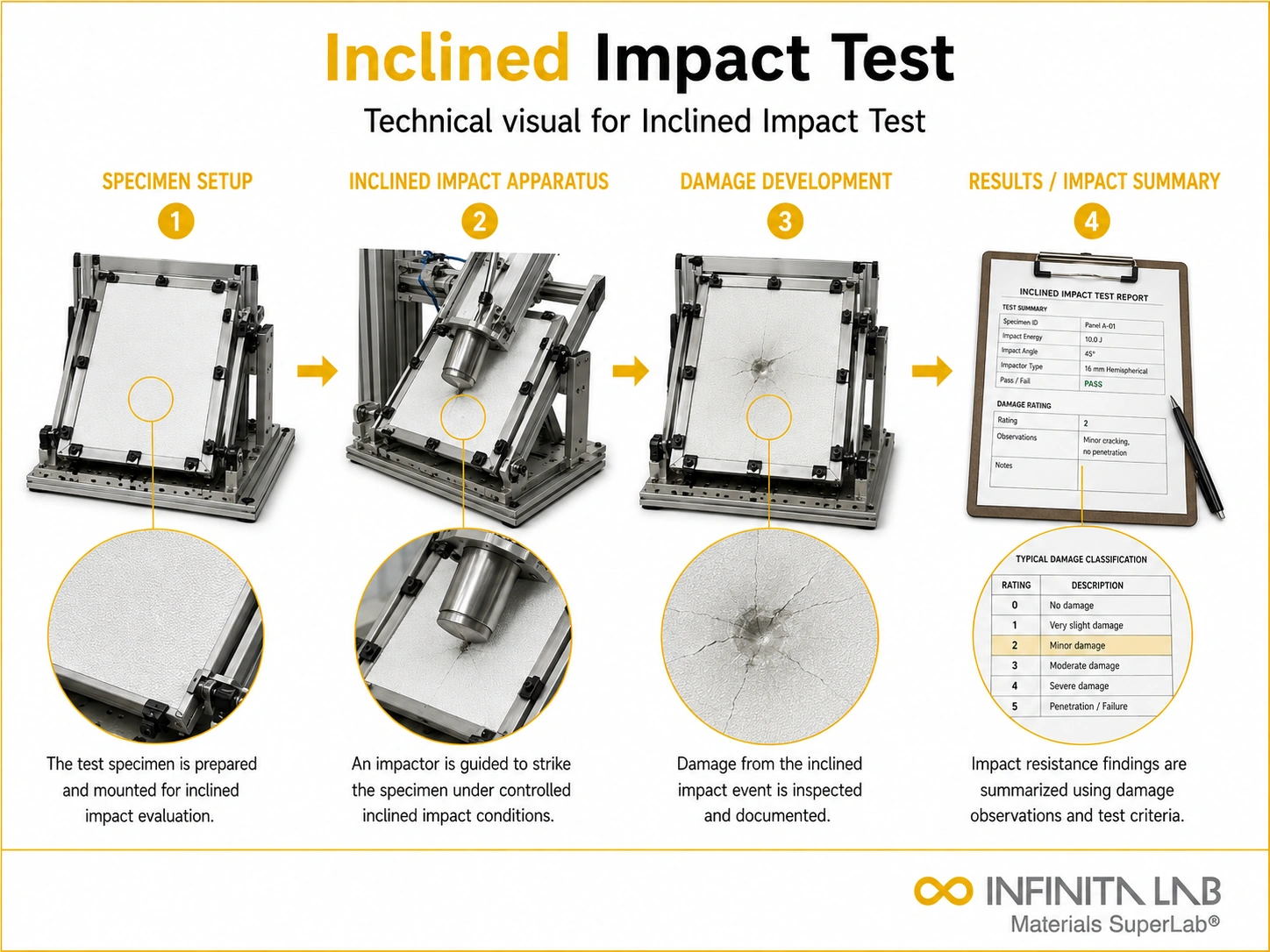
Inclined Impact Testing is a technique used to evaluate the effectiveness of shipping containers and interior packaging for protecting their contents from impacts. This type of testing offers a lab simulation of the effects seen in the handling and distribution cycle and can be used to measure the deterioration of a package and its contents over time. Results from this testing can provide cost-effective distribution, assurance in product launch, increased customer satisfaction, and more.
TRUSTED BY


Get compliant results — request your inclined impact testing quote
- Overview
- Scope, Applications, and Benefits
- Test Process
- Specifications
- Instrumentation
- Results and Deliverables
What Is Inclined Impact?
Inclined impact testing – commonly called the incline impact or Conbur test – evaluates how well a shipping container and its interior packaging protect their contents against the horizontal impacts that occur during handling and distribution. The packaged product is placed on a wheeled carriage (a dolly), drawn up an inclined ramp, and released to roll down and strike a fixed backstop, delivering a controlled, repeatable horizontal impact to a chosen face, edge, or corner of the package.
By controlling the height (and therefore the velocity) from which the carriage is released, the test delivers a defined impact severity, and by re-orienting the package different surfaces can be tested in sequence. This reproduces the kind of horizontal shocks a package experiences during shipping – being shunted, dropped against a wall, or struck during sortation – in a controlled laboratory setting, allowing different package designs of the same size and weight to be compared on a consistent basis.
Inclined impact testing is one of the standard horizontal-impact methods used in package and distribution testing, alongside vertical drop and the horizontal pendulum impact method. It is used to validate package designs, compare cushioning and container options, and form part of broader distribution test programs such as those built around ASTM D4169.

Applications and Benefits of Inclined Impact Testing
Scope
Inclined impact testing covers the controlled application of horizontal impacts to packaged products using an inclined-plane (Conbur) tester, to evaluate the protection provided by the shipping container and interior packaging. The impact severity and the surfaces tested are defined by the test plan or the applicable standard.
Key aspects of the test scope include:
- Test principle – the packaged product on a carriage is released from a set position on an inclined ramp and impacts a fixed backstop at a controlled velocity
- Impact severity control – set by the release position/height on the incline, which determines the impact velocity
- Orientation – different faces, edges, or corners of the package can be presented to the backstop to evaluate impacts on each surface
- Applicable standards – ASTM D880 (impact testing for shipping containers) and the inclined-impact provisions referenced within ASTM D4169 and related package-handling test schedules; ISTA procedures may also call for horizontal impact testing
- Evaluation – both the package (closures, container integrity, cushioning) and the contents (damage, function) are assessed after impact
- Specimen types – shipping containers, unit packages, and interior packaging with representative contents
Applications
- Package design validation – confirming a shipping container and interior packaging protect the contents against horizontal handling impacts before the package goes into use
- Container design comparison – comparing the impact performance of different container designs of the same size and weight on a consistent, repeatable basis
- Cushioning and dunnage evaluation – assessing how interior cushioning and bracing perform under horizontal impact and where improvements are needed
- Distribution test programs – providing the horizontal-impact element within broader distribution simulation programs (e.g., alongside compression, vibration, and drop per ASTM D4169)
- Product launch assurance – verifying packaging performance before launch to reduce the risk of transit damage and the associated returns and complaints
- Heavy or palletized packages – evaluating larger or heavier packaged units for which a controlled horizontal impact is more practical than a free-fall drop
Benefits
- Reproduces real horizontal handling impacts – the inclined-impact method simulates the shunting and horizontal shocks of distribution that vertical drop tests do not capture
- Controlled and repeatable severity – setting the release position on the incline gives a defined, repeatable impact velocity, so designs can be compared on an equal basis
- Tests all package surfaces – re-orienting the package allows faces, edges, and corners to be evaluated, identifying the most vulnerable impact orientations
- Practical for heavy and large packages – the carriage-and-incline approach handles heavier packaged units that are difficult to test by free-fall drop
- Supports cost-effective packaging decisions – identifying weak points (or unnecessary over-packaging) before distribution reduces both damage costs and material costs
Our Testing Procedure
Plan and Condition
Define impact severity, test orientations, and number of impacts, then condition and document the package.
1Set Up the Package
Secure the package on the inclined carriage with the required face, edge, or corner aligned to the backstop.
2Apply Impacts
Release the carriage and repeat the impact for each specified orientation and severity.
3Inspect and Report
Check the package and product for damage, compare results with acceptance criteria, and document the outcome.
4Test parameters and requirements
| Parameter | Details |
|---|---|
| Applicable Standards | ASTM D880; horizontal-impact provisions in ASTM D4169 / ISTA procedures |
| Impact Mechanism | Carriage released on incline strikes fixed backstop |
| Severity Control | Release position/height on incline (sets impact velocity) |
| Orientations | Faces, edges, and corners as defined in the test plan |
| Conditioning | Per ASTM D4332 or specified atmosphere prior to testing |
| Specimen Types | Shipping containers, unit packages, interior packaging with contents |
| Evaluation | Package integrity and contents damage/function |


- Inclined-plane impact tester (Conbur tester) with carriage and fixed backstop
- Carriage release mechanism with position/height control
- Temperature and humidity conditioning chamber (for preconditioning)
- Calibrated scales for package weighing
- Velocity/impact measurement instrumentation (where used)
- Photographic documentation system
Equipment and Instrumentation Used for Testing
What You Receive: Test Report, Data, and Certification
- Inclined impact test report – the impact severity (release position/velocity), surfaces impacted, number of impacts, and the conditions applied
- Package condition findings – container integrity, closure performance, and any structural damage observed after impact
- Contents condition – damage and, where applicable, functional status of the contents after testing
- Pass/fail determination – outcome against the acceptance criteria of the applicable standard or test plan
- Per-impact observations – condition recorded between impacts to identify at which point and orientation damage developed
- Photographic documentation – images of the package and contents before and after the impact sequence
Inclined Impact FAQs
The test is commonly used for shipping containers, crates, pallets, unit loads, appliances, industrial equipment and packaged consumer products. Both the outer packaging and the protection provided to the contents can be assessed.
The test can reproduce impacts associated with railcar switching, pallet marshalling, forklift handling and sudden contact between freight units. It evaluates exposure to shock and crushing forces during distribution.
Impact severity may be controlled using the carriage release height, impact velocity, specimen mass and orientation. Instrumented systems can also control or measure acceleration, pulse duration and velocity change.
The package is inspected for crushing, tearing, punctures, joint separation, deformation and load instability. The product is also checked for functional failure, breakage, displacement or cosmetic damage.
ASTM D880 evaluates the general ability of containers and shipping systems to withstand impacts or protect their contents. ASTM D5277 focuses on reproducing and comparing programmed horizontal shock damage using an inclined impact tester.
Why Choose Infinita Lab for Inclined Impact Testing?
At the core of this breadth is our network of 2,000+ accredited laboratories across the USA, offering access to over 10,000 testing methods and analytical services. From advanced materials characterization (SEM, TEM, RBS, XPS) to mechanical, chemical, environmental, biological, and standardized ASTM/ISO-compliant testing, we deliver unmatched flexibility, specialization, and scale. You are never limited by geography, facility, or methodology — Infinita Lab connects you to the right expertise and testing solution, every time.

Looking for an Accredited Partner for Inclined Impact Testing?
Send query us at hello@infinitalab.com or call us at (888) 878-3090 to learn more about our services and how we can support you.



Request a Quote
Submit your material details and receive testing procedures, pricing, and turnaround time within 24 hours.
 Quick Turnaround and Hasslefree process
 Confidentiality Guarantee
 Free, No-obligation Consultation
 100% Customer Satisfaction
