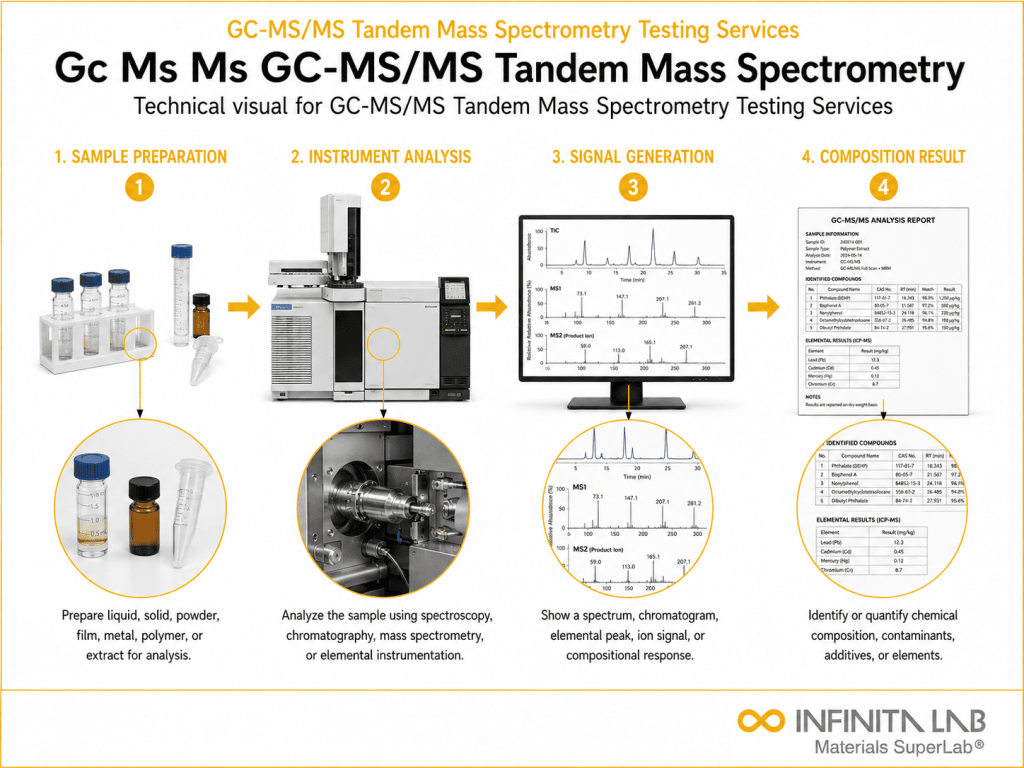


What Is GC MS MS Tandem Mass Spectrometry?
The analysis of the sample using Gas Chromatography-Tandem Mass Spectrometry (GC-MS-MS), a high-sensitivity technique, offers the advantages of compound identification, selectivity, and trace-level quantification that cannot be achieved with conventional GC-MS. The GC-MS-MS analysis offers chemists, researchers, and failure analysts definitive identification and ultra-trace quantitative concentration information for compounds in complex matrices, contamination analysis, and critical material characterization programs, which cannot be achieved with conventional single-stage mass spectrometry.
Applications and Benefits of GC MS MS Tandem Mass Spectrometry Testing
Scope
GC-MS-MS uses its gas chromatographic column to separate complex sample mixtures, then subjects individual compounds to two steps of mass spectrometric analysis: precursor ion selection and fragmentation, followed by product ion analysis, thereby offering higher specificity and sensitivity for measuring and identifying target compounds in complex, highly interfering sample matrices.
GC-MS-MS analysis evaluates:
- Ultra-trace level detection and quantification of volatile and semi-volatile organic compounds in complex matrices
- Target compound confirmation through precursor ion selection and product ion fragmentation pattern analysis
- Residual solvent, pesticide, and contaminant analysis in polymer, food, and pharmaceutical matrices
- Unknown compound identification in high-interference sample matrices where single-stage GC-MS is insufficient
- Trace-level emissions and outgassing compound analysis of materials and assembled components
Applications
- Polymer, adhesive, and coating materials requiring ultra-trace residual solvent and outgassing analysis
- Food and beverage contaminant screening requiring high-sensitivity pesticide and adulterant detection
- Pharmaceutical and chemical formulation impurity analysis at sub-trace concentration levels
- Environmental sample analysis for ultra-trace volatile organic compound detection and quantification
- Forensic and failure analysis investigations requiring highly selective unknown compound identification
Benefits
- Delivers superior analytical sensitivity and selectivity beyond conventional single-stage GC-MS capability
- Identifies and quantifies ultra-trace compounds in complex, high-interference sample matrices
- Provides enhanced compound confirmation through dual-stage fragmentation pattern analysis
- Delivers traceable, laboratory-certified analytical data
- Reduces analytical risk by eliminating matrix interference false positives through tandem MS selectivity
Our Testing Procedure
Sample Preparation
Samples extracted, diluted, or headspace-prepared for GC-MS-MS injection and analysis.
1GC Separation
Sample injected and compounds separated across capillary column under defined temperature program.
2Tandem Mass Spectrometric Detection
Compounds undergo precursor ion selection, collision fragmentation, and product ion detection.
3Data Analysis & Reporting
Tandem mass spectral data processed to generate compound identification and concentration results.
4Test parameters and requirements
| Parameter | Details |
|---|---|
| Applicable Samples | Polymers, adhesives, food, pharmaceuticals, environmental samples, chemical formulations |
| Analytical Technique | Gas chromatography with dual-stage tandem mass spectrometric detection |
| Detection Capability | Ultra-trace compound detection at sub-parts-per-billion concentration levels |
| Measured Parameters | Precursor ion, product ion fragmentation, retention time, concentration |
| Measured Outputs | Chromatograms, tandem mass spectra, concentration data, test compliance result |


- Calibrated GC-MS-MS system with capillary column separation and triple quadrupole or ion trap tandem mass spectrometric detection
- Headspace, liquid injection, and solid-phase microextraction sample introduction systems
- Reference standards for compound identification and quantitative calibration
- Mass spectral library databases for unknown compound identification and matching
- Specialist chromatographic and tandem MS data acquisition and processing software
- Sample preparation equipment for extraction, dilution, and concentration procedures
Equipment and Instrumentation Used for Testing
What You Receive: Test Report, Data, and Certification
- GC-MS-MS chromatograms with compound identification and retention time data
- Precursor and product ion mass spectral data confirming compound identity
- Ultra-trace quantitative concentration results for target analytes across all analyzed samples
- Test compliance result
GC MS MS Tandem Mass Spectrometry FAQs
GC-MS-MS offers the advantage of combining separation via gas chromatography with dual-stage tandem mass spectrometric detection, thereby providing better compound identification, selectivity, and ultra-trace quantification for complex, high-interference sample matrices beyond conventional GC-MS instrumentation.
GC-MS-MS involves two successive steps of mass spectrometric analysis: precursor ion selection and fragmentation, followed by product ion detection. This approach offers increased sensitivity, specificity, and matrix suppression compared to traditional GC-MS-based compound detection and identification techniques.
GC-MS-MS is used to analyze polymers, adhesives, food and beverage products, pharmaceuticals, environmental samples, and chemical formulations, which require ultra-trace compound identification and quantitative concentration data in complex sample matrices of solids, liquids, and gases.
GC-MS-MS is used to detect ultra-trace levels of volatile and semi-volatile organic compounds, including residual solvents, pesticides, impurities, and unknowns in high-interference matrices where conventional GC-MS sensitivity and/or specificity are inadequate.
GC-MS-MS is employed in the polymer, pharmaceutical, food and beverage, environmental, forensic, aerospace, automotive, and chemical manufacturing industries for ultra-trace material characterization, contamination investigations, and failure analysis programs that require high levels of analytical sensitivity and selectivity.
Tandem mass spectrometry (MS/MS) is an analytical technique used to identify and quantify chemical compounds with high sensitivity and selectivity. The sample is first ionized to produce charged molecules, which are separated according to their mass-to-charge ratio (m/z). A selected precursor ion is then fragmented inside a collision cell, typically through collision-induced dissociation (CID). The resulting product ions are analyzed by a second mass analyzer to generate a fragmentation pattern. This information helps confirm molecular identity, determine chemical structures, and measure target compounds in complex samples.
Gas chromatography-tandem mass spectrometry (GC-MS/MS) combines gas chromatography with two stages of mass spectrometry to identify and quantify volatile and semi-volatile compounds. The sample is vaporized and separated into individual components by a gas chromatography column. As each compound enters the mass spectrometer, it is ionized, and a selected precursor ion is isolated by the first mass analyzer. The precursor ion is fragmented in a collision cell, and the resulting product ions are separated and detected by the second mass analyzer. This process provides selective compound identification and sensitive quantification, particularly in complex sample matrices.
A mass spectrometry detector in gas chromatography identifies and measures compounds separated by the GC column. As each compound exits the column, it enters the mass spectrometer's ion source, where it is ionized, commonly through electron ionization (EI). The generated ions are separated according to their mass-to-charge ratios (m/z) using a mass analyzer, such as a quadrupole. A detector, often an electron multiplier, converts the arriving ions into electrical signals that are processed into mass spectra. These spectra provide molecular fragmentation patterns for compound identification, while signal intensity and calibration support quantitative analysis.
Why Choose Infinita Lab for GC MS MS Tandem Mass Spectrometry Testing
When your GC MS MS Tandem Mass Spectrometry results have to hold up - for compliance, a customer audit, or an engineering decision - accuracy and an unbiased third-party report matter more than price. Infinita Lab routes your GC MS MS tandem mass spectrometry testing to ISO/IEC 17025-accredited U.S. partner labs with hands-on method experience, so you get defensible data, transparent reporting, and turnaround times built around your project deadline - not ours.

Looking for an Accredited Partner for GC MS MS Tandem Mass Spectrometry Testing?
Send query us at hello@infinitalab.com or call us at (888) 878-3090 to learn more about our services and how we can support you.