


Gas Chromatography Analysis Testing Services
Gas Chromatography (GC), also known as Vapor-Phase Chromatography (VPC) or Gas-Liquid Partition Chromatography (GLPC), is a type of chromatography technique used to analyze specimens that can be vaporized without decomposition.
TRUSTED BY


Get compliant results — request your gas chromatography analysis testing quote
- Overview
- Scope, Applications, and Benefits
- Test Process
- Specifications
- Instrumentation
- Results and Deliverables
What Is Gas Chromatography Analysis?
Gas chromatography (GC) – also known as vapor-phase chromatography or gas-liquid partition chromatography – is an analytical technique used to separate, identify, and quantify the individual components of a mixture that can be vaporized without decomposing. It is one of the most widely used techniques in analytical chemistry for volatile and semi-volatile compounds, valued for its high resolution, sensitivity, and ability to handle complex multi-component samples.
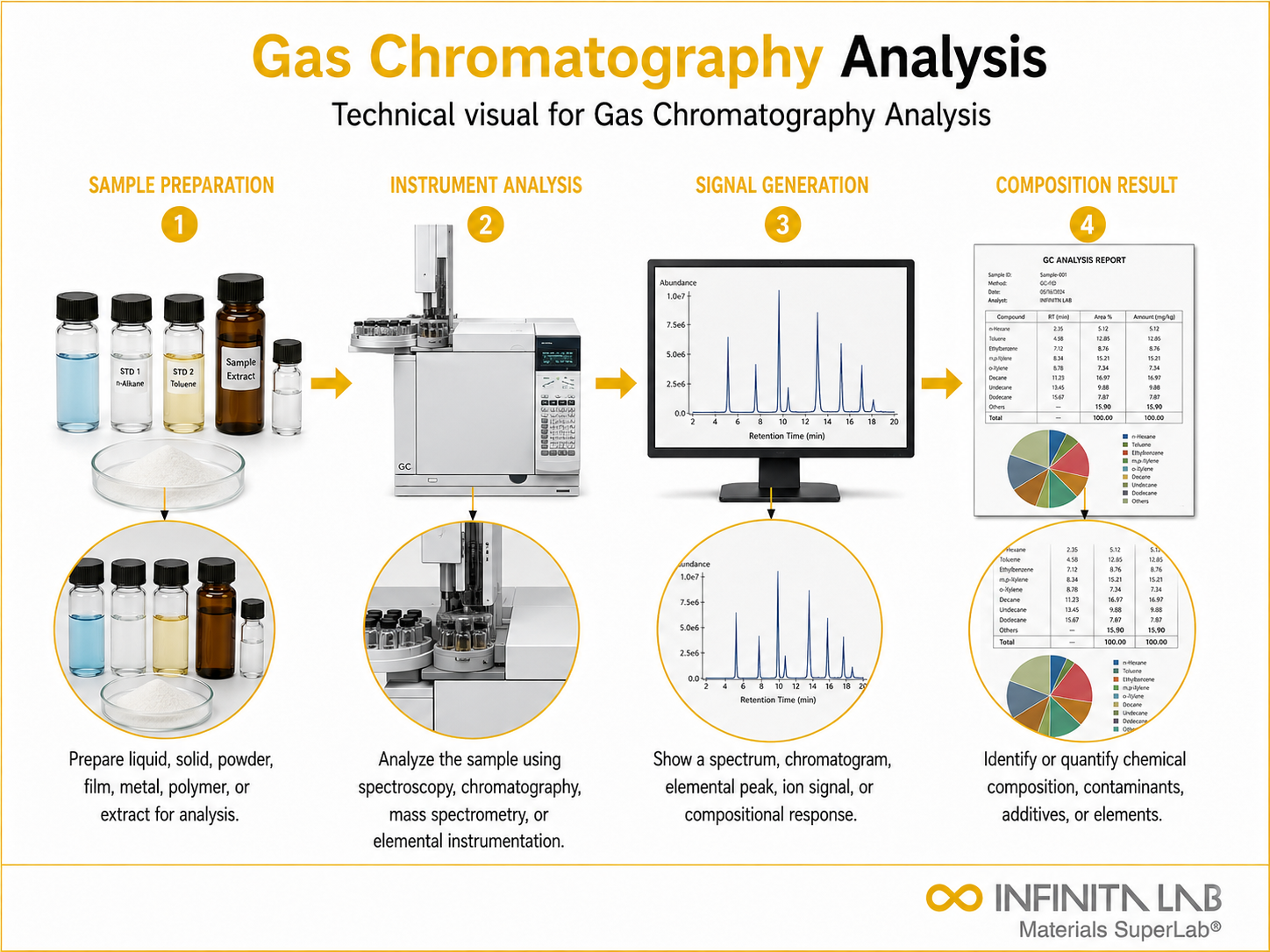
The technique works by vaporizing the sample and carrying it through a long, narrow column using an inert carrier gas (the mobile phase, typically helium, nitrogen, or hydrogen). Inside the column, a stationary phase interacts with each compound to a different degree, causing the components to travel at different speeds and separate. As each separated component exits the column, it reaches a detector that produces a signal proportional to its quantity, generating a chromatogram of peaks that represent the compounds in the sample.
Gas chromatography is used across the chemical, polymer, environmental, pharmaceutical, food, and petrochemical industries for purity analysis, impurity profiling, residual solvent determination, volatile organic compound (VOC) analysis, and composition verification. It is frequently coupled with mass spectrometry (GC-MS) when identification of unknown compounds is required, and with specialized detectors selected to match the analytes of interest.

Applications and Benefits of Gas Chromatography Analysis Testing
Scope
Gas chromatography covers the separation and quantification of volatile and semi-volatile compounds in gas, liquid, and (via headspace or thermal desorption) solid samples. The configuration – injection mode, column, detector, and method conditions – is selected based on the analytes and the matrix.
Key aspects of the technique include:
- Detectors – flame ionization detection (FID) for organic compounds, thermal conductivity detection (TCD) for general use and fixed gases, electron capture detection (ECD) for halogenated compounds, and mass spectrometry (GC-MS) for compound identification, among others
- Injection and sampling modes – direct liquid injection, headspace sampling for volatiles in complex matrices, purge-and-trap, and thermal desorption depending on the sample
- Column types – capillary columns of various stationary-phase chemistries selected to resolve the target compounds
- Analyte classes – VOCs, residual solvents, hydrocarbons, fatty acid methyl esters (FAMEs), residual monomers, fragrance and flavor compounds, and other volatile/semi-volatile species
- Quantification – external standard, internal standard, and standard addition approaches against calibration standards
- Applicable methods – numerous ASTM, USP, EPA, and ISO methods specify GC for particular analytes and matrices
Applications
- Purity and composition analysis – determining the purity of chemicals and solvents and quantifying the components of a mixture for quality control and specification verification
- Residual solvent analysis – measuring residual solvents in pharmaceuticals, polymers, and finished products, often by headspace GC (e.g., per USP <467>)
- Volatile organic compound (VOC) analysis – identifying and quantifying VOCs in materials, products, environmental samples, and emissions
- Petrochemical and fuel analysis – composition, hydrocarbon profiling, and purity determination of fuels, solvents, and petrochemical streams
- Polymer and plastics analysis – residual monomer determination, additive analysis, and outgassing/volatile content studies on polymer materials
- Food, flavor, and fragrance analysis – characterization of flavor and aroma compounds, fatty acid profiles, and volatile contaminants in food and consumer products
- Environmental testing – analysis of organic contaminants in water, soil, and air following established EPA and ISO GC methods
- Impurity and unknown identification – using GC-MS to identify unknown volatile compounds and characterize impurity profiles
Benefits
- High separation power for complex mixtures – GC resolves many components in a single run, making it well suited to samples containing numerous volatile compounds that other techniques cannot separate as cleanly
- High sensitivity and low detection limits – depending on the detector, GC can quantify analytes down to trace (ppb) levels, suitable for residual solvent, VOC, and contaminant analysis
- Flexible detector and sampling options – the technique can be tailored to the analyte and matrix by selecting the appropriate detector (FID, TCD, ECD, MS) and sampling mode (direct, headspace, purge-and-trap)
- Compound identification with GC-MS – coupling GC with mass spectrometry allows not just quantification but confident identification of unknown compounds, which is essential for impurity and contaminant investigations
- Backed by established standard methods – a large body of ASTM, USP, EPA, and ISO methods specify GC, so analyses can be run to recognized methods appropriate to the industry and application
Our Testing Procedure
Prepare the Sample
Dilute, extract, or place the sample in a headspace vial and select the appropriate introduction method.
1Set Up and Calibrate
Configure the GC column, temperature, gas flow, injector, and detector, then run calibration standards.
2Analyse the Sample
Inject the sample, separate its components, and record the resulting chromatogram.
3Identify and Report
Identify and quantify the compounds, then report concentrations, chromatograms, and test conditions.
4Test parameters and requirements
| Parameter | Details |
|---|---|
| Detectors | FID, TCD, ECD, MS (and others as required) |
| Sampling Modes | Direct liquid injection, headspace, purge-and-trap, thermal desorption |
| Analyte Classes | VOCs, residual solvents, hydrocarbons, residual monomers, FAMEs, flavor/fragrance compounds |
| Sample Types | Gases, liquids, and solids (via headspace/desorption) |
| Carrier Gas | Helium, nitrogen, or hydrogen |
| Quantification | External standard, internal standard, standard addition |
| Detection Range | Down to trace (ppb) levels, detector-dependent |


- Gas chromatograph with programmable temperature oven
- Detectors: FID, TCD, ECD, and mass spectrometer (GC-MS)
- Automated headspace sampler and/or purge-and-trap system
- Autosampler for liquid injection
- Capillary GC columns of various stationary phases
- Carrier gas supply and gas management system
- Data acquisition and chromatography analysis software
Equipment and Instrumentation Used for Testing
What You Receive: Test Report, Data, and Certification
- GC analysis report – identified compounds and their concentrations or composition percentages, with the method and detector documented
- Chromatograms – annotated chromatograms showing the separated peaks for samples and standards
- Calibration data – calibration standards and curve used for quantification, confirming the analytical range
- Compound identification (GC-MS) – mass spectral identification of compounds where GC-MS was used, with library match information
- Comparison against specification (where provided) – measured results tabulated against the applicable limits with pass/fail notation
- Sample and method records – sample description, preparation, injection mode, and instrument conditions used
Gas Chromatography Analysis FAQs
The sample is vaporised and carried through a separation column by an inert carrier gas. Different compounds travel through the column at different rates and are detected as they exit.
GC is suitable for gases, liquids and materials containing compounds that can be vaporised without decomposing. Common samples include solvents, fuels, fragrances, polymers, pharmaceuticals and environmental extracts.
Retention time is the time taken for a compound to pass through the column and reach the detector. It can help identify a substance by comparison with a known reference standard.
Common detectors include flame ionisation detectors, thermal conductivity detectors and electron capture detectors. Gas chromatography may also be combined with mass spectrometry for more precise identification.
GC separates the compounds present in a sample, while mass spectrometry provides information about their molecular structure and mass. GC-MS offers stronger compound identification than GC with a conventional detector.
Why Choose Infinita Lab for Gas Chromatography Analysis Testing?
At the core of this breadth is our network of 2,000+ accredited laboratories across the USA, offering access to over 10,000 testing methods and analytical services. From advanced materials characterization (SEM, TEM, RBS, XPS) to mechanical, chemical, environmental, biological, and standardized ASTM/ISO-compliant testing, we deliver unmatched flexibility, specialization, and scale. You are never limited by geography, facility, or methodology — Infinita Lab connects you to the right expertise and testing solution, every time.

Looking for an Accredited Partner for Gas Chromatography Analysis Testing?
Send query us at hello@infinitalab.com or call us at (888) 878-3090 to learn more about our services and how we can support you.



Request a Quote
Submit your material details and receive testing procedures, pricing, and turnaround time within 24 hours.
 Quick Turnaround and Hasslefree process
 Confidentiality Guarantee
 Free, No-obligation Consultation
 100% Customer Satisfaction
