


Foreign Material Analysis Testing Services
The act of identifying and analyzing elements or chemicals that are not supposed to be present in a certain sample or product is known as foreign material analysis (FMA). This is applicable to many different industries, including manufacturing, food processing, medicines, and many more. Foreign material analysis is essential in the food business since contaminants in food can injure consumers, impair a brand's reputation, and result in legal repercussions.
TRUSTED BY


Get compliant results — request your foreign material analysis testing quote
- Overview
- Scope, Applications, and Benefits
- Test Process
- Specifications
- Instrumentation
- Results and Deliverables
What Is Foreign Material Analysis?
Foreign material analysis (FMA) is the process of identifying, characterizing, and tracing contaminants or unexpected substances found in a product, material, or component. The foreign material could be anything that does not belong -a metal fragment in a food product, a fiber in a pharmaceutical tablet, a particle on a semiconductor wafer, a discoloration in a plastic part, or an unknown residue on a machined surface. Whatever the form, the objective is the same: figure out what it is, where it came from, and how it got there.
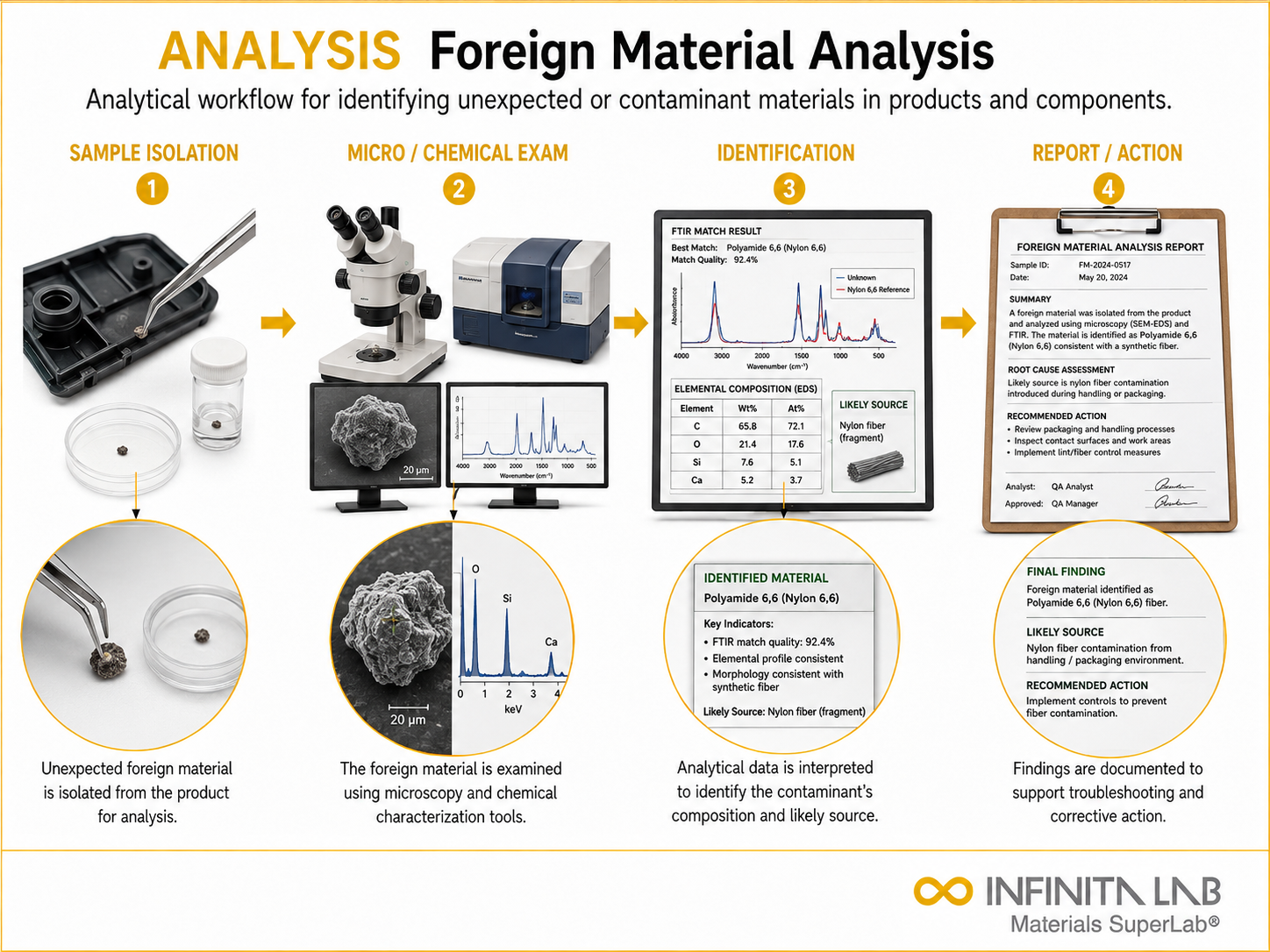
FMA is not a single test. It is an investigative workflow that draws on multiple analytical techniques, depending on the nature of the contamination and the substrate in which it was found. A particle might be characterized visually first under optical microscopy, then chemically by FTIR or Raman spectroscopy, and finally confirmed for elemental composition by SEM-EDS or XRF. The combination of techniques used depends on what information is needed -identity, origin, size, morphology, hardness, or all of the above.
At Infinita Lab, we coordinate foreign material analysis through our network of accredited labs, each equipped with the right instrumentation for the specific contaminant type and industry context. Whether the driver is a customer complaint, a manufacturing quality event, a product recall investigation, or an incoming raw material rejection, we connect you with the right analytical resources and help you reach a defensible answer efficiently.

Applications and Benefits of Foreign Material Analysis Testing
Scope
Foreign material analysis covers the identification and characterization of unexpected particles, inclusions, residues, discolorations, films, fibers, and other contaminants found in or on products, materials, components, or process streams. The scope spans physical characterization (size, shape, morphology, and hardness), chemical identification (polymer type, organic functional groups, and inorganic compounds), and elemental composition. Sample types include solids, powders, liquids, films, coatings, and surfaces across virtually all material classes. Analysis applies to both discrete particles and distributed contamination and can be performed on extracted contaminants or in situ on the host material. The analytical approach is tailored to the contamination scenario. There is no single standard method for FMA, and technique selection depends on the contaminant type, size, substrate, and the questions to be answered.
Applications
- Customer complaint and field return investigation for contaminated products
- Food, beverage, and pharmaceutical contaminant identification for safety and regulatory response
- Manufacturing quality event investigation -particles in process fluids, on machined surfaces, or in finished parts
- Semiconductor and electronics cleanliness monitoring -particles on wafers, PCBs, or optical components
- Incoming raw material rejection -identifying contaminants in resins, powders, films, or coatings
- Medical device and implant contamination characterization
- Automotive and aerospace component inclusion or surface defect identification
- Product liability and failure analysis support requiring traceable contaminant identification
Benefits
- Identifies contaminants that visual inspection alone cannot characterize
- Combines multiple techniques in a logical sequence to build a complete picture of the foreign material
- Provides evidence of contamination origin that supports corrective action and supplier accountability
- Applicable across all industries and material types -no contaminant category is out of scope
- Results are documented with images, spectra, and elemental data that stand up to technical and legal scrutiny
- Faster time to root cause compared to sending samples to multiple labs independently
- Access to specialized instrumentation -SEM, FTIR microscopy, Raman, XRF, ICP-MS -without owning the equipment
Foreign Material Analysis Process
Sample Receipt and Visual Examination
The sample is received, documented, and examined under low-magnification stereo or optical microscopy.
1Physical and Morphological Characterization
Higher-magnification imaging is performed using optical microscopy or scanning electron microscopy (SEM) to document particle morphology
2Chemical and Elemental Identification
The foreign material is characterized chemically using techniques matched to the contaminant type.
3Origin Assessment and Reporting
Findings from all characterization steps are compiled and interpreted to assess the probable identity and origin of the foreign material.
4Test parameters and requirements
| Parameter | Details |
|---|---|
| Service Type | Investigative analytical service -technique selection is customized to each case |
| Contaminant Types | Particles, fibers, films, residues, inclusions, discolorations, and biological matter |
| Sample Types | Solids, powders, liquids, films, coatings, surfaces -all material classes |
| Imaging Techniques | Stereo microscopy, optical microscopy, scanning electron microscopy (SEM) |
| Chemical ID Techniques | FTIR spectroscopy, FTIR microscopy, Raman spectroscopy |
| Elemental Analysis Techniques | SEM-EDS, XRF, ICP-MS, ICP-OES |
| Trace and Organic Analysis | GC-MS, LC-MS, and ion chromatography |


- Stereo microscope and optical microscope for visual examination and imaging
- Scanning electron microscope (SEM) with energy dispersive X-ray spectroscopy (EDS)
- FTIR spectrometer and FTIR microscope for organic and polymer identification
- Raman spectrometer for organic, inorganic, and carbon-based material identification
- X-ray fluorescence (XRF) spectrometer for non-destructive elemental screening
- ICP-MS and ICP-OES for trace elemental quantification from dissolved samples
- GC-MS for volatile and semi-volatile organic contaminant identification
- Ion chromatography for ionic contamination characterization
Equipment and Instrumentation Used for Testing
What You Receive: Test Report, Data, and Certification
- Identity of the foreign material -material class, chemical composition, or specific compound
- Elemental composition data with qualitative or quantitative results as applicable
- SEM and optical micrographs showing particle morphology and surface features
- FTIR or Raman spectra with library match results for organic materials
- Particle size and dimensional measurements
- Assessment of probable origin based on composition, morphology, and context
- Recommendations for corrective action or further investigation, where appropriate
- Full analytical report with all data, images, and methodology documented for quality and engineering review
Foreign Material Analysis FAQs
Foreign Material Analysis can identify a wide range of contaminants, including metals, polymers, glass, fibers, powders, corrosion products, residues, and unknown particulates using advanced analytical techniques.
Analysts compare the contaminant's physical and chemical characteristics with potential source materials from the manufacturing process, environment, or raw materials to help determine its origin.
It depends on the sample and investigation goals. Non-destructive techniques are typically used first, followed by destructive methods only if additional characterization is required.
Common techniques include optical microscopy, SEM/EDS, FTIR, Raman spectroscopy, XRF, and other methods selected based on the contaminant's size, composition, and suspected origin.
Providing details such as where the material was found, product information, process history, suspected contamination sources, and reference samples can significantly improve the accuracy and efficiency of the analysis.
Why Choose Infinita Lab for Foreign Material Analysis Testing
At the core of this breadth is our network of 2,000+ accredited laboratories across the USA, offering access to over 10,000 testing methods and analytical services. From advanced materials characterization (SEM, TEM, RBS, XPS) to mechanical, chemical, environmental, biological, and standardized ASTM/ISO-compliant testing, we deliver unmatched flexibility, specialization, and scale. You are never limited by geography, facility, or methodology — Infinita Lab connects you to the right expertise and testing solution, every time.

Looking for an Accredited Partner for Foreign Material Analysis Testing?
Send query us at hello@infinitalab.com or call us at (888) 878-3090 to learn more about our services and how we can support you.



Request a Quote
Submit your material details and receive testing procedures, pricing, and turnaround time within 24 hours.
 Quick Turnaround and Hasslefree process
 Confidentiality Guarantee
 Free, No-obligation Consultation
 100% Customer Satisfaction
