


Failure Mode Mechanism Analysis Testing Services
Failure mode and mechanism analysis is a critical process in engineering to identify the root causes of component or system failures.
TRUSTED BY


Get compliant results — request your failure mode mechanism analysis testing quote
- Overview
- Scope, Applications, and Benefits
- Test Process
- Specifications
- Instrumentation
- Results and Deliverables
What Is Failure Mode Mechanism Analysis?
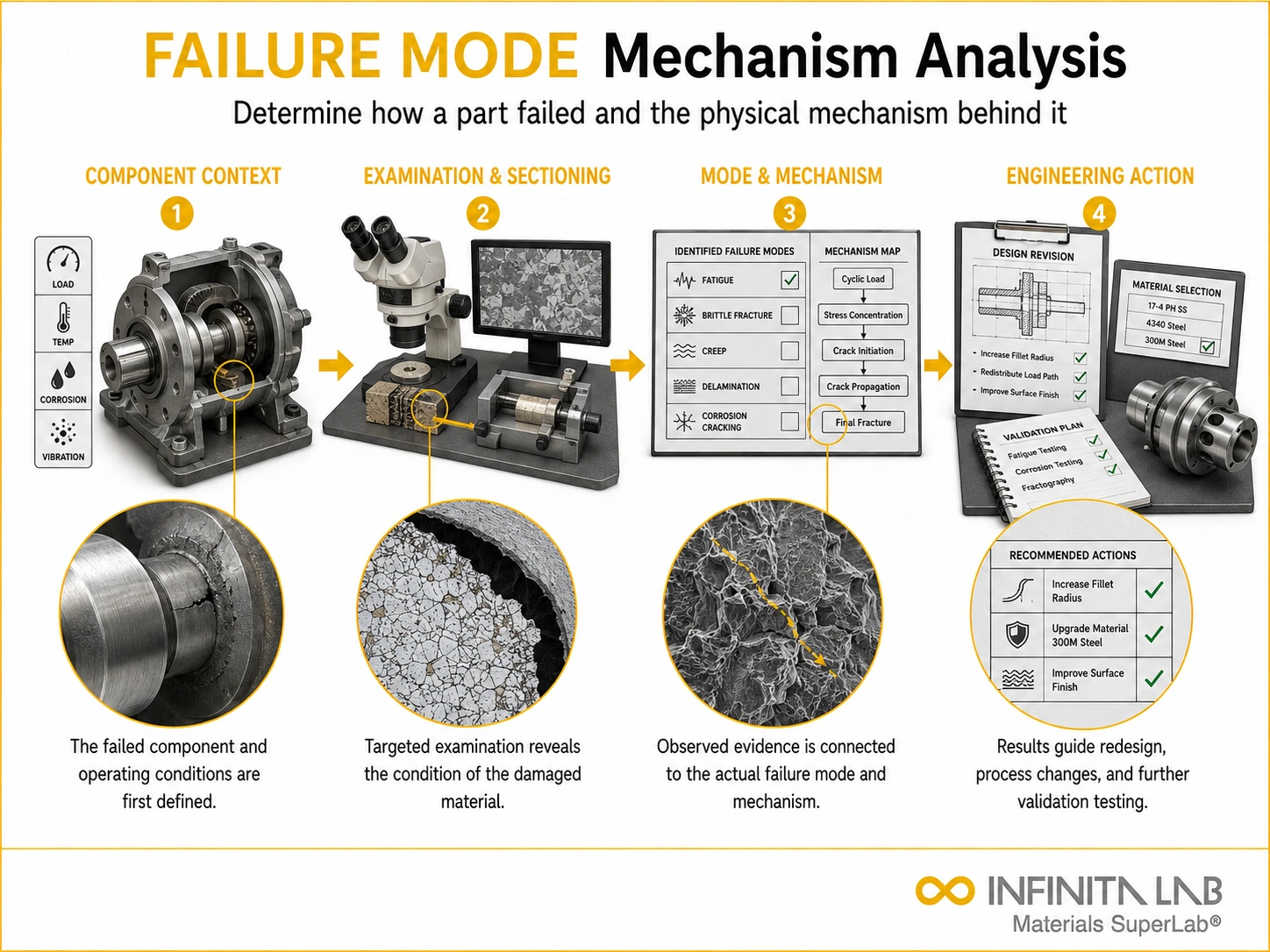
Failure mode and mechanism analysis is a systematic investigation into why a material, component, or assembly failed to perform its intended function. The goal is to identify both the mode of failure – what physically happened, such as fracture, delamination, or corrosion – and the underlying mechanism that drove it, such as fatigue crack propagation, stress corrosion, or thermal degradation. Understanding both is necessary to determine root cause and implement effective corrective actions.
The analysis begins with a macroscopic examination of the failed part to characterize the failure location, fracture surface morphology, and any visible anomalies. This is followed by progressively higher-magnification investigation using optical microscopy, scanning electron microscopy (SEM), and where needed, energy-dispersive X-ray spectroscopy (EDS) or other analytical techniques to identify chemical species, corrosion products, or contamination at the failure site.
Failure mode and mechanism analysis applies across industries wherever components are returned from the field, fail during qualification testing, or are flagged in production. The output is a technically defensible explanation of what failed and why – grounded in physical evidence rather than assumption – which supports engineering redesign, supplier corrective actions, warranty decisions, and litigation support.

Applications and Benefits of Failure Mode Mechanism Analysis Testing
Scope
Failure mode and mechanism analysis applies to metallic, polymeric, ceramic, composite, and electronic materials and components. The scope of each investigation is defined by the failure evidence available and the information needed to determine root cause. Analysis typically encompasses:
- Macroscopic examination of fracture surfaces, deformation patterns, and failure location
- Microscopic characterization of crack initiation sites and propagation paths
- Chemical analysis of corrosion products, contaminants, or unexpected phases
- Mechanical property evaluation to assess whether material met original specification
- Comparison of failed component microstructure against specification requirements
- Assessment of manufacturing, processing, or assembly contributions to failure
Applications
- Field return and warranty failure investigation
- Qualification test failure root cause determination
- Production defect investigation and corrective action support
- Supplier quality disputes and incoming material rejection analysis
- Litigation and insurance claim support
- Design improvement through understanding of in-service failure modes
Benefits
- Provides physical evidence-based root cause rather than speculation
- Identifies whether failure is due to design, material, processing, or service conditions
- Supports targeted corrective actions rather than broad process changes
- Generates defensible documentation for customer, supplier, or legal review
- Prevents recurrence by addressing the actual failure mechanism
- Applicable across all material classes and component types
Our Testing Procedure
Receipt and Macroscopic Examination
The failed component is received, documented photographically, and examined at low magnification
1Sectioning and Sample Preparation
Relevant sections are extracted from the failure site and prepared for microscopic and analytical examination
2Microscopic and Chemical Analysis
SEM, optical microscopy, EDS, and other analytical techniques are applied to characterize the fracture surface, crack morphology
3Root Cause Determination and Reporting
All evidence is synthesized to identify the failure mode and mechanism.
4Failure Mode & Mechanism Analysis Technical Specifications
| Parameter | Details |
|---|---|
| Applicable Materials | Metals, polymers, ceramics, composites, electronic assemblies |
| Primary Examination Tools | Optical microscopy, SEM, EDS, cross-section metallography |
| Supporting Techniques | XRF, FTIR, hardness testing, tensile testing as required |
| Deliverable | Formal failure analysis report with root cause conclusion |
| Turnaround | Defined at project initiation based on scope and technique requirements |
| Report Format | Technical narrative with photographic evidence and analytical data |


- Scanning electron microscope (SEM) with EDS capability
- Optical metallurgical microscope
- Precision sectioning and specimen preparation equipment
- Hardness testing system for mechanical property verification
- FTIR spectrometer for polymer and organic material identification
- XRF analyzer for elemental composition screening
Instrumentation Used for Failure Mode & Mechanism Analysis
What You Receive: Test Report, Data, and Certification
- Photographic documentation of failure location and fracture surfaces
- Microscopic images of crack initiation and propagation features
- Chemical analysis data for identified species at the failure site
- Root cause conclusion with supporting physical evidence
- Corrective action recommendations
- Quality assurance documentation
Failure Mode Mechanism Analysis FAQs
FMMA identifies how a product failed (failure mode) and the underlying physical, chemical, or mechanical cause of that failure (failure mechanism). This helps organizations implement effective corrective and preventive actions.
While standard failure analysis focuses on identifying the cause of a specific failure, FMMA goes further by linking the observed failure mode to the root failure mechanism and evaluating its impact on product reliability and performance.
FMMA can be applied to a wide range of products, including electronic components, semiconductors, medical devices, automotive parts, aerospace components, polymers, and industrial materials.
Depending on the failure, FMMA may involve microscopy, cross-sectioning, chemical analysis, electrical testing, thermal analysis, mechanical testing, and imaging techniques to determine the root failure mechanism.
Why Choose Infinita Lab for Failure Mode Mechanism Analysis Testing
At the core of this breadth is our network of 2,000+ accredited laboratories across the USA, offering access to over 10,000 testing methods and analytical services. From advanced materials characterization (SEM, TEM, RBS, XPS) to mechanical, chemical, environmental, biological, and standardized ASTM/ISO-compliant testing, we deliver unmatched flexibility, specialization, and scale. You are never limited by geography, facility, or methodology — Infinita Lab connects you to the right expertise and testing solution, every time.

Looking for an Accredited Partner for Failure Mode Mechanism Analysis Testing?
Send query us at hello@infinitalab.com or call us at (888) 878-3090 to learn more about our services and how we can support you.



Request a Quote
Submit your material details and receive testing procedures, pricing, and turnaround time within 24 hours.
 Quick Turnaround and Hasslefree process
 Confidentiality Guarantee
 Free, No-obligation Consultation
 100% Customer Satisfaction
