


Force Calibration Testing Services
Dynamometers, Load Cell Calibration And More Devices used in force measurement applications can be trusted to reliably give the performance that is required when they undergo precise force calibration regularly. The force calibration services you require to keep your equipment in top functioning order can be obtained from Infinite Lab.
TRUSTED BY


Get compliant results — request your force calibration testing quote
- Overview
- Scope, Applications, and Benefits
- Test Process
- Specifications
- Instrumentation
- Results and Deliverables
What Is Force Calibration?
Force calibration is the process of verifying and establishing the accuracy of a force measurement instrument -a load cell, force gauge, tension/compression tester, or dynamometer -by comparing its output against a reference standard of known and traceable accuracy. A force measuring instrument that has not been recently calibrated may read incorrectly, and any test data generated with it is unreliable. For materials testing, structural testing, production process control, and any application where a force measurement is used to make a pass/fail decision or generate a specification-referenced result, calibration is not optional.
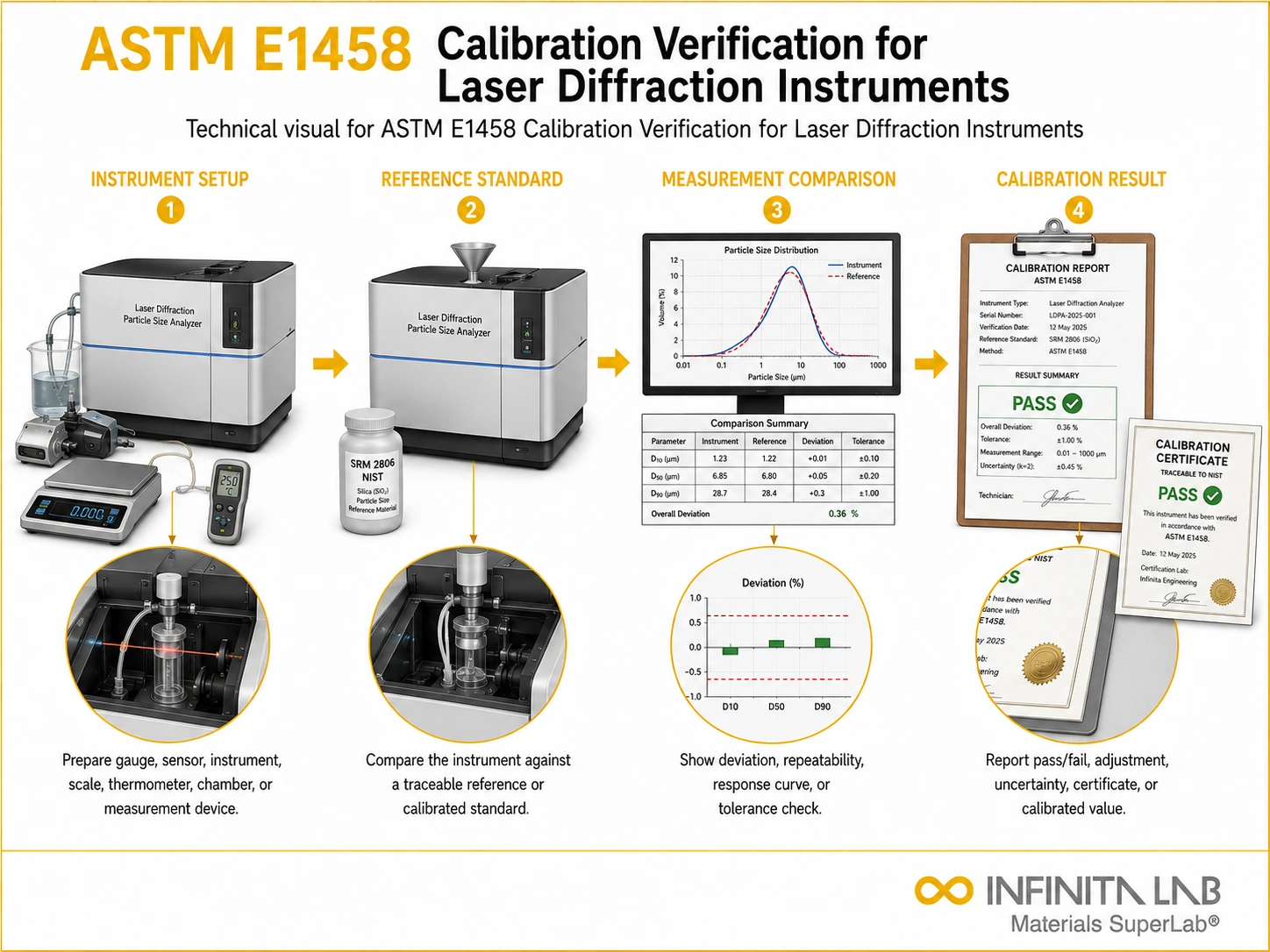
Calibration is performed by applying known forces to the instrument under test and comparing its indicated value to the applied reference force. The reference standards -typically a deadweight machine, hydraulic force standard, or comparison load cell -are themselves traceable to national metrology institute standards through an unbroken chain of calibration. The result of calibration is a calibration report that documents the instrument’s error at each test point, its measurement uncertainty, and whether it meets the accuracy specification required for its intended use.
Force calibration services cover instruments across a wide dynamic range -from small-force gauges in the millinewton range used in medical device and electronics testing to large load cells and structural test frames rated to several meganewtons. The applicable standards include ISO 376 for force transducer calibration, ASTM E74 for calibration of force-measuring instruments, and ASTM E4 for force verification of testing machines.

Applications and Benefits of Force Calibration Testing
Scope
Force calibration services cover the calibration and verification of force measuring instruments including load cells, force gauges, force transducers, proving rings, dynamometers, and tension/compression testing machines. Calibration is performed per ASTM E74 (force-measuring instruments), ASTM E4 (testing machine force verification), or ISO 376 (force transducers) as applicable to the instrument type and the requirements of the client’s quality system or product specification. Calibration is performed in tension, compression, or both directions depending on the instrument configuration. Traceable calibration certificates referencing national metrology institute standards are issued with each calibration. Instruments that fail to meet the accuracy specification are identified and returned with documentation of the out-of-tolerance condition.
Applications
- Load cell and force transducer calibration for materials testing machines and structural test frames
- Handheld force gauge calibration for production line pull, push, and insertion force testing
- Proving ring and reference force standard calibration for secondary laboratory standards
- Testing machine force verification per ASTM E4 for universal testing machines, fatigue frames, and hardness testers
- Medical device force testing instrument calibration for catheter pull force, suture strength, and implant testing
- Torque wrench and rotary torque transducer calibration for assembly process control
- Aerospace and defense force measurement calibration for structural test programs
- Annual calibration program management for manufacturing and testing facilities
Benefits
- Traceable calibration chain to national standards (NIST in the US) ensures defensible, accepted data
- Covers the full force range from millinewton to meganewton instrument classes
- Calibration to ASTM E74, ASTM E4, or ISO 376 satisfies requirements of most quality management systems and product standards
- Identifies instruments that have drifted out of tolerance before they generate nonconforming test data
- Calibration certificates suitable for ISO 9001, AS9100, ISO/IEC 17025, and NADCAP quality system requirements
- Turnaround options available for critical instruments needed quickly
- On-site calibration available for large or installed test frames that cannot be moved
Our Testing Procedure
Pre-Calibration Inspection and Documentation
The instrument is inspected for physical condition, range, resolution, and any damage that would affect calibration validity.
1Reference Standard Setup
The calibration reference -deadweight machine, hydraulic force standard, or reference-grade load cell
2Force Application and Data Recording
Known forces are applied to the instrument under test in ascending and descending steps covering the calibration range.
3Data Analysis, Certificate Issuance, and Labeling
The instrument's error at each calibration point is calculated.
4Test parameters and requirements
| Parameter | Details |
|---|---|
| Service Type | Calibration service -force measurement instruments |
| Applicable Standards | ASTM E74 (force-measuring instruments), ASTM E4 (testing machine verification), ISO 376 (force transducers) |
| Traceability | Calibration chain traceable to NIST (US) or other national metrology institute |
| Instrument Types | Load cells, force gauges, proving rings, dynamometers, testing machines, torque transducers |
| Force Range | Millinewton to meganewton range depending on lab capability |
| Calibration Directions | Tension, compression, or both as required by instrument design and use |


- Deadweight force machine traceable to national standards for primary calibration
- Hydraulic force standard or transfer standard load cells for large-range calibration
- Reference proving rings and reference load cells for comparison calibration
- Precision signal conditioning and readout electronics for instrument output measurement
- Temperature-controlled calibration environment for stability during measurement
Equipment and Instrumentation Used for Testing
What You Receive: Test Report, Data, and Certification
- Calibration certificate with applied reference forces, instrument indicated values, and errors at each calibration point
- Measurement uncertainty statement per the applicable calibration standard
- Pass/fail assessment against the instrument accuracy specification or classification limit
- Calibration due date based on the calibration interval specified by the quality system or standard
- Out-of-tolerance notification and documentation where the instrument fails to meet specification
- Calibration label affixed to the instrument
- Calibration record for traceability in the client’s quality management system
Force Calibration FAQs
Regular calibration ensures force-measuring equipment provides accurate and traceable results, helping maintain product quality, comply with industry standards, and reduce measurement uncertainty.
Force calibration is commonly performed on load cells, force gauges, testing machines, torque-to-force systems, and other equipment used to measure tensile or compressive forces.
Calibration frequency depends on factors such as usage, operating environment, manufacturer recommendations, and quality system requirements. Annual calibration is common, though heavily used equipment may require more frequent verification.
Yes. Accredited calibration laboratories perform force calibration using reference standards that are traceable to national or international metrology institutes, ensuring reliable and comparable measurement results.
Why Choose Infinita Lab for Force Calibration Testing?
At the core of this breadth is our network of 2,000+ accredited laboratories across the USA, offering access to over 10,000 testing methods and analytical services. From advanced materials characterization (SEM, TEM, RBS, XPS) to mechanical, chemical, environmental, biological, and standardized ASTM/ISO-compliant testing, we deliver unmatched flexibility, specialization, and scale. You are never limited by geography, facility, or methodology — Infinita Lab connects you to the right expertise and testing solution, every time.

Looking for an Accredited Partner for Force Calibration Testing?
Send query us at hello@infinitalab.com or call us at (888) 878-3090 to learn more about our services and how we can support you.



Request a Quote
Submit your material details and receive testing procedures, pricing, and turnaround time within 24 hours.
 Quick Turnaround and Hasslefree process
 Confidentiality Guarantee
 Free, No-obligation Consultation
 100% Customer Satisfaction
