


Flow Calibration Testing Services
The process of confirming or modifying a fluid's flow rate through a flow metre or other flow measurement instrument is known as flow calibration. To make sure the flow measurement instrument is accurately measuring the flow rate of the fluid going through it, flow calibration is done.
TRUSTED BY


Get compliant results — request your flow calibration testing quote
- Overview
- Scope, Applications, and Benefits
- Test Process
- Specifications
- Instrumentation
- Results and Deliverables
What Is Flow Calibration?
Flow calibration is the process of comparing the output of a flow measurement device — flowmeter, flow controller, or flow transmitter — against a traceable reference standard to determine its accuracy, correct for systematic errors, and issue a calibration certificate with stated uncertainty.
Accurate flow measurement is critical in process industries, pharmaceuticals, environmental monitoring, and energy management. Regular calibration ensures that flow instruments deliver reliable, defensible measurement data that meets quality management system requirements and regulatory standards.

Applications and Benefits of Flow Calibration Testing
Scope
Flow calibration ensures the accurate measurement and control of liquid and gas flow rates across a wide range of industrial and laboratory applications. It includes both volumetric and mass flow calibration to verify instrument performance, maintain process efficiency, and support compliance with quality standards.
Our flow calibration services cover:
- Volumetric and mass flow calibration for both liquids and gases
- Calibration of Coriolis, turbine, ultrasonic, electromagnetic, and Rotameter flowmeters
- Flow controllers and mass flow controllers (MFCs) for precise flow regulation
- Multi-point calibration across the full operating range to ensure accuracy at different flow conditions
- Both on-site and laboratory calibration services based on operational requirements
Applications
- Process industry flow measurement QA
- Environmental emissions monitoring
- Custody transfer meters (fiscal metering)
- HVAC and building management system flow sensors
Benefits
- Ensures measurement accuracy and process repeatability
- Supports ISO 9001/GMP quality management system compliance
- Provides traceable, UKAS/NIST-referenced calibration certificates
- Identifies meter drift and out-of-tolerance conditions
- Reduces process waste and product quality variability
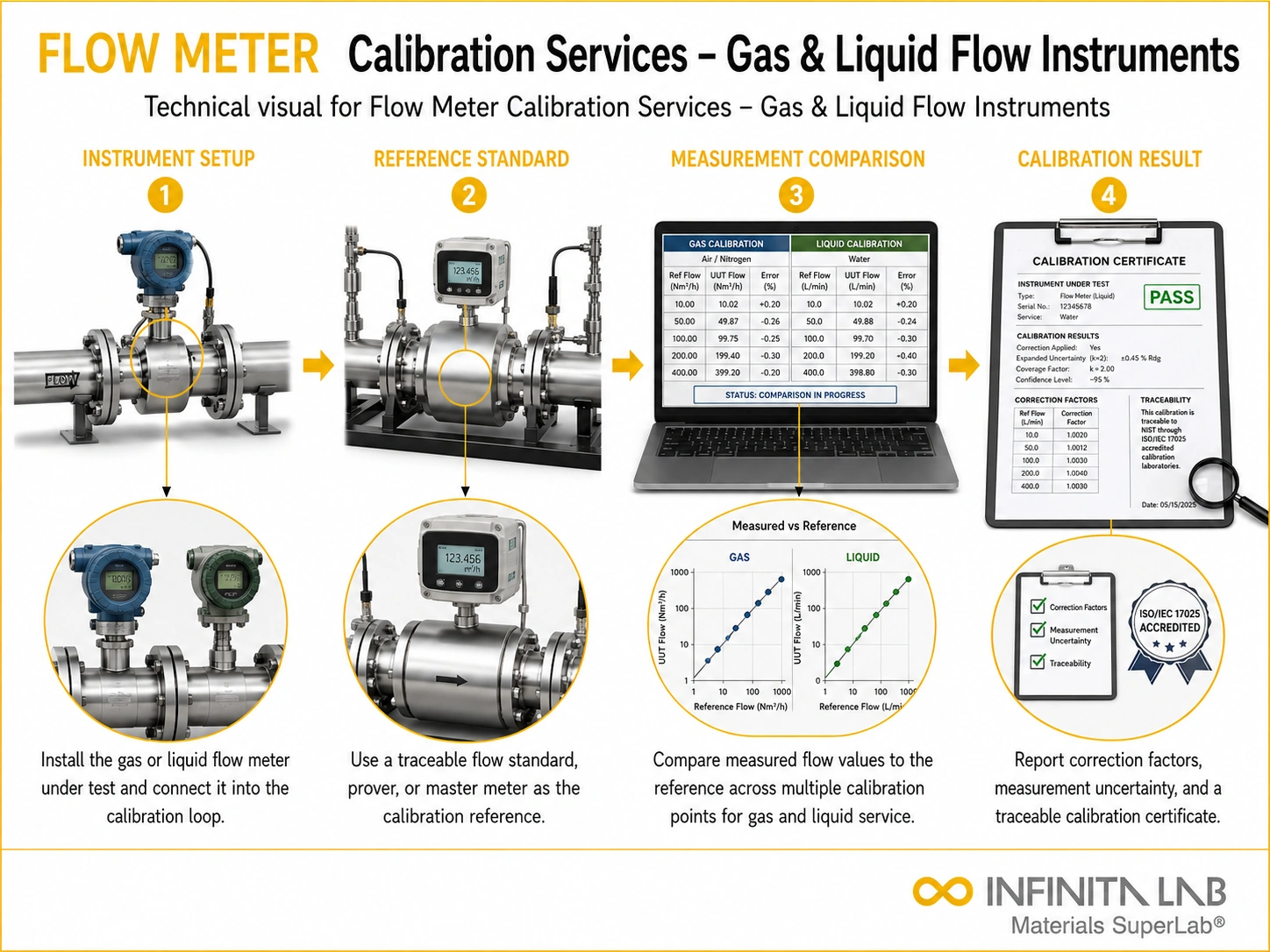
Our Testing Procedure
Pre-Calibration Inspection
Instrument is inspected, baseline readings are recorded, and calibration history is reviewed.
1Reference Setup
A traceable reference standard is connected in series.
2Multi-Point Calibration
Readings are checked at multiple flow points and errors are recorded.
3Certificate Issuance
As-found/as-left data, correction factors
4Test parameters and requirements
| Parameter | Details |
|---|---|
| Fluids | Water, air, nitrogen, hydrocarbons (application dependent) |
| Flow Range | 0.001 L/min to >10,000 m³/h (instrument dependent) |
| Reference Standard | Traceable gravimetric, piston, or master meter |
| Calibration Points | 5–10 points across operating range |
| Measurement Uncertainty | ±0.1%–0.5% (traceable) |


- Traceable master flowmeter reference standard
- Gravimetric or volumetric reference prover
- Precision balance (gravimetric method)
- Temperature and pressure sensors (density compensation)
- Calibration data management software
Equipment and Instrumentation Used for Testing
What You Receive: Test Report, Data, and Certification
- As-found and as-left calibration data
- Error and deviation tables across the calibration range
- Correction factors or calibration curves
- Uncertainty budget statement
Flow Calibration FAQs
Calibration frequency depends on the application, regulatory requirements, and historical drift data. Typical intervals range from 6 months to 2 years. Critical process or fiscal metering instruments often require annual calibration as a minimum.
Volumetric calibration measures the volume of fluid passing per unit time (L/min, m³/h). Mass flow calibration measures the mass per unit time (kg/h, g/min), which is independent of fluid density variations due to temperature and pressure.
Yes. In-situ calibration using clamp-on ultrasonic reference meters or portable calibration rigs is possible for many meter types, avoiding process disruption and the cost of meter removal.
ISO 17025 governs the accreditation of calibration laboratories. Specific flow measurement standards include ISO 4064 (water meters), AGA-3/7/9 (gas), and OIML R49. Industry-specific standards (API MPMS, EN 14154) may also apply.
No. Calibration determines measurement error and may include adjustment. Verification only confirms that the instrument meets its specification without adjustment. Both are important elements of a metrological confirmation program.
Why Choose Infinita Lab for Flow Calibration Testing?
At the core of this breadth is our network of 2,000+ accredited laboratories across the USA, offering access to over 10,000 testing methods and analytical services. From advanced materials characterization (SEM, TEM, RBS, XPS) to mechanical, chemical, environmental, biological, and standardized ASTM/ISO-compliant testing, we deliver unmatched flexibility, specialization, and scale. You are never limited by geography, facility, or methodology — Infinita Lab connects you to the right expertise and testing solution, every time.

Looking for an Accredited Partner for Flow Calibration Testing?
Send query us at hello@infinitalab.com or call us at (888) 878-3090 to learn more about our services and how we can support you.



Request a Quote
Submit your material details and receive testing procedures, pricing, and turnaround time within 24 hours.
 Quick Turnaround and Hasslefree process
 Confidentiality Guarantee
 Free, No-obligation Consultation
 100% Customer Satisfaction
