


- Temperature rise profile
- Maximum surface temperature
- Material deformation or distortion data
- Discoloration or surface degradation analysis
- Thermal performance evaluation
- Test report as per DIN 75220
- Compliance and quality documentation
- Design improvement recommendations
DIN 75220: Solar Simulation Automotive Testing Services
DIN 75220 standard is used to determine the aging behavior of polymer vehicle components. It is especially suitable for displaying the interactions of various materials within a component or between various components because it applies to complex assemblies or whole tools.
TRUSTED BY


Get DIN 75220 compliant results — request your solar simulation automotive testing quote
- Overview
- Scope, Applications, and Benefits
- Test Process
- Specifications
- Instrumentation
- Results and Deliverables
What Is DIN 75220 Solar Simulation Automotive?
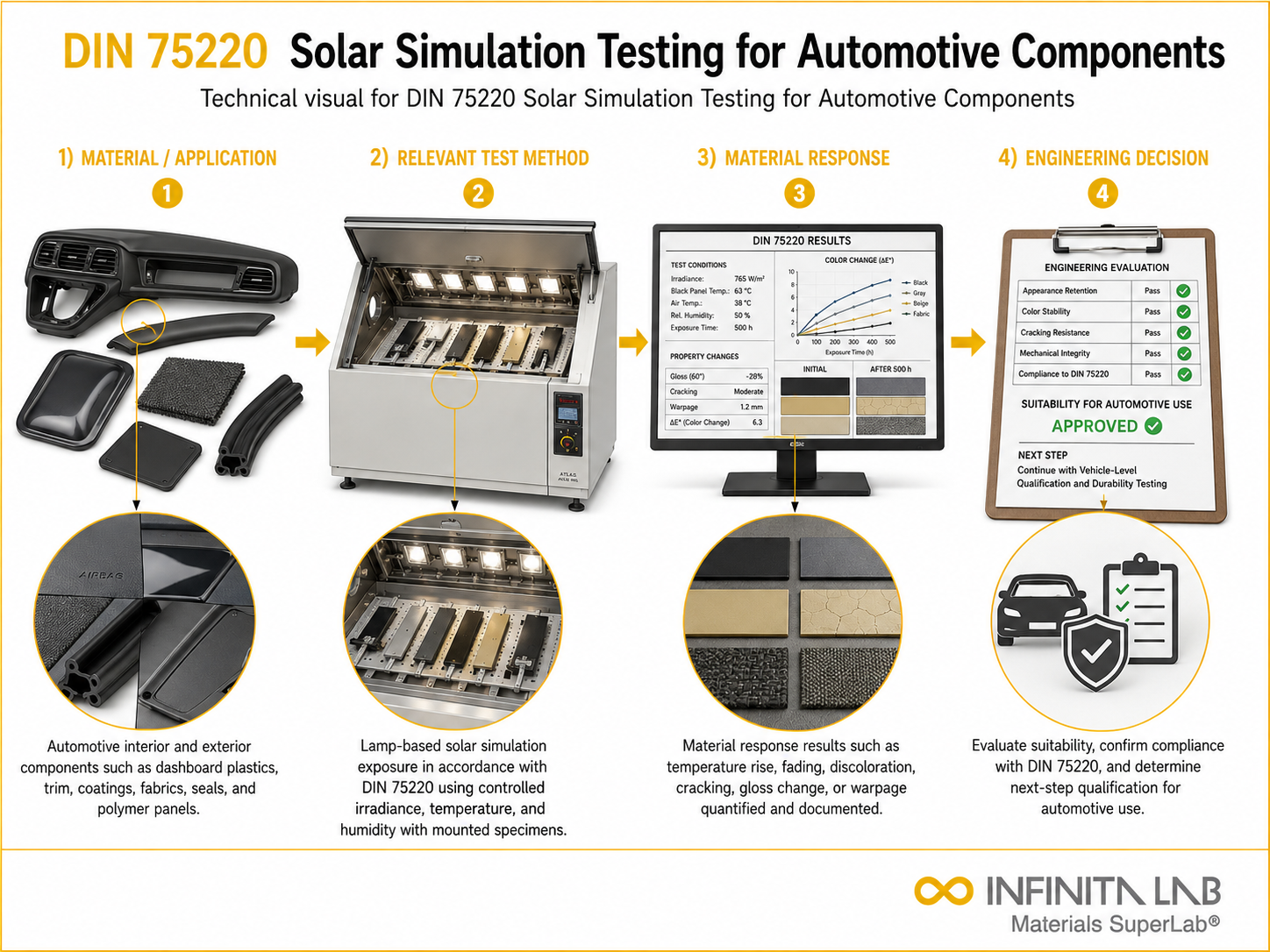
DIN 75220 evaluates the resistance of automotive materials, assemblies, and interior components to simulated solar radiation exposure under controlled laboratory conditions. The test assesses the effects of combined thermal loading and ultraviolet radiation on automotive products exposed to long-term sunlight conditions inside and outside vehicles. DIN 75220 is widely used by German automotive OEMs and Tier 1 suppliers to evaluate color stability, dimensional stability, thermal durability, coating integrity, and aging resistance of automotive interior and exterior materials.
The test typically uses simulated solar irradiance of approximately 765 W/m² with black panel temperatures reaching approximately 100 °C during exposure cycles. Standard qualification programs commonly involve exposure durations of approximately 200 hours, depending on OEM specifications and component requirements. Under DIN 75220 exposure conditions, dashboard surfaces may exceed 120 °C, steering wheel surfaces may reach approximately 80 °C, and seatbelt buckles can exceed 70 °C, making solar simulation testing critical for passenger safety, thermal durability, and long-term appearance retention.
Applications and Benefits of DIN 75220 Solar Simulation Automotive Testing
Scope
DIN 75220 defines a controlled method to simulate solar radiation using artificial light sources to evaluate thermal effects on automotive components. It measures temperature rise and material response under defined irradiation conditions.
The method supports validation of component performance under solar loading environments.
- Measurement of temperature increase under simulated solar radiation
- Evaluation of material thermal stability and aging behavior
- Assessment of component performance under heat load
- Analysis of deformation, discoloration, or degradation
- Comparison of materials and design configurations
- Standardized automotive environmental testing
Applications
- Automotive Interiors – dashboards, door trims, center consoles, steering wheels, headliners, and interior polymer systems exposed to high solar heat loads
- Automotive Exteriors – coated plastic parts, trim systems, exterior panels, films, and painted assemblies exposed to UV radiation and thermal cycling
- Seating & Upholstery – automotive fabrics, synthetic leather systems, seat foams, and upholstery assemblies requiring thermal aging and color stability evaluation
- HVAC Systems – ventilation ducts, climate control components, air outlet assemblies, and temperature-sensitive polymer systems
- EV & Battery Systems – battery enclosure polymers, charging system plastics, and thermally exposed electric vehicle interior assemblies
- Design & Development – comparative evaluation of new automotive material formulations, lightweight structures, and UV-resistant coating technologies
- Transportation & Railway – passenger interior materials, seating systems, coated surfaces, and enclosed transportation cabin assemblies
- Consumer Automotive Components – sun visors, display housings, electronic control panels, and decorative interior trim systems
Benefits
Evaluates sunlight resistance of materials
Helps improve durability of interior components
Supports automotive material qualification
Reduces risk of color fading and deformation
Ensures long-term interior performance
Our DIN 75220 Testing Procedure
Specimen Preparation
Material samples are prepared according to specified size and conditioning requirements.
1Solar Simulation Setup
Samples are placed inside the solar simulation chamber equipped with a high-intensity light source.
2Exposure to Simulated Sunlight
The specimen is exposed to controlled light intensity and temperature conditions that simulate sunlight inside a vehicle.
3Evaluation and Inspection
After exposure, samples are inspected for color changes, surface damage, or material degradation.
4DIN 75220 Test Parameters and Requirements
| Parameter | Details |
|---|---|
| Test Type | Automotive solar simulation and thermal loading evaluation |
| Light Source | Xenon arc or solar simulation lamp |
| Typical Irradiance | Approximately 765 W/m² |
| Black Panel Temperature | Up to approximately 100 °C |
| Typical Exposure Duration | Approximately 200 hours |
| Exposure Environment | Temperature, airflow, humidity, irradiance |
| Typical Test Assemblies | Coupons, interior components, complete assemblies |
| Related Standards | SAE J1885, SAE J2412, ISO 105-B06, VDA 278, VDA 279 |
| Measured Parameters | Color change, surface degradation, material stability |
| Test Duration | Defined exposure cycles depending on requirement |
- Solar simulation test chamber
- Xenon arc lamp or solar simulator
- Temperature sensors (thermocouples, IR sensors)
- Radiometer for irradiance measurement
- Data acquisition system
- Environmental control system (temperature and humidity)
- Mounting fixtures for components
- Airflow control system
Equipment and Instrumentation Used for DIN 75220 Testing
What You Receive: Test Report, Data, and Certification
DIN 75220 Solar Simulation Automotive FAQs
DIN 75220 evaluates the aging behavior of automotive interior materials when exposed to simulated solar radiation, heat, and environmental conditions to assess durability, discoloration, deformation, and material performance over time.
This testing helps manufacturers predict how interior materials will perform under prolonged sunlight exposure, ensuring components maintain appearance, mechanical stability, and safety during real-world vehicle operation.
Solar simulators reproduce the spectral distribution and intensity of sunlight using xenon arc lamps, enabling controlled exposure that mimics real environmental conditions while ensuring repeatability and consistency in laboratory testing.
Temperature rise directly impacts material stability, passenger comfort, and component performance, especially in enclosed vehicle cabins where solar heating can significantly elevate interior temperatures.
The test uses artificial global solar radiation with a spectral distribution similar to natural sunlight, generated inside a solar simulation chamber under controlled laboratory conditions.
Why Choose Infinita Lab for Solar Simulation Automotive Testing
At the core of this breadth is our network of 2,000+ accredited laboratories across the USA, offering access to over 10,000 testing methods and analytical services. From advanced materials characterization (SEM, TEM, RBS, XPS) to mechanical, chemical, environmental, biological, and standardized ASTM/ISO-compliant testing, we deliver unmatched flexibility, specialization, and scale. You are never limited by geography, facility, or methodology — Infinita Lab connects you to the right expertise and testing solution, every time.

Need DIN 75220 Solar Simulation Automotive Testing You Can Rely On?
Send query us at hello@infinitalab.com or call us at (888) 878-3090 to learn more about our services and how we can support you.



Request a Quote
Submit your material details and receive testing procedures, pricing, and turnaround time within 24 hours.
 Quick Turnaround and Hasslefree process
 Confidentiality Guarantee
 Free, No-obligation Consultation
 100% Customer Satisfaction
