


ASTM E337: Method For Measuring Humidity With A Psychrometer The Measurement Of Wet And Dry Bulb Temperature Testing Services
Accredited ASTM E337 method for measuring humidity with a psychrometer the measurement of wet and dry bulb temperature testing from Infinita Lab, performed to the exact standard requirements - accurate, reproducible results with full documentation for compliance, R&D, and quality control programs.
TRUSTED BY


Get ASTM E337 compliant results - request your method for measuring humidity with a psychrometer the measurement of wet and dry bulb temperature testing quote
- Overview
- Scope, Applications, and Benefits
- Test Process
- Specifications
- Instrumentation
- Results and Deliverables
What Is ASTM E337 Method For Measuring Humidity With A Psychrometer The Measurement Of Wet And Dry Bulb Temperature?
ASTM E337, the Standard Test Method for Measuring Humidity with a Psychrometer (the Measurement of Wet- and Dry-Bulb Temperatures), lays out the procedures and instrumentation needed to determine atmospheric relative humidity and dew point from simultaneous wet-bulb and dry-bulb temperature readings. The current edition is E337-15, reapproved in 2023. It’s still the primary reference for psychrometric humidity measurement across meteorological, industrial, and materials-testing work. Two psychrometer configurations fall under the standard: the aspirated (motor-ventilated) type, suited to roughly 5°C to 80°C, and the sling or whirling type, limited to about 5°C to 50°C. Both rely on a matched pair of thermometers. One stays dry and tracks ambient air temperature; the other is wrapped in a water-saturated wick that captures the cooling effect of evaporation. ASTM E337 spells out the airflow, wick saturation, and thermometer placement needed to get a stable, representative wet-bulb depression, plus guidance on periodic thermometer calibration to hold accuracy over time. Once stabilized dry-bulb and wet-bulb readings are in hand, the method calls for psychrometric tables or charts, corrected for local barometric pressure, to convert that temperature differential into relative humidity and dew point values. The standard doesn’t lock users into one instrument design. Instead, it sets core performance and construction criteria while leaving room for different psychrometer types, giving laboratories, field technicians, and environmental monitoring programs a consistent, traceable basis for humidity verification wherever direct hygrometric instruments are impractical, unavailable, or need independent cross-checking against a recognized reference method. Because the method rests on basic physical principles rather than sensitive electronics, field and industrial settings often favor it; the equipment stays rugged and low-maintenance. Operators use the resulting relative humidity and dew point values to confirm that ambient and surface conditions fall within acceptable limits for coating application and other moisture-sensitive processes.

Applications and Benefits of ASTM E337 Method For Measuring Humidity With A Psychrometer The Measurement Of Wet And Dry Bulb Temperature Testing
Scope
ASTM E337-02 outlines procedures for determining relative humidity using wet- and dry-bulb temperature measurements. It evaluates:
- ASTM E337 covers atmospheric humidity measurement using psychrometric methods based on paired wet-bulb and dry-bulb readings.
- Two principal instrument types fall under the standard: aspirated (motor-ventilated) psychrometers and sling (whirling) psychrometers.
- Each has its own effective range: roughly 5°C to 80°C for aspirated psychrometers, about 5°C to 50°C for sling psychrometers.
- Construction details matter here, including thermometer placement, wick material, and how airflow gets generated.
- There’s a minimum airflow requirement across the wet bulb, needed for a valid evaporative-cooling reading.
- Saturating and maintaining the wet-bulb wick properly keeps measurement drift from creeping in.
- Converting wet-bulb depression into relative humidity and dew point relies on psychrometric tables or charts, corrected for local barometric pressure.
- Thermometer calibration and verification practices are addressed too, to maintain reading accuracy over repeated use.
- Both controlled laboratory conditioning environments and field or outdoor measurements fall within scope.
- It’s meant for situations where a direct-reading hygrometer is unavailable, impractical, or needs independent verification.
Applications
- Checking ambient relative humidity and dew point before coating, painting, or surface-preparation work
- Environmental monitoring at meteorological and atmospheric science field stations
- Conditioning-room humidity verification for textile, paper, and plastics testing labs
- Quality control checks on HVAC and industrial climate-control systems
- Confirming humidity inside environmental test chambers used for materials, electronics, and packaging evaluation
- Field checks on surface-to-dew-point temperature spread for corrosion-prevention and industrial coating programs
- Cross-validating electronic hygrometers and other humidity-sensing instruments
Benefits
- A simple, self-contained way to measure humidity, with no dependence on electronic sensors or outside calibration infrastructure
- A standardized, repeatable procedure recognized across industries and geographies
- Independent verification of other humidity-measuring instruments and systems
- Documented compliance with coating, surface-preparation, and environmental specifications
- Minimal equipment needed, which keeps it practical for both field and lab use
- Traceable, defensible humidity data you can use for quality records and project documentation
Our ASTM E337 Testing Procedure
Instrument Setup
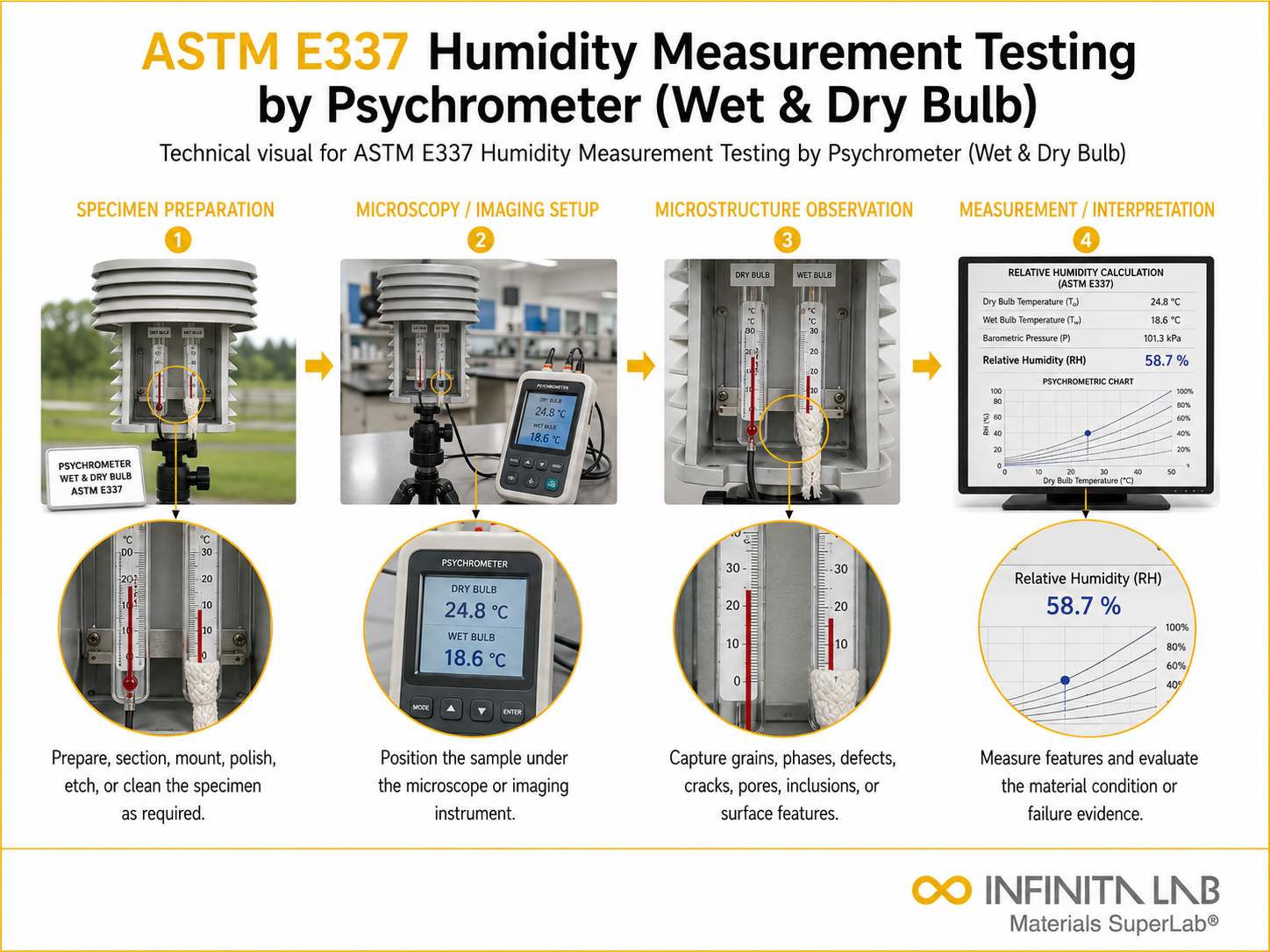
Psychrometer is prepared with dry-bulb and wetted wick on the wet-bulb thermometer.
1Air Exposure
The instrument is exposed to airflow (natural or forced) to stabilize readings.
2Temperature Measurement
Wet-bulb and dry-bulb temperatures are recorded after equilibrium is reached.
3Calculation
Relative humidity is calculated using psychrometric charts or equations.
4ASTM E337 Test Parameters and Requirements
| Parameter | Details |
|---|---|
| Applicable Environment | Ambient air, laboratories, industrial and field conditions |
| Temperature Range | Typically 0°C to 50°C |
| Measured Outputs | Relative humidity (%), wet-bulb and dry-bulb temperatures |
| Airflow Requirement | Adequate ventilation or air movement for accurate readings |


- Sling (Whirling) Psychrometer – A handheld unit you rotate by hand, pairing wet- and dry-bulb thermometers for quick field readings
- Aspirated Psychrometer – Motor-ventilated, pulling a controlled airflow across the wet bulb for steadier, higher-precision readings
- Matched Thermometer Pair – Precision glass or digital thermometers that record wet-bulb and dry-bulb temperatures
- Muslin Wick – The saturated fabric sleeve fitted over the wet-bulb thermometer, enabling evaporative cooling
- Distilled Water Reservoir – Keeps the wick supplied with moisture so the evaporative response stays accurate
- Barometer – Records local barometric pressure, used to correct psychrometric table/chart readings
- Psychrometric Tables/Charts – Reference data that converts wet-bulb depression into relative humidity and dew point
Equipment and Instrumentation Used for ASTM E337 Testing
What You Receive: Test Report, Data, and Certification
- Measured dry-bulb and stabilized wet-bulb temperatures for each test location or interval
- Calculated relative humidity and dew point values, pulled from psychrometric tables or charts
- A record of the local barometric pressure used in the calculation
- Documentation covering instrument type, calibration status, and test conditions
- A formal test report you can use for project files, compliance records, or coating/surface-prep sign-off
- Technical consultation on what the results mean and how they apply to your project’s humidity criteria
ASTM E337 Method For Measuring Humidity With A Psychrometer The Measurement Of Wet And Dry Bulb Temperature FAQs
It measures relative humidity by determining wet-bulb and dry-bulb temperatures using a psychrometer, allowing calculation of atmospheric moisture content for environmental monitoring, laboratory testing, and industrial process control under standardized conditions.
A psychrometer is an instrument consisting of wet-bulb and dry-bulb thermometers used to measure humidity by comparing temperature differences, which indicate the amount of moisture present in the air under specific environmental conditions.
Wet-bulb temperature reflects the cooling effect of evaporation and is essential for determining humidity, as the difference between wet- and dry-bulb temperatures directly correlates with the moisture content of the surrounding air.
It is used in HVAC systems, laboratories, meteorology, and industrial environments to monitor and control humidity levels, ensuring proper environmental conditions for materials, processes, and human comfort across various applications.
The method provides reasonably accurate humidity measurements, typically within ±2–5% relative humidity, depending on proper instrument use, airflow conditions, calibration, and environmental stability during measurement.
ASTM E337 measures atmospheric humidity using a psychrometer with wet- and dry-bulb temperature readings. The temperature difference is used to determine relative humidity under controlled conditions.
A humidity meter measures moisture in the air and converts the sensor response into relative humidity, typically expressed as a percentage (% RH).
A humidity measurement tool detects moisture in the surrounding air using a humidity sensor or psychrometric method. The measured response is converted into relative humidity and displayed as a percentage. ASTM E337 specifically uses wet- and dry-bulb temperature measurements with a psychrometer.
Why Choose Infinita Lab for Method For Measuring Humidity With A Psychrometer The Measurement Of Wet And Dry Bulb Temperature Testing
When your Method For Measuring Humidity With A Psychrometer The Measurement Of Wet And Dry Bulb Temperature results have to hold up - for compliance, a customer audit, or an engineering decision - ASTM E337 accuracy and an unbiased third-party report matter more than price. Infinita Lab routes your ASTM E337 method for measuring humidity with a psychrometer the measurement of wet and dry bulb temperature testing to ISO/IEC 17025-accredited U.S. partner labs with hands-on method experience, so you get defensible data, transparent reporting, and turnaround times built around your project deadline - not ours.

Need ASTM E337 Method For Measuring Humidity With A Psychrometer The Measurement Of Wet And Dry Bulb Temperature Testing You Can Rely On?
Send query us at hello@infinitalab.com or call us at (888) 878-3090 to learn more about our services and how we can support you.



Request a Quote
Submit your material details and receive testing procedures, pricing, and turnaround time within 24 hours.
 Quick Turnaround and Hasslefree process
 Confidentiality Guarantee
 Free, No-obligation Consultation
 100% Customer Satisfaction
