

What Is ASTM E322 Steel Cast Iron WDXRF Analysis?
ASTM E322, formerly titled “Standard Test Method for Analysis of Low-Alloy Steels and Cast Irons by Wavelength Dispersive X-Ray Fluorescence Spectrometry,” was a comparative analytical procedure maintained by ASTM International’s Committee E01 on Analytical Chemistry for Metals, Ores, and Related Materials. Its last active edition, E322-12, was withdrawn by ASTM in January 2021. ASTM never issued a direct, like-for-like replacement under the same designation. Infinita Lab still documents this historical method, though. Client drawings, legacy quality records, and older material certifications keep referencing it by name. And the wavelength dispersive X-ray fluorescence (WDXRF) technique it described hasn’t gone anywhere: it’s alive and well under the standards that carry its scope forward today, principally ASTM E1085 for low-alloy steel and ASTM E572 for stainless and alloy steel, alongside ASTM E351 for broader cast iron chemical analysis.
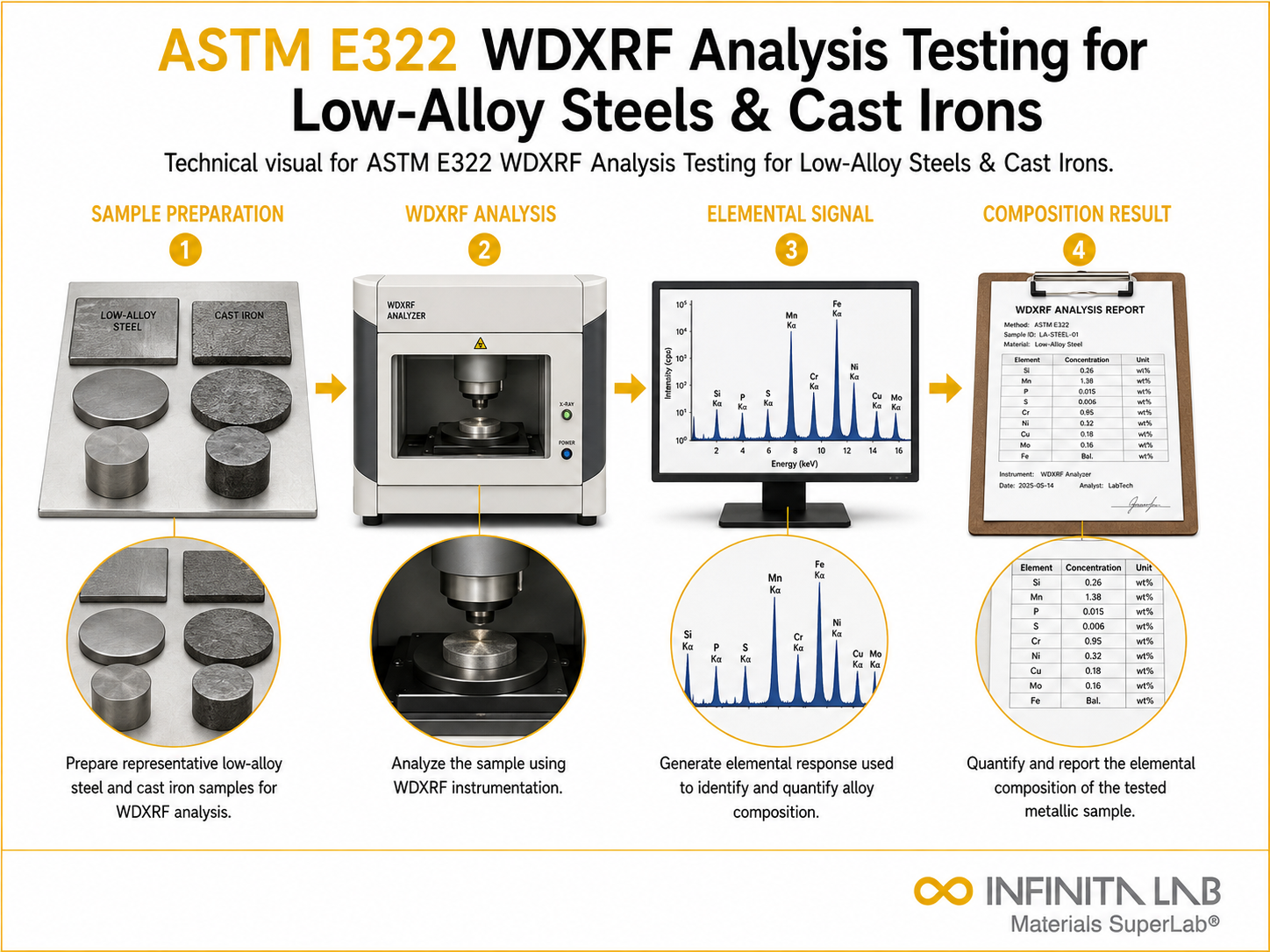
As originally written, E322 laid out a routine, comparative method for determining the mass fraction of alloying and residual elements in solid low-alloy steel and cast iron specimens: manganese, nickel, chromium, molybdenum, copper, and vanadium. The approach called for a flat, representative metallic surface, usually produced by machining or grinding. That surface got irradiated with an X-ray beam from a sealed X-ray tube. The excited elements emitted characteristic fluorescent X-rays, which were diffracted by analyzing crystals at specific angles and measured by detectors. The resulting intensities were converted to elemental concentrations by comparing them with calibration curves built from certified reference materials matched to the sample’s matrix, since the method was comparative rather than absolute; accurate results depended on proper specimen preparation, matrix-matched standardization, and periodic instrument verification against known reference materials.

Applications and Benefits of ASTM E322 Steel Cast Iron WDXRF Analysis Testing
Scope
ASTM E322-12 outlines procedures for quantitative elemental analysis using WDXRF. It evaluates:
- Applied only to solid, homogeneous specimens of low-alloy steel and cast iron, in flat, machined or ground form suitable for direct X-ray irradiation.
- Described a wavelength dispersive X-ray fluorescence procedure where characteristic X-rays are diffracted by analyzing crystals and measured at fixed or scanning goniometer angles.
- Covered manganese, nickel, chromium, molybdenum, copper, and vanadium, within mass fraction ranges set by the referenced calibration materials.
- This was a comparative method. Accuracy depended on calibration against certified reference materials of closely matched composition and metallurgical form.
- Assumed a single-phase, segregation-free specimen surface, since grain structure and surface finish could skew fluorescence intensity readings.
- Ranges could stretch beyond what was originally validated, provided suitable reference materials and operating conditions were used.
- Loose, granular, liquid, or non-metallic samples fell outside its scope; those required different preparation or an entirely different standard.
- Built for routine production and quality-control work, not as a referee or arbitration method in disputes.
- ASTM withdrew E322 in 2021. The designation no longer corresponds to a currently published, active standard.
- Even so, labs asked to test “to E322” typically run the equivalent WDXRF procedure under its active successors, most commonly ASTM E1085 and ASTM E572.
Applications
- Verifying alloy and residual element content in low-alloy steel bar, plate, and billet during production quality control.
- Confirming cast iron composition against foundry melt specs before pouring or shipment.
- Incoming-material inspection, especially where mill certificates still reference the legacy E322 designation.
- Fast, multi-element screening that complements slower wet-chemical or combustion analysis.
- Metallurgical investigations and failure analyses needing historical comparison to older test records.
- Grade verification and positive material identification in manufacturing and procurement.
- Benchmarking new alloy formulations against established compositional targets for R&D teams.
Benefits
- Rapid, simultaneous multi-element results, no need for sequential wet-chemical runs.
- Minimal sample destruction: a prepared solid specimen can usually be reused or archived afterward.
- Simpler specimen prep than full dissolution-based chemical analysis.
- High throughput, well suited to production-line and batch-release QC.
- Solid traceability, as long as calibration stays tied to certified reference materials.
- Still compatible with the WDXRF instrumentation labs run today across the metals testing industry.
Our ASTM E322 Testing Procedure
Sample Preparation
The sample surface is cleaned, ground, and polished to obtain a flat and uniform surface.
1Instrument Calibration
The WDXRF instrument is calibrated using certified reference materials of similar composition.
2X-ray Excitation
The sample is exposed to X-rays, causing elements to emit characteristic fluorescent radiation.
3Data Analysis & Reporting
Emitted wavelengths are analyzed to determine elemental composition and reported quantitatively.
4ASTM E322 Test Parameters and Requirements
| Parameter | Details |
|---|---|
| Applicable Materials | Low-alloy steels and cast irons |
| Sample Type | Solid, flat, and polished metallic samples |
| Measured Elements | Fe, C (indirect), Si, Mn, Cr, Ni, Mo, Cu, V, and others |
| Detection Range | Major elements (%) to trace levels (ppm) |
| Test Environment | Controlled laboratory conditions |


- Wavelength Dispersive X-Ray Fluorescence (WDXRF) Spectrometer – generates the X-ray excitation and separates fluorescent radiation by wavelength for elemental measurement.
- Sealed X-Ray Tube Source – provides the primary excitation beam aimed at the prepared specimen surface.
- Analyzing Crystals / Goniometer – diffract characteristic fluorescent X-rays at precise angles, each one tied to a specific element.
- Scintillation and Gas-Flow Proportional Detectors – measure the intensity of diffracted X-rays across the relevant wavelength range.
- Surface Grinder / Precision Lathe – preps flat, representative metallic specimen surfaces, free of significant irregularities.
- Certified Reference Materials (CRMs) – matrix-matched standards used to calibrate the spectrometer and check ongoing accuracy.
- Spectrometer Control & Data Reduction Software – handles instrument operation, intensity-to-concentration conversion, and matrix correction math.
Equipment and Instrumentation Used for ASTM E322 Testing
What You Receive: Test Report, Data, and Certification
- A formal certificate of analysis, listing measured mass fractions for each target element.
- Results compared against client-specified compositional limits or applicable grade requirements.
- Calibration traceability documented back to the certified reference materials used during testing.
- Clear notes on ASTM E322’s historical status, naming the active standard the equivalent WDXRF procedure actually ran under.
- Data suitable for quality records, incoming-inspection files, or metallurgical investigation reports.
- Raw spectral or intensity data, available on request for clients needing deeper technical review.
ASTM E322 Steel Cast Iron WDXRF Analysis FAQs
It determines the elemental composition of low-alloy steels and cast irons using WDXRF, providing accurate quantitative analysis of major, minor, and trace elements essential for material verification, quality control, and compliance with industry specifications.
Wavelength dispersive X-ray fluorescence is an analytical technique that measures characteristic X-ray emissions from elements, enabling precise identification and quantification of elemental composition in metallic samples without destroying the material during testing.
It ensures accurate chemical composition analysis of steels and cast irons, which is critical for maintaining material properties, ensuring product quality, meeting standards, and preventing failures in structural, automotive, and industrial applications.
Solid metallic samples with clean, flat, and polished surfaces are required to ensure accurate X-ray interaction and reliable measurement of elemental composition using WDXRF techniques in laboratory testing conditions.
Industries such as automotive, construction, foundry, and steel manufacturing use ASTM E322-12 for material verification, quality control, and ensuring compliance with specifications in components requiring consistent chemical composition and reliable mechanical performance.
Why Choose Infinita Lab for Steel Cast Iron WDXRF Analysis Testing
When your Steel Cast Iron WDXRF Analysis results have to hold up - for compliance, a customer audit, or an engineering decision - ASTM E322 accuracy and an unbiased third-party report matter more than price. Infinita Lab routes your ASTM E322 steel cast iron WDXRF analysis testing to ISO/IEC 17025-accredited U.S. partner labs with hands-on method experience, so you get defensible data, transparent reporting, and turnaround times built around your project deadline - not ours.

Need ASTM E322 Steel Cast Iron WDXRF Analysis Testing You Can Rely On?
Send query us at hello@infinitalab.com or call us at (888) 878-3090 to learn more about our services and how we can support you.





