


ASTM E223: Sulfuric Acid Analysis Testing Services
Accredited ASTM E223 sulfuric acid analysis testing from Infinita Lab, performed to the exact standard requirements - accurate, reproducible results with full documentation for compliance, R&D, and quality control programs.
TRUSTED BY


Get ASTM E223 compliant results - request your sulfuric acid analysis testing quote
- Overview
- Scope, Applications, and Benefits
- Test Process
- Specifications
- Instrumentation
- Results and Deliverables
What Is ASTM E223 Sulfuric Acid Analysis?
Sulfuric acid might be the most manufactured industrial chemical in the world, but not all of it is created equal. A drum destined for a lead-acid battery plant needs a very different purity profile than one heading to a fertiliser operation or a metal-pickling line, and that’s the gap ASTM E223 was built to close. Formally titled Standard Test Methods for Analysis of Sulfuric Acid, the standard gathers a set of classical wet-chemical and gravimetric procedures under Subcommittee D16.10, part of ASTM Committee D16 on Aromatic, Industrial, Speciality and Related Chemicals. It’s also a living document rather than a relic – the current E223-25 edition, reapproved in early 2025, is the latest link in a chain of revisions stretching back through E223-16 and E223-08, which keeps it active rather than gathering dust on a shelf.
What the standard actually covers is six connected procedures: total acidity, Baumé gravity, nonvolatile matter, iron, sulfur dioxide, and arsenic. Run together, they answer two questions a buyer or producer really cares about – how concentrated is this acid, and how clean is it? Total acidity and Baumé gravity establish the grade and strength of a given batch, while the nonvolatile-matter, iron, sulfur-dioxide, and arsenic procedures flag the trace-level contamination that can quietly ruin a downstream process, corrode equipment, or trip a customer’s purity spec.
At Infinita Lab, we route ASTM E223 testing through our network of accredited chemical-analysis partner laboratories, so manufacturers, distributors, and industrial users of sulfuric acid get documented, defensible results without having to build or maintain that wet-chemistry capability in-house.

Applications and Benefits of ASTM E223 Sulfuric Acid Analysis Testing
Scope
- Covers the analysis of sulfuric acid across industrial, reagent, and battery grades.
- Total acidity determination establishes the H2SO4 concentration by weight through acidimetric titration.
- Baumé gravity measurement cross-checks concentration using density, tying back to grading conventions still used across the acid trade.
- Non-volatile matter testing isolates residue left behind after the acid is driven off, giving a direct read on overall purity.
- Iron content procedures flag trace metallic contamination that can affect downstream reactions or corrode process equipment.
- Sulfur dioxide testing quantifies residual sulfureous compounds that can carry over from the acid manufacturing process.
- Arsenic determination addresses a trace contaminant that carries tight tolerances in food-adjacent, pharmaceutical-adjacent, and electronics supply chains.
- Method selection follows the acid’s intended grade, so battery-grade material and bulk industrial process acid aren’t run through an identical checklist.
- Each procedure maps to specific sections of the standard, which keeps results traceable back to a defined method.
- Oversight sits with ASTM Subcommittee D16.10, which periodically reviews and reissues the standard.
Applications
- Battery manufacturers use it to verify electrolyte-grade acid before it goes into lead-acid cells.
- Chemical producers apply it as a release test on bulk sulfuric acid leaving the plant.
- Fertiliser operations rely on it to confirm process acid meets the concentration needed for phosphate or ammonium sulfate production.
- Metal finishing and pickling lines check incoming acid so etch rates and bath chemistry stay predictable.
- Mining and metal-leaching operations depend on consistent acid strength for extraction efficiency, and E223 gives them a documented way to confirm it.
- Distributors and acid blenders use the results to document quality when acid changes hands between suppliers and buyers.
- Environmental and regulatory programs sometimes draw on the same trace-impurity data to support compliance records.
Benefits
- Provides a documented, repeatable basis for accepting or rejecting an acid shipment.
- Protects downstream equipment from the corrosion and fouling that unmonitored impurities can cause.
- Supports supplier qualification and ongoing vendor audits with consistent, comparable data.
- Cuts the risk of a batch failing further downstream, after it’s already moved through processing.
- Builds a paper trail useful for customer complaints, insurance claims, or regulatory questions.
- Lets purchasing and QC teams compare acid from different suppliers on the same technical footing.
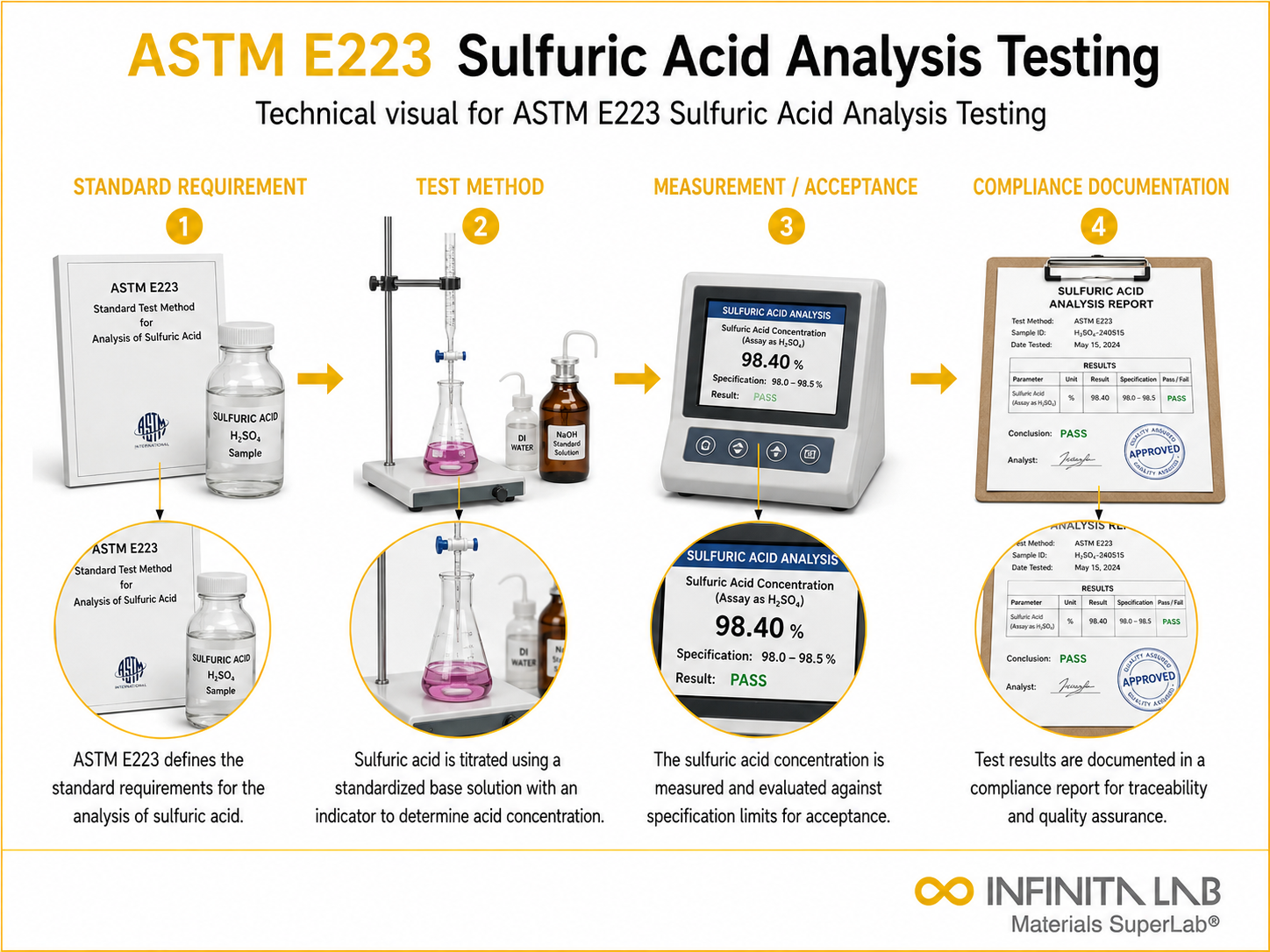
Our ASTM E223 Testing Procedure
Sample Preparation
Sulfuric acid samples are diluted or handled neat as required, then weighed gravimetrically in a sealed vessel to prevent moisture uptake.
1Assay Titration
Total acidity is determined by titrating a weighed sample with standardized NaOH to the equivalence point.
2Impurity Analysis
Iron, arsenic, and heavy metals are measured by ICP-OES or AAS; SO₂ by iodometric titration; and residue on ignition gravimetrically.
3Reporting & Compliance
Results are reported in standard units and compared with ASTM E223 or customer limits.
4ASTM E223 Test Parameters and Requirements
| Parameter | Details |
|---|---|
| Applicable Grades | Industrial, reagent, battery, electronic grade H₂SO₄ |
| Assay Method | NaOH potentiometric titration |
| Iron Determination | ICP-OES or AAS (ppm level) |
| Sulfurous Acid | Iodometric titration |
| Residue on Ignition | Gravimetric (mg/kg) |


- Automatic/Manual Titrator – Runs the acidimetric titration used to determine total acidity (H2SO4 assay).
- Analytical Balance – Delivers the precise mass measurements the gravimetric procedures, like non-volatile matter, depend on.
- Hydrometer / Density Meter – Measures specific gravity for the Baumé gravity determination.
- Drying Oven & Muffle Furnace – Handle the evaporation and ignition steps used in the non-volatile-matter procedure.
- Atomic Absorption Spectrometer (AAS) / ICP – Quantifies trace iron and arsenic at the levels the standard calls for.
- Fume Hood & Acid-Handling Equipment – Protects analysts during the handling of concentrated, corrosive sulfuric acid.
- Reference Standards & Calibration Solutions – Keep every instrument traceable and every reported result defensible.
Equipment and Instrumentation Used for ASTM E223 Testing
What You Receive: Test Report, Data, and Certification
- A detailed test report mapping each result to its corresponding ASTM E223 procedure and method section.
- Total acidity (H2SO4 assay) reported as weight per cent, alongside the Baumé gravity reading.
- Quantified non-volatile matter, iron, sulfur dioxide, and arsenic results, each tied to the method used to generate it.
- Supporting QC documentation, including duplicate and reference-standard checks, available on request.
- A certificate of analysis suitable for supplier qualification files, customer submissions, or internal QC records.
- Retained raw data and lab traceability records, so a result can be revisited if a question comes up later.
ASTM E223 Sulfuric Acid Analysis FAQs
Battery-grade (electrolyte-grade) sulfuric acid has tighter limits on metallic impurities (especially iron, copper, manganese) that can catalyze water decomposition and grid corrosion in lead-acid batteries. Industrial-grade acid has broader impurity tolerances suitable for non-critical chemical processes.
Iron contamination accelerates corrosion of process equipment, catalyzes unwanted side reactions in chemical synthesis, and in battery acid, promotes positive grid corrosion and water decomposition. Iron levels are typically controlled to <5–10 ppm for battery grade and <50 ppm for most industrial grades.
Sulfurous acid (H₂SO₃, from dissolved SO₂) is a reducing impurity that interferes with oxidizing reactions and analytical methods. In battery acid, it can cause premature self-discharge. ASTM E223 measures SO₂ by iodometric titration to ensure it is within specification.
Oleum contains dissolved SO₃ in excess of H₂SO₄, expressed as % free SO₃. ASTM E223 includes a free SO₃ determination by controlled dilution and back-titration applicable to oleum grades (typically 20–65% SO₃).
All work must be conducted in a fume hood with appropriate PPE (acid-resistant gloves, face shield, lab coat). Dilution must always be performed by adding acid to water (not water to acid) to prevent violent exothermic spattering. Spill neutralization with sodium bicarbonate and proper chemical waste disposal are mandatory.
A sulfuric acid test determines the concentration or specific properties of sulfuric acid by analyzing a prepared sample using an appropriate analytical method.
An H₂SO₄ test analyzes sulfuric acid to determine its concentration, purity, or other specified chemical properties using a suitable laboratory procedure.
The test involves preparing the sulfuric acid sample and measuring the required chemical property, such as concentration or acidity, using an appropriate analytical technique.
Why Choose Infinita Lab for Sulfuric Acid Analysis Testing
When your Sulfuric Acid Analysis results have to hold up - for compliance, a customer audit, or an engineering decision - ASTM E223 accuracy and an unbiased third-party report matter more than price. Infinita Lab routes your ASTM E223 sulfuric acid analysis testing to ISO/IEC 17025-accredited U.S. partner labs with hands-on method experience, so you get defensible data, transparent reporting, and turnaround times built around your project deadline - not ours.

Need ASTM E223 Sulfuric Acid Analysis Testing You Can Rely On?
Send query us at hello@infinitalab.com or call us at (888) 878-3090 to learn more about our services and how we can support you.



Request a Quote
Submit your material details and receive testing procedures, pricing, and turnaround time within 24 hours.
 Quick Turnaround and Hasslefree process
 Confidentiality Guarantee
 Free, No-obligation Consultation
 100% Customer Satisfaction
