


ASTM E203: Moisture Volumetric Karl Fischer Titration Testing Services
Accredited ASTM E203 moisture volumetric karl fischer titration testing from Infinita Lab, performed to the exact standard requirements - accurate, reproducible results with full documentation for compliance, R&D, and quality control programs.
TRUSTED BY


Get ASTM E203 compliant results - request your moisture volumetric karl fischer titration testing quote
- Overview
- Scope, Applications, and Benefits
- Test Process
- Specifications
- Instrumentation
- Results and Deliverables
What Is ASTM E203 Moisture Volumetric Karl Fischer Titration?
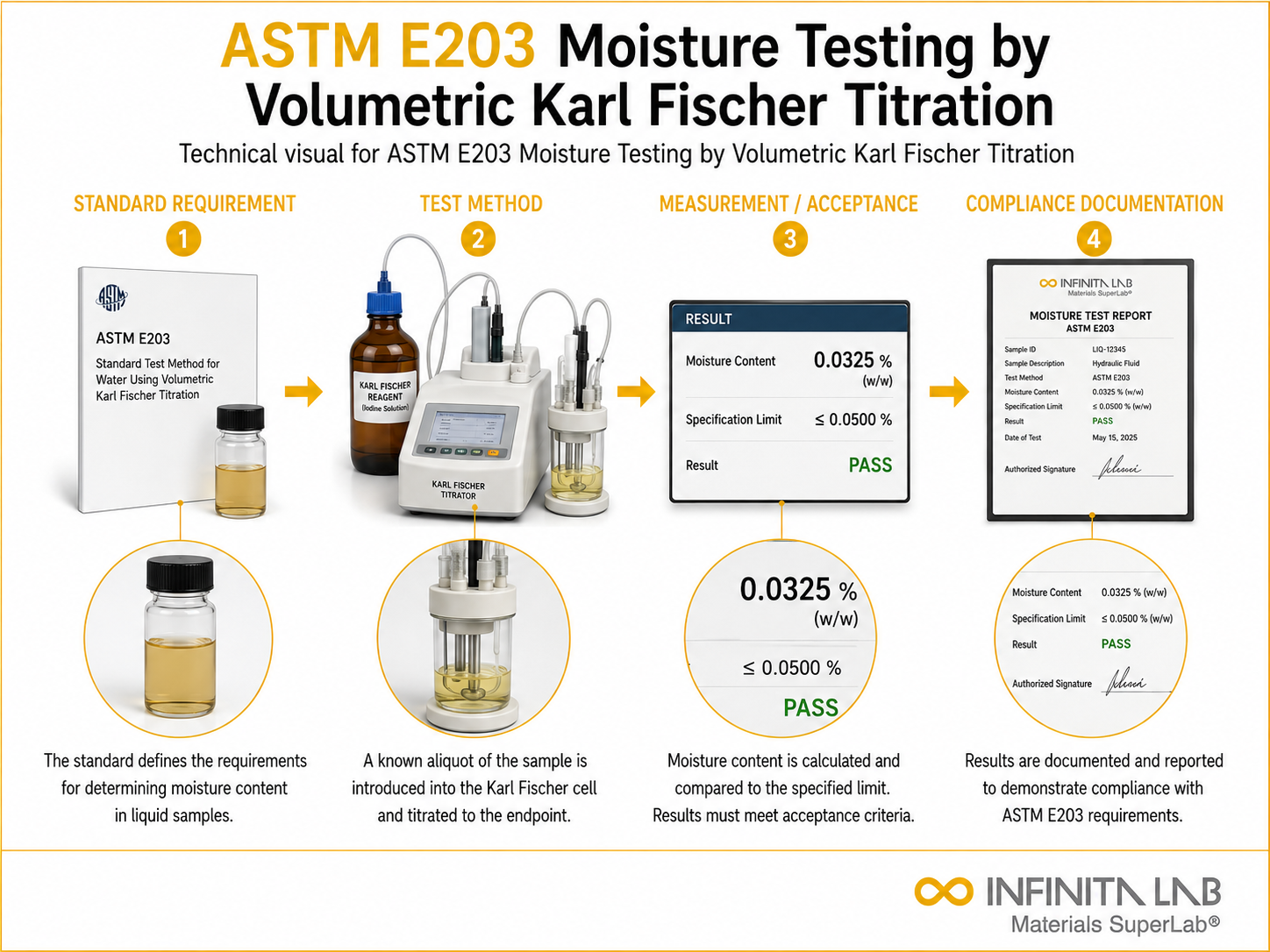
ASTM E203, Standard Test Method for Water Using Volumetric Karl Fischer Titration, provides a general procedure for determining free water and water of hydration in solid or liquid organic and inorganic compounds using an automatic or manual volumetric titration system. The method is widely used across chemical, pharmaceutical, petrochemical, and industrial manufacturing sectors wherever moisture content must be measured accurately and reproducibly.
Volumetric Karl Fischer titration is built on a well-established chemical reaction. A Karl Fischer reagent containing iodine, sulphur dioxide, an organic base, and an alcohol (typically methanol) is added to a sample dissolved or suspended in a suitable solvent. Water present in the sample reacts stoichiometrically with the iodine in the reagent: one mole of water consumes one mole of iodine in the classic methanol-based system. In the volumetric approach, this reagent is delivered from a calibrated buret directly into the titration cell until an electrochemical endpoint, typically detected potentiometrically with a dual-platinum electrode, signals that all available water has been consumed. Because the reaction is stoichiometric and the titrant concentration is known from prior standardisation against a water standard, the volume of titrant consumed can be converted directly into a precise water content result, usually reported as a percentage by weight.
Accurate moisture determination matters because even small amounts of water can materially affect a material’s chemical stability, reactivity, shelf life, and physical performance. Excess moisture in raw materials, intermediates, and finished products can accelerate hydrolysis and degradation, alter viscosity and processing behaviour, promote microbial growth, and compromise the effectiveness of desiccants, catalysts, and active ingredients. ASTM E203 gives manufacturers, formulators, and quality teams a standardised, traceable method for verifying that moisture levels fall within specification before materials move further into production or into the field.

Applications and Benefits of ASTM E203 Moisture Volumetric Karl Fischer Titration Testing
Scope
- ASTM E203 covers the determination of free water and water of hydration in most solid and liquid organic and inorganic compounds using volumetric Karl Fischer titration.
- The titration principle relies on the stoichiometric reaction between water in the sample and iodine present in the Karl Fischer reagent, which also contains sulfur dioxide, a base, and an alcohol.
- Titrant is added from a calibrated buret until an electrochemical endpoint is reached, and the volume of titrant consumed is directly proportional to the amount of water present.
- The method is generally applied to samples with higher water content, typically from the parts-per-million range up into the per cent range, distinguishing it from coulometric Karl Fischer titration, which is reserved for trace moisture levels where iodine is generated electrochemically rather than delivered volumetrically.
- Sample types include liquids that can be introduced directly into the titration cell as well as solids that are dissolved, extracted, or otherwise brought into solution for analysis.
- The standard addresses both direct analysis of compounds such as alcohols, ethers, ketones, esters, hydrocarbons, salts, oxides, acids, and desiccants, and indirect analysis of compounds requiring chemical modification to remove interferences.
- The method applies to a broad range of industries, including petrochemicals, pharmaceuticals, food and beverage products, plastics and polymers, oils and lubricants, and speciality and industrial chemicals.
- Typical use cases include incoming raw material inspection, in-process moisture monitoring, finished product release testing, and stability or shelf-life studies.
- Testing under ASTM E203 supports quality control programs, regulatory and specification compliance, and root-cause investigations where moisture is a suspected contributor to product performance issues.
- The method excludes gaseous samples analysed at room temperature, which fall outside the standard’s defined scope.
Applications
- Verifying moisture specifications for petrochemical products, fuels, and industrial oils and lubricants.
- Confirming water content in pharmaceutical raw materials, excipients, and finished dosage forms.
- Assessing moisture levels in food ingredients and packaging materials to support quality and stability.
- Testing plastics, resins, and polymer materials where residual moisture can affect processing and part quality.
- Supporting incoming inspection and supplier qualification programs for moisture-sensitive raw materials.
- Investigating product failures, degradation, or performance issues linked to excess moisture.
- Providing documented, traceable data for regulatory submissions and customer specification compliance.
Benefits
- Delivers accurate, reproducible water content results based on a well-established stoichiometric titration principle.
- Applicable to a wide range of sample types, including liquids and solids that can be dissolved or extracted.
- Supports higher water content ranges than coulometric methods, making it well suited to many industrial and commodity materials.
- Provides objective, standardised data that supports specification compliance and quality decisions.
- Helps identify moisture-related risks to stability, reactivity, and shelf life before they affect downstream processes.
- Generates documentation suitable for regulatory, customer, and internal quality records.
Our ASTM E203 Testing Procedure
Sample and Reagent Preparation
Condition, weigh the sample, and prepare the Karl Fischer reagent safely.
1Titration Setup and Sample Introduction
Load reagent, ensure airtight setup, calibrate if needed, and add the sample.
2Reaction Monitoring
Add reagent to the sample while observing the electrical potential. Continue the reaction until all water in the sample has reacted.
3Endpoint Detection and Data Collection
Detect endpoint at stable potential and record reagent volume to determine water content.
4ASTM E203 Test Parameters and Requirements
| Parameter | Details |
|---|---|
| Applicable Materials | Solids, liquids, powders, complex matrices |
| Reagents Used | Iodine, sulphur dioxide, base (e.g., imidazole or pyridine), methanol or suitable solvent |
| Typical Sample Size | Solids: 1–10 g, Liquids: 1–5 mL |
| Measured Parameter | Water content |
| Output Units | % water or ppm (parts per million) |


- Volumetric Karl Fischer titrator – Automated instrument that dispenses titrant and monitors the titration to the electrochemical endpoint.
- Karl Fischer reagent and titrant – Iodine-based titrant and companion solvent used to react with water in the sample and enable precise volumetric measurement.
- Titration vessel – Sealed cell in which the sample is dissolved or suspended, and titrant is added under controlled, low-moisture conditions.
- Magnetic stirrer – Ensures continuous mixing of the sample and reagent for a uniform, complete reaction throughout titration.
- Electrode for endpoint detection – Dual-platinum electrode used to detect the potentiometric endpoint that signals complete reaction of water with iodine.
- Analytical balance – Precision balance used to weigh solid or semi-solid samples before analysis accurately.
- Sample introduction and dissolution equipment – Syringes, sample vials, and dissolution or extraction apparatus used to prepare and introduce liquid and solid samples into the titration cell.
Equipment and Instrumentation Used for ASTM E203 Testing
What You Receive: Test Report, Data, and Certification
- Quantitative water content result reported as per cent by weight (or equivalent units) for each sample tested.
- A formal test report referencing ASTM E203, documenting sample identification, preparation, and titration parameters.
- Titration data supporting traceability of the reported result, including titrant standardisation information.
- Comparison of results against customer- or industry-specified moisture limits where applicable.
- Technical consultation to help interpret results in the context of material stability, processing, or regulatory requirements.
- Documentation formatted to support quality records, regulatory submissions, and customer specification compliance.
ASTM E203 Moisture Volumetric Karl Fischer Titration FAQs
ASTM E203 is a standard test method for determining water content in liquids and solids using volumetric Karl Fischer titration, suitable for moderate to relatively high moisture levels.
The choice depends on the expected water content. ASTM E203 (Volumetric) is preferred for materials with higher water content (typically >0.1%). If your material is expected to have trace levels of water below 100 ppm, then the Coulometric method (ASTM E1064) is to be preferred.
Some chemical functional groups can interfere with the Karl Fischer reaction. Oxidizing agents can react with the iodide, while reducing agents can react with the iodine. Mercaptans, sulfides, and strong acids and bases also need special treatment before the Karl Fischer titration.
The test measures water content, typically expressed in weight percent or parts per million, using a chemical titration reaction specific to water.
Accuracy can be affected by side reaction with sample components, exposure to atmospheric moisture, improper reagent standardization, instrument calibration errors, and in adequate sample handling or dissolution during titration.
ASTM E203 determines water content using volumetric Karl Fischer titration. The sample is titrated with Karl Fischer reagent until the endpoint is reached, and the amount of reagent consumed is used to calculate the water content.
ASTM E203-24 is the Standard Test Method for Water Using Volumetric Karl Fischer Titration. It provides a method for determining free water and water of hydration in most solid and liquid organic and inorganic compounds, with measurements ranging from parts-per-million levels to high water concentrations.
Why Choose Infinita Lab for Moisture Volumetric Karl Fischer Titration Testing
When your Moisture Volumetric Karl Fischer Titration results have to hold up - for compliance, a customer audit, or an engineering decision - ASTM E203 accuracy and an unbiased third-party report matter more than price. Infinita Lab routes your ASTM E203 moisture volumetric karl fischer titration testing to ISO/IEC 17025-accredited U.S. partner labs with hands-on method experience, so you get defensible data, transparent reporting, and turnaround times built around your project deadline - not ours.

Need ASTM E203 Moisture Volumetric Karl Fischer Titration Testing You Can Rely On?
Send query us at hello@infinitalab.com or call us at (888) 878-3090 to learn more about our services and how we can support you.



Request a Quote
Submit your material details and receive testing procedures, pricing, and turnaround time within 24 hours.
 Quick Turnaround and Hasslefree process
 Confidentiality Guarantee
 Free, No-obligation Consultation
 100% Customer Satisfaction
