


ASTM E3039: Crack Tip Opening Angle CTOA Testing Services
ASTM E3039 test uses a drop-weight tear test (DWTT)-type specimen to determine the fracture propagation toughness in terms of the steady-state crack-tip-opening angle (CTOA). The values expressed in SI units should be considered standard.
TRUSTED BY


Get ASTM E3039 compliant results — request your crack tip opening angle CTOA testing quote
- Overview
- Scope, Applications, and Benefits
- Test Process
- Specifications
- Instrumentation
- Results and Deliverables
What Is ASTM E3039 Crack Tip Opening Angle CTOA?
ASTM E3039 describes a standard test method for determining the fracture propagation toughness of metals using the crack tip opening angle (CTOA). This method evaluates a material’s resistance to stable crack growth, which is critical for structural integrity in demanding applications.
The test is particularly relevant for ductile metallic materials, where controlled crack propagation behavior is essential for safety and performance. CTOA is a key fracture-mechanics parameter for characterizing resistance to crack extension under dynamic loading conditions.

Applications and Benefits of ASTM E3039 Crack Tip Opening Angle CTOA Testing
Scope
ASTM E3039 outlines procedures for measuring CTOA during stable crack growth in metallic materials. It evaluates:
- Crack tip opening angle (CTOA)
- Fracture propagation toughness
- Stable ductile crack growth behavior
- Resistance to crack extension
Applications
- Oil and gas pipelines
- Structural steel components
- Pressure vessels
- Energy and power infrastructure
- Fracture mechanics research
Benefits
- Provides accurate fracture toughness characterization
- Helps predict crack propagation behavior
- Enhances structural safety and reliability
- Supports material selection and qualification
- Enables compliance with industry standards
Our ASTM E3039 Testing Procedure
Specimen Preparation
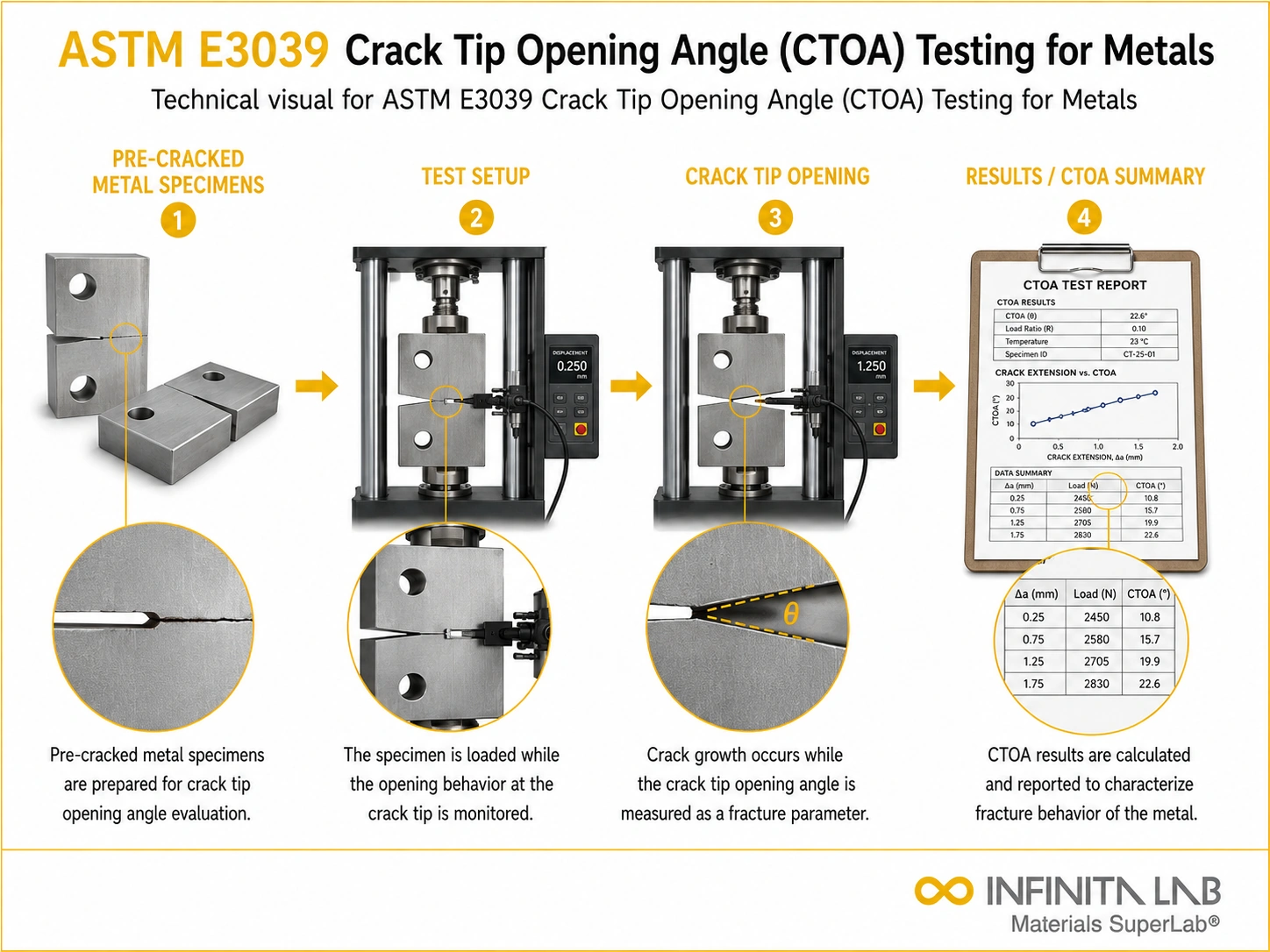
A DWTT-type specimen with a machined notch and pre-crack is prepared as per standard geometry.
1Test Setup
The specimen is mounted in a drop-weight tear testing system with proper alignment and instrumentation.
2Impact Loading
A controlled drop-weight impact is applied to initiate and propagate the crack.
3Measurement & Analysis
CTOA is measured during steady-state crack growth using optical or gauge-based systems.
4ASTM E3039 Test Parameters and Requirements
| Parameter | Details |
|---|---|
| Applicable Materials | Ferritic steels and ductile metals |
| Specimen Type | DWTT (Drop-Weight Tear Test) specimen with pre-crack |
| Thickness Range | Typically 6 mm to 20 mm (up to ~32 mm with special provisions) |
| Fracture Requirement | Predominantly ductile fracture with high shear area (≥85%) |
| Measured Outputs | CTOA (degrees), fracture propagation toughness |


- Drop-Weight Tear Test (DWTT) machine
- High-speed data acquisition system
- Optical measurement systems or clip gauges
- Specimen machining and pre-cracking tools
- Alignment fixtures and supports
Equipment and Instrumentation Used for ASTM E3039 Testing
What You Receive: Test Report, Data, and Certification
- Crack tip opening angle (CTOA) values
- Fracture propagation toughness data
- Crack growth behavior analysis
- Material performance evaluation reports
ASTM E3039 Crack Tip Opening Angle CTOA FAQs
ASTM E3039 is a standard test method used to determine crack tip opening angle in metals, evaluating resistance to stable crack growth under applied loading conditions in structural and engineering applications.
ASTM E3039 is important because it helps understand fracture behavior of metals, enabling engineers to predict crack growth and ensure safety and reliability of critical components under stress.
ASTM E3039 measures the angle formed at the crack tip during stable crack growth, relating this parameter to the material’s resistance to fracture propagation.
ASTM E3039 requires a fracture testing machine, high-resolution imaging systems, crack measurement devices, and properly prepared specimens for accurate evaluation.
ASTM E3039 results are reported as crack tip opening angle values, indicating fracture resistance and helping assess material performance under crack propagation conditions.
Why Choose Infinita Lab for Crack Tip Opening Angle CTOA Testing?
At the core of this breadth is our network of 2,000+ accredited laboratories across the USA, offering access to over 10,000 testing methods and analytical services. From advanced materials characterization (SEM, TEM, RBS, XPS) to mechanical, chemical, environmental, biological, and standardized ASTM/ISO-compliant testing, we deliver unmatched flexibility, specialization, and scale. You are never limited by geography, facility, or methodology — Infinita Lab connects you to the right expertise and testing solution, every time.

Looking for an Accredited Partner for ASTM E3039 Crack Tip Opening Angle CTOA Testing?
Send query us at hello@infinitalab.com or call us at (888) 878-3090 to learn more about our services and how we can support you.



Request a Quote
Submit your material details and receive testing procedures, pricing, and turnaround time within 24 hours.
 Quick Turnaround and Hasslefree process
 Confidentiality Guarantee
 Free, No-obligation Consultation
 100% Customer Satisfaction
