


ASTM E299: Peroxides Organic Solvents Testing Services
ASTM E299 – 08 Test Method provides a procedure for determining the peroxide or active oxygen level in Organic Solvents. Autoxidation in certain classes of compounds including ethers, acetals, dienes, and alkylaromatic hydrocarbons forms Peroxides and presents a potential safety hazard.
TRUSTED BY


Get ASTM E299 compliant results — request your peroxides organic solvents testing quote
- Overview
- Scope, Applications, and Benefits
- Test Process
- Specifications
- Instrumentation
- Results and Deliverables
What Is ASTM E299 Peroxides Organic Solvents?
ASTM E299-08 is a standardized test method published by ASTM International for detecting and quantifying trace levels of peroxides in organic solvents. Peroxides form as oxidative degradation products in many common laboratory and industrial solvents – particularly ethers, alcohols, and hydrocarbons – when those solvents are exposed to air, light, or elevated temperatures during storage or handling. Even at trace concentrations, peroxide contamination poses a serious safety hazard, as certain peroxides are shock-sensitive and can detonate when exposed to heat, friction, or impact.
ASTM E299-08 is applied in laboratory safety programs, solvent quality control, and incoming material inspection wherever peroxide-forming solvents are received, stored, or used. It provides a reproducible, low-cost analytical procedure that does not require sophisticated instrumentation, making it practical for routine safety screening as well as more formal quality assurance workflows.

Applications and Benefits of ASTM E299 Peroxides Organic Solvents Testing
Scope
ASTM E299-08 applies to organic solvents that are known or suspected to form peroxides under normal storage and handling conditions. The method detects trace peroxide concentrations typically in the range of a few parts per million, expressed as hydrogen peroxide equivalents. It is a wet chemical, colorimetric procedure suitable for use in standard analytical laboratory environments.
Solvents commonly evaluated using this method include:
- Ethers – diethyl ether, tetrahydrofuran (THF), 1,4-dioxane, diisopropyl ether, and related compounds known for high peroxide-forming tendency
- Alcohols and glycols – isopropanol, 2-butanol, and certain polyols that can accumulate peroxides on prolonged storage
- Hydrocarbons and cyclic compounds – cyclohexane, decalin, and other aliphatic or alicyclic hydrocarbons susceptible to autoxidation
- Halogenated solvents – chloroform and methylene chloride, which can form peroxidic impurities under certain conditions
- Ketones and aldehydes – compounds that may generate peroxide species as secondary oxidation products
The method does not distinguish among individual peroxide species; it measures total peroxide content as a composite value relative to a hydrogen peroxide standard.
Applications
- Laboratory safety programs – routine screening of stored solvents to identify peroxide accumulation before distillation, concentration, or other operations that elevate explosion risk
- Solvent quality control – incoming inspection of received solvents to verify that peroxide levels are within acceptable limits before use or storage
- Chemical manufacturing and processing – monitoring of process solvents where peroxide buildup could compromise reaction selectivity, product quality, or personnel safety
- Academic and research institutions – periodic testing of long-stored solvents, particularly ethers, as part of chemical hygiene and laboratory safety protocols
- Solvent recycling and reclamation operations – assessment of recovered solvents before redistillation or reuse
Benefits
- Direct safety risk reduction: identifies peroxide-contaminated solvents before they are subjected to distillation, evaporation, or other concentration operations, where shock-sensitive residues can form.
- Simple, accessible procedure – the colorimetric method does not require specialized instrumentation and can be performed in any standard analytical laboratory
- Quantitative output – results are expressed as hydrogen peroxide equivalents in parts per million, providing a numerical basis for comparison against safety thresholds and acceptance criteria
- Low detection limits – the method is sensitive to trace-level peroxide concentrations, allowing action to be taken well before hazardous levels are reached
- Standardized and defensible – compliance with an ASTM-published method provides a documented, reproducible basis for quality records, safety audits, and regulatory review.
- Cost-effective screening – reagent and equipment costs are minimal relative to the safety and quality risk of undetected peroxide contamination
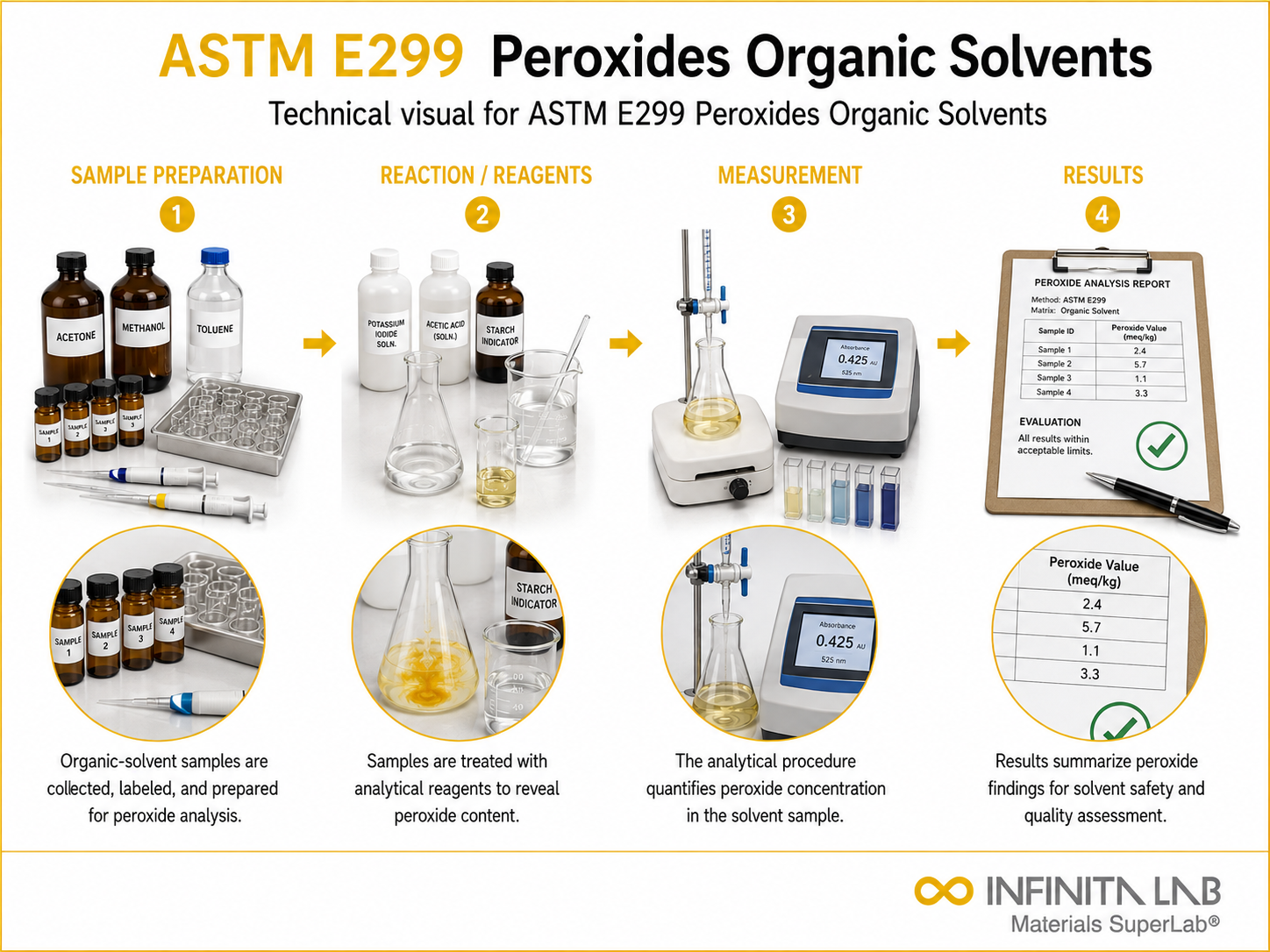
Our ASTM E299 Testing Procedure
Reagent Preparation & Calibration
Prepare required reagents and establish a calibration curve using hydrogen peroxide standards.
1Sample Preparation & Reaction
Measure the solvent sample and react it with ferrous ammonium sulphate and sulfuric acid to develop the colorimetric response.
2Absorbance Measurement
Measure absorbance using a spectrophotometer and determine peroxide concentration from the calibration curve.
3Calculation & Reporting
Calculate the peroxide content (ppm H₂O₂ equivalent), evaluate it against acceptance limits, and document the results.
4ASTM E299 Test Parameters and Requirements
| Parameter | Details |
|---|---|
| Analyte | Total peroxide content |
| Result Expression | Parts per million (ppm) as hydrogen peroxide equivalent |
| Detection Range | Trace levels - typically low ppm range |
| Applicable Solvents | Ethers, alcohols, hydrocarbons, halogenated solvents, ketones, and other peroxide-forming organics |
| Reagents Required | Ferrous ammonium sulfate, sulfuric acid, indicator solution, and hydrogen peroxide reference standard |
| Measurement Method | UV-Vis spectrophotometry at a specified wavelength |
| Calibration | Hydrogen peroxide standard curve |


- UV-Vis spectrophotometer with an appropriate wavelength range and cuvette holder
- Analytical balance for reagent and sample preparation
- Calibrated volumetric glassware – pipettes, volumetric flasks, and burettes
- Hydrogen peroxide reference standard solutions for calibration
- Ferrous ammonium sulfate and sulfuric acid reagent systems prepared per method specification
- Timer for reaction period control
- Fume hood for sample handling of volatile or hazardous solvents
- Appropriate chemical-resistant personal protective equipment and secondary containment
Equipment and Instrumentation Used for ASTM E299 Testing
What You Receive: Test Report, Data, and Certification
- Test report – complete documentation of the sample identity, test date, reagent lots, calibration data, absorbance readings, calculated peroxide concentration, and pass/fail determination against the applicable threshold
- Quantitative peroxide concentration – result expressed in parts per million as hydrogen peroxide equivalent, with reference to the calibration standard used
- Pass/fail determination – compliance status against the specified acceptance limit or safety threshold for the solvent in question.
- Calibration records – standard curve data and linearity confirmation for the analytical run
ASTM E299 Peroxides Organic Solvents FAQs
The standard normally measures active oxygen concentrations from approximately 5 to 80 µg/g, or ppm, and higher. A special reaction-absorption cell can extend the measurement range down to 0–5 ppm.
Yes. Solid samples can be evaluated when they dissolve completely in the specified acetic acid–chloroform solvent mixture. Insoluble materials may require a different analytical method.
The method can measure hydroperoxides, diacyl peroxides, diaroyl peroxides, peresters and ketone peroxides. Their analytical response may vary depending on their chemical reactivity.
The sample undergoes a controlled chemical reaction that produces a measurable colour response related to its peroxide content. Spectrophotometric absorbance is compared with calibration data to determine active oxygen concentration.
Air exposure, sample ageing, contamination, incomplete dissolution and improper reagent preparation can influence results. Instrument calibration, reaction time and consistent sample handling are also important.
Why Choose Infinita Lab for Peroxides Organic Solvents Testing?
At the core of this breadth is our network of 2,000+ accredited laboratories across the USA, offering access to over 10,000 testing methods and analytical services. From advanced materials characterization (SEM, TEM, RBS, XPS) to mechanical, chemical, environmental, biological, and standardized ASTM/ISO-compliant testing, we deliver unmatched flexibility, specialization, and scale. You are never limited by geography, facility, or methodology — Infinita Lab connects you to the right expertise and testing solution, every time.

Need ASTM E299 Peroxides Organic Solvents Testing You Can Rely On?
Send query us at hello@infinitalab.com or call us at (888) 878-3090 to learn more about our services and how we can support you.



Request a Quote
Submit your material details and receive testing procedures, pricing, and turnaround time within 24 hours.
 Quick Turnaround and Hasslefree process
 Confidentiality Guarantee
 Free, No-obligation Consultation
 100% Customer Satisfaction
