

What Is ASTM E290 Guided Bend Ductility?
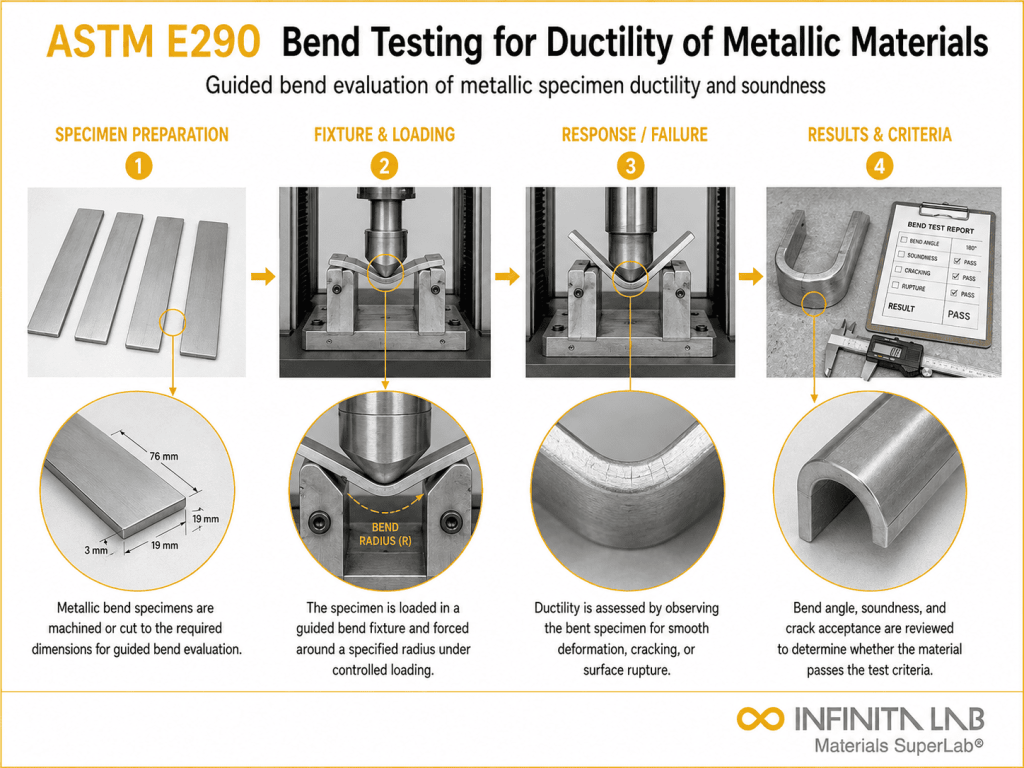
ASTM E290 is a defined procedure for assessing the ductility of metallic substances. To determine whether the material cracks or fails under strain, a specimen is bent to a predetermined radius.
Determining a material’s capacity to undergo plastic deformation without fracture is the primary objective of the ASTM E290 test. The bend test exposes the material’s “outer fibers” to maximum tensile stress, whereas its “inner fibers” undergo compression, in contrast to a tension test, which tears a material apart.
Applications and Benefits of ASTM E290 Guided Bend Ductility Testing
Scope
ASTM E290 focuses on assessing ductility by bending specimens under controlled conditions. It ensures reliable evaluation of material flexibility and resistance to cracking.
The test evaluates:
- Ductility of material
- Bendability without fracture
- Surface crack formation
- Plastic deformation behavior
- Material quality
Applications
- Quality control testing of rolled, forged, and heat-treated metallic products
- Acceptance testing of materials in accordance with product specifications
- Evaluation of welds, plates, bars, and structural components
- Verification of material ductility after heat treatment or forming operations
- Inspection of metals used in construction, pressure vessels, and structural applications
Benefits
- Simple and rapid method to assess material ductility
- Effective in revealing surface cracks, laminations, and internal defects
- Requires minimal specimen preparation and equipment
- Suitable for routine quality control and acceptance testing
- Provides direct visual evaluation of material performance under bending
Our ASTM E290 Testing Procedure
Specimen Preparation
Prepare the test specimen to the specified dimensions with smooth, defect-free surfaces.
1Test Setup
Place the specimen on the bend supports or fixture as per the specified bend method.
2Load Application
Apply load gradually to bend the specimen around the mandrel or support.
3Result Evaluation
Record pass/fail or degree of cracking as per the acceptance criteria.
4ASTM E290 Test Parameters and Requirements
| Parameter | Details |
|---|---|
| Specimen Form | Plate, sheet, bar, rod, or weld coupon |
| Bend Angle | As specified by the product standard |
| Test Temperature | Room temperature unless otherwise specified |
| Evaluation Method | Visual inspection |
| Acceptance Criteria | No cracking or cracking within specified limits |


- Bend testing machine or universal testing machine
- Bend test fixture (mandrel, rollers, or plunger)
- Load application and control system
- Specimen support anvils
- Measuring tools (calipers or ruler)
Equipment and Instrumentation Used for ASTM E290 Testing
What You Receive: Test Report, Data, and Certification
- The specimen either passes or fails based on visible cracking or fracture
- Presence, location, and severity of surface cracks after bending are noted
- Confirmation of material ductility and soundness under bending stress
- Identification of laminations, inclusions, or improper heat treatment
- Results reported in accordance with specified acceptance criteria
ASTM E290 Guided Bend Ductility FAQs
ASTM E290 is a standard test method used to evaluate ductility of materials by bending specimens to assess their ability to deform without cracking under applied load.
ASTM E290 is important because it helps determine material flexibility and resistance to fracture, ensuring suitability for forming and structural applications.
ASTM E290 involves bending a specimen around a specified radius or angle and inspecting for cracks or defects to assess ductility.
Metallic materials, including steel, aluminum, copper, and their alloys, are suitable for ASTM E290 bend testing.
While tensile testing measures properties like ultimate tensile strength and elongation, ASTM E290 focuses on qualitative assessments of ductility through bending.
The latest edition is ASTM E290-26, titled Standard Test Methods for Bend Testing of Material for Ductility. Published in 2026, it covers procedures for evaluating the ability of materials to withstand bending without cracking or developing unacceptable surface irregularities. The standard includes guided-bend, semi-guided bend, free-bend, and bend-and-flatten testing methods. It is used to assess material ductility, forming characteristics, and quality.
ASTM E290 is a standard test method used to evaluate the ductility of materials through controlled bending. It specifies four bending approaches that apply different levels of support and constraint to the specimen. After bending, the convex surface is examined for cracks, fractures, and other surface irregularities. The results help determine whether a material can withstand the required deformation without unacceptable damage.
ASTM E290 evaluates material ductility by bending a prepared specimen under controlled conditions. Depending on the selected procedure, the specimen is bent using a mandrel, supports, or applied force until it reaches a specified angle or inside bend radius. In the bend-and-flatten method, the specimen is bent until its legs come into contact. After testing, the outer curved surface is inspected for cracks and fractures to assess the material's ability to withstand plastic deformation.
Why Choose Infinita Lab for Guided Bend Ductility Testing
When your Guided Bend Ductility results have to hold up - for compliance, a customer audit, or an engineering decision - ASTM E290 accuracy and an unbiased third-party report matter more than price. Infinita Lab routes your ASTM E290 guided bend ductility testing to ISO/IEC 17025-accredited U.S. partner labs with hands-on method experience, so you get defensible data, transparent reporting, and turnaround times built around your project deadline - not ours.

Need ASTM E290 Guided Bend Ductility Testing You Can Rely On?
Send query us at hello@infinitalab.com or call us at (888) 878-3090 to learn more about our services and how we can support you.