


ASTM E1175: Solar Photopic Reflectance Transmittance Testing Services
Accredited ASTM E1175 solar photopic reflectance transmittance testing from Infinita Lab, performed to the exact standard requirements - accurate, reproducible results with full documentation for compliance, R&D, and quality control programs.
TRUSTED BY


Get ASTM E1175 compliant results - request your solar photopic reflectance transmittance testing quote
- Overview
- Scope, Applications, and Benefits
- Test Process
- Specifications
- Instrumentation
- Results and Deliverables
What Is ASTM E1175 Solar Photopic Reflectance Transmittance?
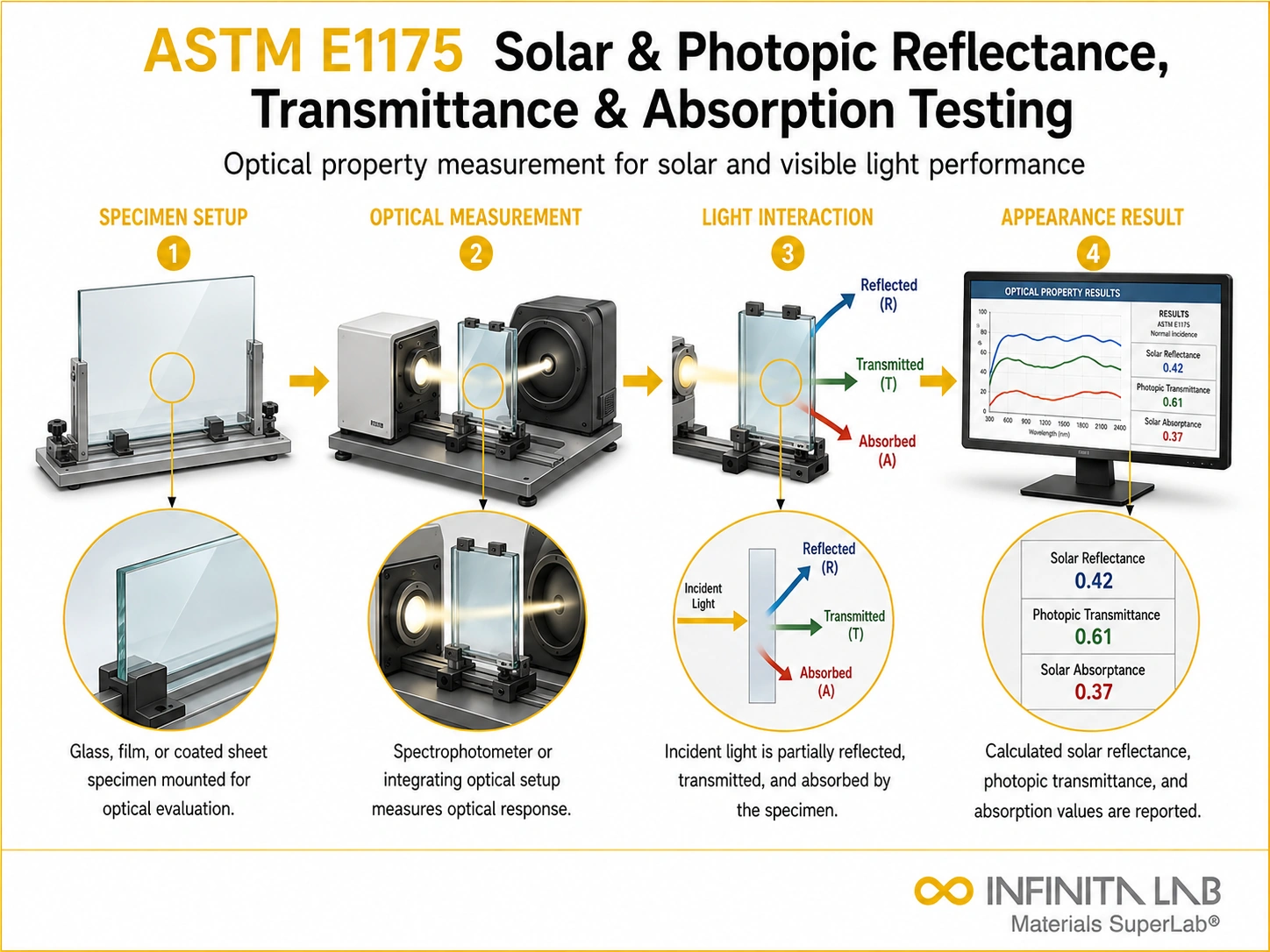
ASTM E1175 is a standard test method for quantifying the total solar/photopic reflectance, transmittance, and absorptance of materials, particularly those that are large, non-uniform, textured (such as window blinds, drapes, or corrugated plastics), or possess intricate surfaces, utilizing a large integrating sphere to deliver precise optical data for quality control and performance assessment.
The goal is to quantify optical characteristics (the amount of light reflected, transmitted, or absorbed) for challenging-to-test materials that are incompatible with conventional spectrophotometers. To obtain absolute measurements, light scattered by big or textured samples is captured using a large integrating sphere.

Applications and Benefits of ASTM E1175 Solar Photopic Reflectance Transmittance Testing
Scope
ASTM E1175 establishes procedures for calculating total solar and photopic reflectance, transmittance, and absorption using spectral measurement data. It ensures consistent integration methods and standardized wavelength ranges for accurate evaluation.
- Determines solar and photopic optical properties of materials
- Uses spectral data over defined wavelength ranges
- Applicable to transparent, translucent, and opaque materials
- Requires spectrophotometric measurement inputs
- Ensures reproducible and standardized calculations
Applications
- Evaluation of glazing and window materials
- Energy efficiency analysis of building materials
- Solar control coating performance assessment
- Optical property characterization of films and plastics
- Research and development of energy-efficient materials
- Compliance testing for building and material standards
Benefits
- Provides accurate total solar and photopic property values
- Supports energy-efficient material design
- Enables comparison of optical performance across materials
- Enhances thermal and visual comfort analysis
- Ensures standardized and reproducible results
- Aids in regulatory compliance and certification
Our ASTM E1175 Testing Procedure
Spectral Data Acquisition
Reflectance and transmittance are measured across relevant wavelength ranges using a spectrophotometer.
1Data Processing
Spectral data is prepared and validated for integration calculations.
2Weighted Integration
Data is integrated using standard solar and photopic weighting functions.
3Property Calculation
Total reflectance, transmittance, and absorption values are calculated.
4ASTM E1175 Test Parameters and Requirements
| Parameter | Details |
|---|---|
| Materials | Transparent, translucent, opaque |
| Method | Spectral optical measurement |
| Wavelength Range | Solar or photopic range |
| Instrumentation | Spectrophotometer (integrating sphere as required) |
| Data Output | Integrated solar/photopic R, T, A values |
| Reporting | Results with test conditions |


- UV–Vis–NIR spectrophotometer
- Integrating sphere attachment
- Calibrated reflectance and transmittance standards
- Sample holder or mounting stage
- Light source covering the solar/photopic range
- Data acquisition and analysis software
Equipment and Instrumentation Used for ASTM E1175 Testing
What You Receive: Test Report, Data, and Certification
- Total solar reflectance, transmittance, and absorption values
- Photopic reflectance and transmittance values
- Spectral data plots and integration results
- Comparative optical performance analysis
- Test report with methodology and conditions
- Compliance verification with ASTM E1175
ASTM E1175 Solar Photopic Reflectance Transmittance FAQs
ASTM E1175 uses spectral data integration rather than single-point measurements, providing more accurate total values by accounting for wavelength-dependent behavior across the solar and visible spectrum.
Solar radiation spans a wide wavelength range, and material response varies with wavelength. Integration ensures that all spectral contributions are weighted correctly, yielding realistic total solar performance values.
Solar properties consider the entire solar spectrum affecting thermal performance, while photopic properties focus on visible light response, representing human visual perception and brightness.
By providing accurate solar and visible light properties, it helps engineers select materials that optimize thermal performance and daylighting, reducing energy consumption.
By integrating spectral data into meaningful total values, it provides comprehensive insight into how materials interact with light and heat, supporting informed design and optimization decisions.
Why Choose Infinita Lab for Solar Photopic Reflectance Transmittance Testing?
When your Solar Photopic Reflectance Transmittance results have to hold up - for compliance, a customer audit, or an engineering decision - ASTM E1175 accuracy and an unbiased third-party report matter more than price. Infinita Lab routes your ASTM E1175 solar photopic reflectance transmittance testing to ISO/IEC 17025-accredited U.S. partner labs with hands-on method experience, so you get defensible data, transparent reporting, and turnaround times built around your project deadline - not ours.

Need ASTM E1175 Solar Photopic Reflectance Transmittance Testing You Can Rely On?
Send query us at hello@infinitalab.com or call us at (888) 878-3090 to learn more about our services and how we can support you.



Request a Quote
Submit your material details and receive testing procedures, pricing, and turnaround time within 24 hours.
 Quick Turnaround and Hasslefree process
 Confidentiality Guarantee
 Free, No-obligation Consultation
 100% Customer Satisfaction
