


ASTM D746 Brittleness Temperature Testing for Plastics & Rubber
This ASTM D 746 Standard Test Method identifies the temperature at which plastics and elastomers turn brittle and fail under distinct impact conditions, aiding in assessing their structural integrity and performance.
TRUSTED BY


Precision-driven testing for dimensional accuracy and compliance
- Overview
- Scope, Applications, and Benefits
- Test Process
- Specifications
- Instrumentation
- Results and Deliverables
Overview
The standard impact test procedure for determining the temperature at which plastic and elastomeric materials exhibit brittle failure under specified high-velocity impact conditions is ASTM D746, the brittleness temperature test. To determine the brittleness temperature of rubber, flexible plastics, and elastomeric materials, ASTM D 746 specifies specimen preparation, impact equipment, and test procedures. This information gives manufacturers, materials engineers, and product designers vital low-temperature performance data for supplier verification programs, material selection, and product design validation.

Scope, Applications, and Benefits
Scope
ASTM D 746 establishes the temperature threshold below which a material changes from ductile to brittle impact behaviour under high-velocity impact loading by striking specified cantilever specimens at a series of decreasing test temperatures until brittle failure occurs.
ASTM D 746 brittleness temperature testing evaluates:
- Low-temperature brittleness threshold of rubber, flexible plastics, and elastomeric materials
- Ductile-to-brittle transition temperature under defined high-velocity impact conditions
- Comparative low-temperature impact performance of plastic and elastomeric material systems
- Effect of formulation, compounding, and processing on low-temperature brittleness behavior
- Compliance with defined minimum brittleness temperature requirements for plastic materials
Applications
- Flexible plastic and elastomeric materials for low-temperature outdoor and industrial applications
- Rubber seals, gaskets, and flexible components operating in cold-temperature environments
- Automotive exterior plastic and rubber components require low-temperature impact performance
- Packaging materials, films, and flexible plastic products used in cold-chain applications
- Material suppliers and compounders requiring ASTM D 746 brittleness temperature test data
Benefits
- Provides reliable low-temperature brittleness data for plastic and elastomeric material selection
- Supports material specification compliance and supplier verification programs
- Identifies low-temperature brittleness deficiencies before product deployment
- Delivers traceable brittleness temperature test records for engineering and research submissions
- Reduces design risk by verifying low-temperature impact performance early in the approval cycle
Test Process
Sample Preparation
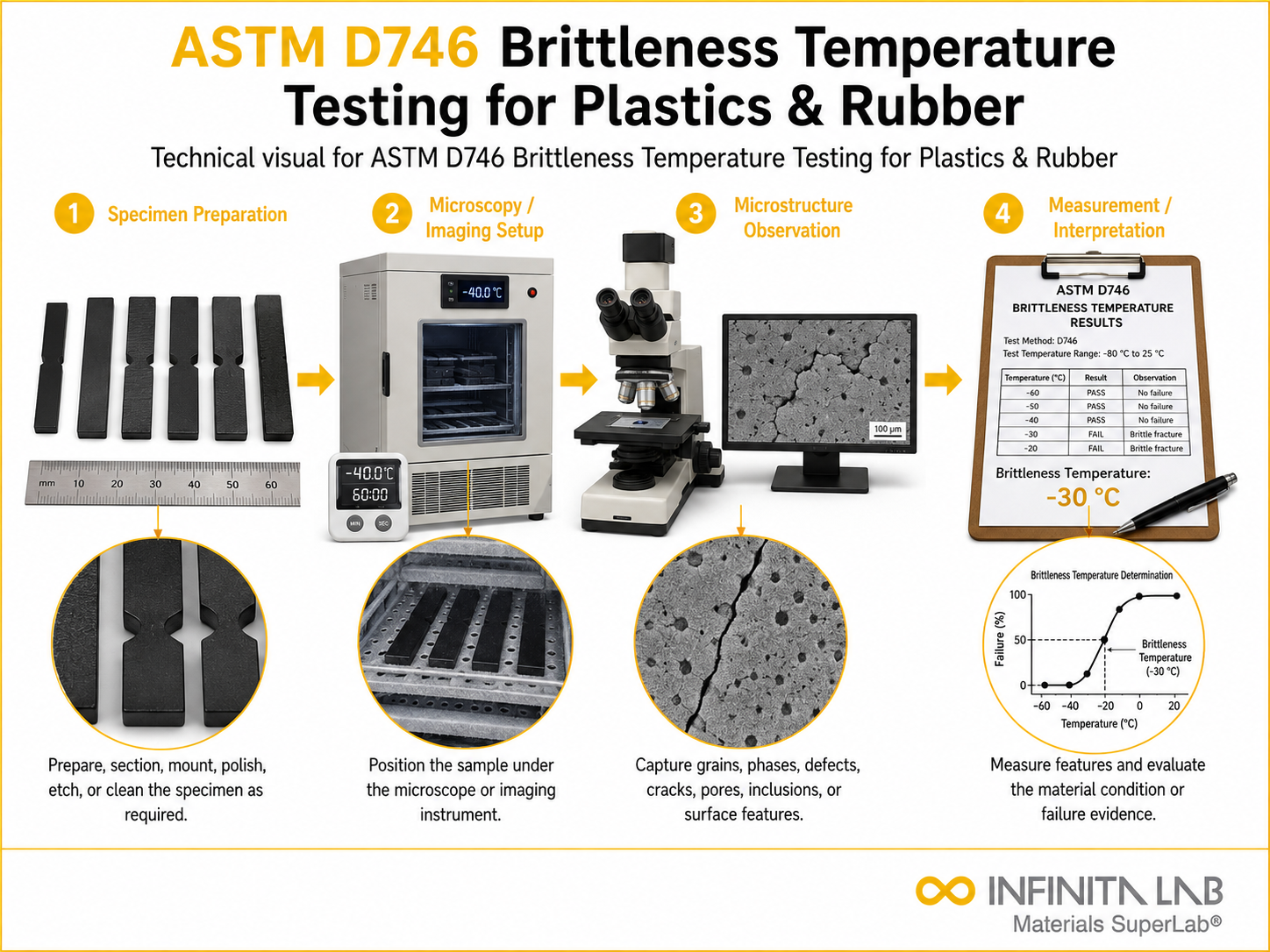
Plastic or elastomeric specimens cut to defined cantilever dimensions and conditioned per ASTM D 746.
1Low-Temperature Conditioning
Specimens immersed in temperature-controlled bath and equilibrated at each defined test temperature.
2High-Velocity Impact Testing
Conditioned specimens struck by defined impact striker at each test temperature and failure mode recorded.
3Data Analysis & Reporting
Failure data analyzed across test temperatures to determine brittleness temperature and test compliance result.
4Technical Specifications
| Parameter | Details |
|---|---|
| Applicable Materials | Rubber, flexible plastics, elastomers, and thermoplastic elastomeric materials |
| Specimen Geometry | Defined cantilever specimen dimensions per ASTM D 746 requirements |
| Temperature Range | Defined decreasing temperature increments per ASTM D 746 test conditions |
| Measured Parameters | Brittle failure occurrence, test temperature, and brittleness temperature determination |
| Measured Outputs | Failure observations, brittleness temperature value, and test compliance result |


Instrumentation Used for Testing
- ASTM D 746 high-velocity impact apparatus with defined striker geometry
- Low-temperature conditioning bath with precision temperature control
- Calibrated thermometer and temperature monitoring system
- Specimen preparation tools for defined cantilever geometry cutting
- Specimen conditioning equipment for temperature equilibration
- Data acquisition and test reporting system
Results and Deliverables
- Impact failure observations at each test temperature for all evaluated specimens
- Brittleness temperature determination per ASTM D 746 statistical evaluation method
- Low-temperature impact performance comparison data across material sets, where applicable
- Test compliance result assessed against the defined material brittleness temperature requirements
- ASTM D 746 test report for material approval, design verification, and supplier assessment submissions
Frequently Asked Questions
ASTM D746 identifies the brittleness temperature of plastics and elastomers. It does this by finding the temperature at which materials break when hit. This helps assess how these materials perform in cold conditions and how well they resist cracking.
Brittleness temperature testing helps manufacturers find out if plastic materials stay flexible in cold temperatures or become brittle. This is important for products used in cold environments.
ASTM D746 is often used for thermoplastics, elastomers, flexible polymers, and plastic compounds. These materials are found in automotive parts, electrical insulation, packaging materials, and outdoor equipment that may be exposed to low temperatures.
ASTM D746 testing cools material samples to lower temperatures. It then applies impact loading to find the temperature at which a specific percentage of samples show brittle failure.
ASTM D746 tests brittleness in a controlled lab setting. This may not reflect the complex stresses found in the real world. Long-term exposure, environmental factors, and loading conditions impact how materials perform.
Why Choose Infinita Lab for Advanced Materials Testing and Characterization?
At the core of this breadth is our network of 2,000+ accredited laboratories across the USA, offering access to over 10,000 testing methods and analytical services. From advanced materials characterization (SEM, TEM, RBS, XPS) to mechanical, chemical, environmental, biological, and standardized ASTM/ISO-compliant testing, we deliver unmatched flexibility, specialization, and scale. You are never limited by geography, facility, or methodology — Infinita Lab connects you to the right expertise and testing solution, every time.

Looking for a Trusted Partner for Accurate and Reliable Testing Services?
Send query us at hello@infinitalab.com or call us at (888) 878-3090 to learn more about our services and how we can support you.



Request a Quote
Submit your material details and receive testing procedures, pricing, and turnaround time within 24 hours.
 Quick Turnaround and Hasslefree process
 Confidentiality Guarantee
 Free, No-obligation Consultation
 100% Customer Satisfaction
