


ASTM D1790: Plastic Film Sheet Brittleness Temperature Testing Services
This ASTM D 1790 standard test method is used to determine the temperature at which plastic sheets with a thickness of 1.00 mm or less experience brittle failure under precisely defined impact conditions. By measuring the material's tendency to fracture, the method helps determine how brittle it is. By putting the plastic sheeting under controlled impact at various temperatures.
TRUSTED BY


Get ASTM D1790 compliant results — request your plastic film sheet brittleness temperature testing quote
- Overview
- Scope, Applications, and Benefits
- Test Process
- Specifications
- Instrumentation
- Results and Deliverables
What Is ASTM D1790 Plastic Film Sheet Brittleness Temperature?
ASTM D1790 describes the standard method of testing the brittleness temperature of plastic sheeting by impact at sub-normal temperatures. Brittleness temperature is the lowest temperature at which a plastic sheet will not crack or fracture when subjected to impact. This test method is essential for determining the low-temperature behavior of plastics used in applications where the material will be subjected to cold temperatures during service, handling, or storage.
The ASTM D1790 method allows evaluation of material toughness, cold-weather durability, and resistance to sudden impact at reduced temperatures. It finds broad applicability in packaging, automotive components, construction materials, and consumer goods in both thermoplastic and thermoset sheet products.

Applications and Benefits of ASTM D1790 Plastic Film Sheet Brittleness Temperature Testing
Scope
ASTM D1790 outlines procedures for determining the temperature at which plastic sheet materials transition from a flexible to a brittle state under impact loading at progressively lower temperatures.
It evaluates:
- Brittleness temperature based on impact failure
- Resistance of plastic sheets to cracking at low temperatures
- Effects of formulation, processing, and aging on low-temperature toughness
- Material performance under controlled cold-impact conditions
The method applies to plastic sheets and films of uniform thickness, including both unreinforced and reinforced materials.
Applications
- Packaging films and freezer-grade plastic sheets
- Automotive exterior and interior plastic components
- Construction and building plastic panels
- Outdoor signage and display materials
- Electrical insulation films and protective sheets
- Quality control and material qualification testing
Benefits
- Identifies safe operating temperature limits for plastic sheets
- Supports material selection for cold-environment applications
- Detects formulation or processing-related brittleness issues
- Enhances product reliability and durability
- Enables comparison of materials under standardized conditions
- Supports quality assurance and product development efforts
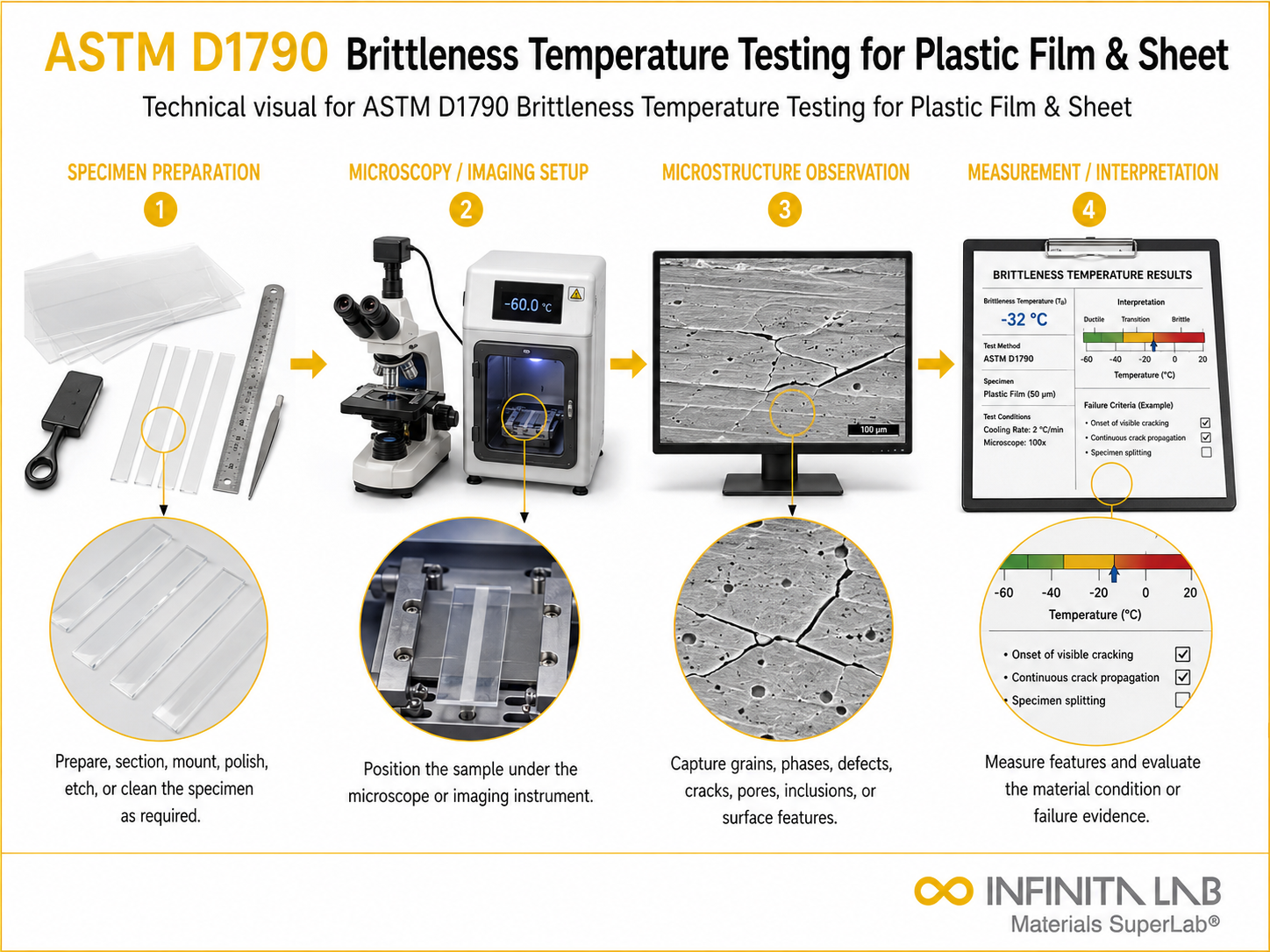
Our ASTM D1790 Testing Procedure
Specimen Preparation & Conditioning
Plastic sheets are cut into standard dimensions and conditioned to remove prior moisture and thermal history before testing.
1Low-Temperature Cooling
Specimens are gradually cooled using a controlled low-temperature medium, such as a refrigerated bath, to reach the specified test temperatures.
2Impact Testing
At each temperature level, a free-falling striker is used to impact the specimen under controlled conditions.
3Inspection & Brittleness Determination
Specimens are visually inspected for cracks or fractures after impact, and the lowest temperature at which no cracking occurs is recorded as the brittleness temperature.
4ASTM D1790 Test Parameters and Requirements
| Parameter | Details |
|---|---|
| Applicable Materials | Thermoplastic and thermoset plastic sheets and films |
| Specimen Form | Rectangular sheet strips of uniform thickness |
| Conditioning | Pre-cooling and drying before testing |
| Temperature Medium | Refrigerated bath or equivalent cooling system |
| Failure Criterion | Visible cracking or fracture upon impact |
| Measured Output | Brittleness temperature (°C or °F) |


- Low-temperature chamber or refrigerated bath
- Impact test apparatus with free-falling striker
- Specimen mounting fixtures
- Temperature monitoring and control system
- Visual inspection tools and lighting
- Data recording and reporting tools
Equipment and Instrumentation Used for ASTM D1790 Testing
What You Receive: Test Report, Data, and Certification
- Brittleness temperature value for plastic sheet materials
- Assessment of low-temperature impact resistance
- Cold-weather durability evaluation
- Comparison of material formulations or processing conditions
- Data supporting material selection and specification
- Documentation for quality control and compliance purposes
ASTM D1790 Plastic Film Sheet Brittleness Temperature FAQs
The brittleness temperature is the lowest temperature at which a plastic sample does not show signs of cracking or failure when impacted. It indicates how the material behaves in cold environments.
A falling striker impact is used to simulate mechanical stress at low temperatures.
Typically, multiple specimens of specified dimensions are required to ensure statistical validity. Guidance is provided based on material type and thickness.
Why Choose Infinita Lab for Plastic Film Sheet Brittleness Temperature Testing?
At the core of this breadth is our network of 2,000+ accredited laboratories across the USA, offering access to over 10,000 testing methods and analytical services. From advanced materials characterization (SEM, TEM, RBS, XPS) to mechanical, chemical, environmental, biological, and standardized ASTM/ISO-compliant testing, we deliver unmatched flexibility, specialization, and scale. You are never limited by geography, facility, or methodology — Infinita Lab connects you to the right expertise and testing solution, every time.

Need ASTM D1790 Plastic Film Sheet Brittleness Temperature Testing You Can Rely On?
Send query us at hello@infinitalab.com or call us at (888) 878-3090 to learn more about our services and how we can support you.



Request a Quote
Submit your material details and receive testing procedures, pricing, and turnaround time within 24 hours.
 Quick Turnaround and Hasslefree process
 Confidentiality Guarantee
 Free, No-obligation Consultation
 100% Customer Satisfaction
