


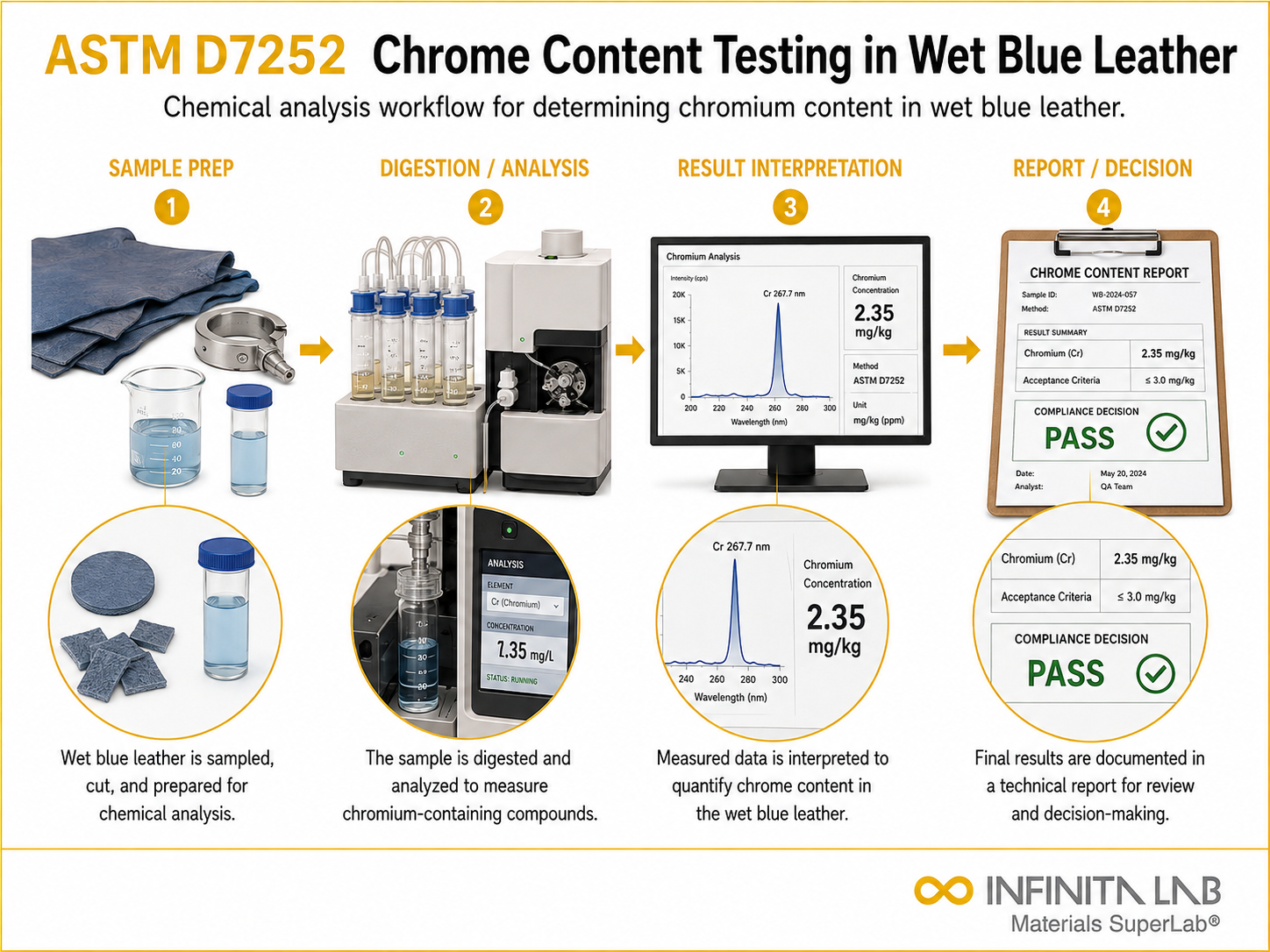
ASTM D7252 Chrome Content Testing in Wet Blue Leather
In crude or modified isocyanates, ASTM D7252-17 measures the proportion by weight of monomeric isomers and total Monomer. The values expressed in SI units should be considered standard. This standard does not include any other units of measurement.
TRUSTED BY


Precision-driven testing for dimensional accuracy and compliance
- Overview
- Scope, Applications, and Benefits
- Test Process
- Specifications
- Instrumentation
- Results and Deliverables
Overview
ASTM D7252-17 provides standard procedures for determining rheological properties of asphalt binder after long-term aging simulation using a Pressure Aging Vessel (PAV). The PAV treatment simulates in-service oxidative aging of asphalt in pavement over many years of service. Post-PAV rheological measurements characterize the hardening and embrittlement of the asphalt binder.
This data is essential for selecting pavement-grade asphalt binders that resist low-temperature cracking and fatigue distress in aged pavements.

Scope, Applications, and Benefits
Scope
ASTM D7252-17 covers rheological testing of PAV-aged asphalt binder and determines:
- Creep stiffness and m-value (BBR test) for low-temperature cracking resistance
- Phase angle and complex modulus in the intermediate temperature range
- Compliance with Superpave Performance Grade (PG) requirements after PAV aging
- Ranking of asphalt binders for fatigue and thermal cracking resistance
Applications
- Superpave PG asphalt binder specification compliance testing
- Pavement design binder selection for climate-specific service
- Evaluation of aged asphalt binder from recovered pavement cores
- Modified asphalt binder performance characterization
- Research on oxidative aging mechanisms in asphalt
Benefits
- Enables long-term performance characterization without field aging
- Provides data for Superpave binder grading and selection
- Supports PG grade extension with modifiers
- Applicable to modified and unmodified asphalt binders
- Widely accepted by DOT and AASHTO for pavement specification
Test Process
PAV Aging
RTFO-aged asphalt is further aged in a PAV at 100°C and 2.1 MPa for 20 hours to simulate long-term aging.
1Bending Beam Rheometer (BBR) Test
PAV-aged asphalt is tested in the BBR at low temperature to measure creep stiffness (S) and m-value for thermal cracking resistance.
2Dynamic Shear Rheometer (DSR) Test
Intermediate temperature phase angle and
3PG Compliance Assessment
All results are compared to Superpave PG grade limits for the low- and intermediate-temperature portion of the specification.
4Technical Specifications
| Parameter | Details |
|---|---|
| Standard | ASTM D7252-17 |
| Test Principle | PAV aging followed by BBR and DSR rheological testing |
| PAV Conditions | 100°C, 2.1 MPa air pressure, 20 hours |
| BBR Measured Output | Creep stiffness S (MPa), relaxation rate m-value at 60 sec |
| DSR Measured Output | Phase angle δ, complex modulus |
| Superpave Limits | S ≤ 300 MPa, m ≥ 0.300 (BBR); |


- Pressure Aging Vessel (PAV) with temperature and pressure control
- Bending Beam Rheometer (BBR) with liquid bath for low-temperature testing
- Dynamic Shear Rheometer (DSR) with Peltier plate temperature control
- Rotary Thin Film Oven (RTFO) for short-term aging pre-treatment
- Analytical balance and sample preparation molds
Instrumentation Used for Testing
Results and Deliverables
- BBR creep stiffness and m-value at specified low temperatures
- DSR complex modulus and phase angle at specified temperatures
- PG grade pass/fail determination for aged binder
- Full Superpave PG grading report
- Data for pavement mixture design and climate-based binder selection
Frequently Asked Question
The m-value represents the rate of stress relaxation in aged asphalt at low temperatures; a higher m-value indicates better stress relaxation, reducing the risk of thermal cracking in cold climates.
Asphalt hardens significantly over years of service due to oxidative aging; testing only virgin binder overestimates low-temperature performance, while PAV aging simulates the actual condition of aged pavement.
PAV aging at 100°C/20 hours is generally considered equivalent to 7–10 years of field aging under typical pavement service conditions.
Yes- ASTM D7252 is applicable to modified binders, though some highly elastic modified binders may require special specimen preparation procedures.
Stiffness above 300 MPa at the minimum design temperature indicates that the asphalt is too rigid to accommodate thermally induced stress, increasing the risk of transverse cracking in pavements.
Why Choose Infinita Lab for Advanced Materials Testing and Characterization?
At the core of this breadth is our network of 2,000+ accredited laboratories across the USA, offering access to over 10,000 testing methods and analytical services. From advanced materials characterization (SEM, TEM, RBS, XPS) to mechanical, chemical, environmental, biological, and standardized ASTM/ISO-compliant testing, we deliver unmatched flexibility, specialization, and scale. You are never limited by geography, facility, or methodology — Infinita Lab connects you to the right expertise and testing solution, every time.

Looking for a Trusted Partner for Accurate and Reliable Testing Services?
Send query us at hello@infinitalab.com or call us at (888) 878-3090 to learn more about our services and how we can support you.



Request a Quote
Submit your material details and receive testing procedures, pricing, and turnaround time within 24 hours.
 Quick Turnaround and Hasslefree process
 Confidentiality Guarantee
 Free, No-obligation Consultation
 100% Customer Satisfaction
