


ASTM D4443: Residual Vinyl Chloride Monomer Content Testing Services
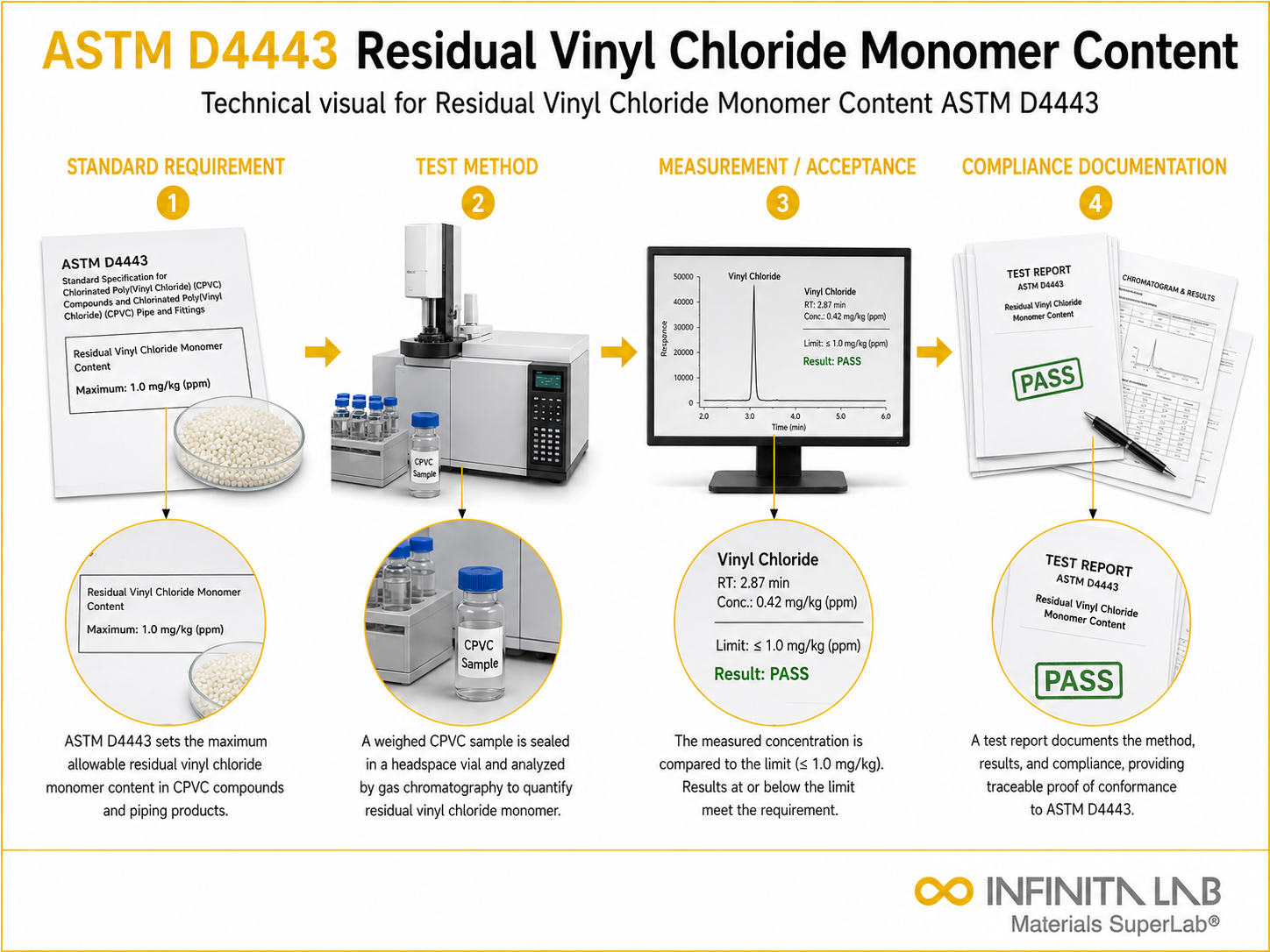
By using headspace gas chromatography, the ASTM D4443 test technique includes the detection of residual vinyl chloride monomer content in the PPB Range in vinyl chloride homo- and copolymers. Vinyl chloride-containing polymers are widely used to package a variety of materials, including foods.
TRUSTED BY


Get ASTM D4443 compliant results — request your residual vinyl chloride monomer content testing quote
- Overview
- Scope, Applications, and Benefits
- Test Process
- Specifications
- Instrumentation
- Results and Deliverables
What Is ASTM D4443 Residual Vinyl Chloride Monomer Content?
ASTM D4443 is the standard test method for determining the residual vinyl chloride monomer (RVCM) content in vinyl chloride homopolymers and copolymers down to the parts-per-billion (ppb) range. During PVC and vinyl copolymer manufacturing, not all of the vinyl chloride monomer reacts – a small residual amount remains trapped in the finished polymer. Because vinyl chloride monomer (VCM) is a recognized carcinogen, the residual content in polymers, especially those used in food packaging and medical applications, must be measured and kept to very low levels.
The method uses headspace gas chromatography (HS-GC). The polymer sample is dissolved or dispersed in a suitable solvent in a sealed vial and heated, driving the volatile residual VCM out of the polymer matrix and into the headspace above the sample. A portion of that headspace is then injected into a gas chromatograph, where the VCM is separated and quantified against calibration standards. The high sensitivity of headspace GC is what allows detection at the ppb levels required for these products.
ASTM D4443 is widely used for quality control of PVC resins and finished vinyl products, particularly where the material contacts food, beverages, or pharmaceuticals. The residual monomer level is both a product safety parameter and an indicator of how completely the polymerization and subsequent stripping/devolatilization processes were carried out.

Applications and Benefits of ASTM D4443 Residual Vinyl Chloride Monomer Content Testing
Scope
ASTM D4443 covers the determination of residual vinyl chloride monomer in vinyl chloride homopolymers and copolymers in the ppb concentration range using headspace gas chromatography. The method is applicable to resins and finished products made from vinyl chloride-based polymers.
Key aspects of the test scope include:
- Analytical technique – headspace gas chromatography (HS-GC), in which volatile residual VCM partitions into the vial headspace upon heating and is then analyzed by GC
- Concentration range – capable of measuring residual VCM down to the parts-per-billion (ppb) range, the sensitivity needed for food-contact and medical-grade materials
- Sample types – vinyl chloride homopolymer (PVC) resins and finished products, and vinyl chloride copolymer materials
- Sample preparation – the polymer is dissolved or dispersed in a suitable solvent (such as N,N-dimethylacetamide) in a sealed headspace vial prior to equilibration and analysis
- Quantification – residual VCM is quantified against calibration standards prepared at known VCM concentrations, typically using the standard addition or external standard approach
- Detection – flame ionization detection (FID) is commonly used; the method specifies the GC conditions needed to resolve and quantify VCM
Applications
- PVC resin manufacturing QC – measuring residual VCM in PVC resins as a routine quality control parameter to confirm the polymerization and stripping processes reduced monomer to acceptable levels
- Food packaging materials – verifying that vinyl chloride polymers used in films, bottles, and containers that contact food meet the very low residual monomer levels required for food-contact safety
- Medical and pharmaceutical products – confirming residual VCM levels in PVC used for medical tubing, blood bags, IV components, and pharmaceutical packaging
- Beverage and water contact products – testing PVC pipe, fittings, and containers intended for potable water or beverage contact
- Consumer products – evaluating residual monomer in vinyl consumer goods where exposure or migration is a concern
- Process validation – using RVCM measurements to verify and optimize the devolatilization/stripping steps in PVC production
- Incoming material verification – confirming that purchased vinyl resins meet the residual monomer specification before they are used in manufacturing
Benefits
- Detects VCM at the ppb levels required for safety – headspace GC provides the sensitivity needed to measure residual monomer at the very low concentrations relevant for food-contact and medical materials, where higher-detection-limit methods would be inadequate
- Directly addresses a recognized health concern – because VCM is a known carcinogen, measuring and controlling residual monomer is a genuine product safety requirement, not just a quality metric
- Headspace sampling avoids matrix interference – analyzing the vapor phase above the dissolved polymer isolates the volatile VCM from the non-volatile polymer matrix, giving clean, interference-free quantification
- Supports food-contact and medical material requirements – RVCM data is needed to demonstrate that vinyl materials meet the residual monomer limits expected for these sensitive applications
- Indicates process completeness – the residual monomer level reflects how effectively the polymerization and stripping steps were performed, giving manufacturers a useful process-control indicator
Our ASTM D4443 Testing Procedure
Prepare the Sample
Weigh the polymer into a headspace vial, add solvent, and seal immediately.
1Equilibrate
Heat the sealed vial under controlled conditions to release residual VCM into the headspace.
2Analyse by GC
Inject the headspace sample into the gas chromatograph and compare it with calibration standards.
3Calculate and Report
Determine residual VCM in ppb or ppm and compare it with the specification limit.
4ASTM D4443 Test Parameters and Requirements
| Parameter | Details |
|---|---|
| Analyte | Residual vinyl chloride monomer (VCM) |
| Technique | Headspace gas chromatography (HS-GC) |
| Detection | Flame ionization detection (FID) |
| Concentration Range | Parts-per-billion (ppb) range |
| Sample Types | PVC resins, vinyl chloride homopolymers and copolymers, finished products |
| Sample Preparation | Dissolution/dispersion in solvent (e.g., N,N-dimethylacetamide) in sealed headspace vial |
| Calibration | VCM standards at known concentrations (external standard or standard addition) |


- Gas chromatograph with flame ionization detector (FID)
- Automated headspace sampler with temperature-controlled equilibration
- Headspace vials and sealing equipment
- Analytical balance for sample weighing
- VCM calibration standards and gas standards
- Microsyringes and solvent dispensing equipment
Equipment and Instrumentation Used for ASTM D4443 Testing
What You Receive: Test Report, Data, and Certification
- Residual VCM report – measured residual vinyl chloride monomer content in ppb (or ppm) for each sample
- Calibration data – calibration standards and curve used to quantify the result, confirming the analytical range and sensitivity
- Chromatograms – GC chromatograms showing the VCM peak for samples and standards
- Comparison against specification (where provided) – measured RVCM tabulated against the applicable limit with pass/fail notation
- Sample records – polymer description, sample mass, solvent and preparation conditions, and lot/batch identification
- Method statement – confirmation of the headspace GC conditions and detection method applied per ASTM D4443
ASTM D4443 Residual Vinyl Chloride Monomer Content FAQs
Residual vinyl chloride monomer is the unreacted vinyl chloride remaining in a polymer after manufacturing. Measuring it is important because vinyl chloride is recognised as a human carcinogen.
The method applies to vinyl chloride resins, compounds, films, bottle walls and similar polymer products. The specimen must be capable of dissolving in a suitable solvent.
The test method can determine residual vinyl chloride concentrations down to approximately 5 µg/kg, or about 5 parts per billion. This makes it suitable for trace-level analysis.
Incorrect sample mass, poor vial sealing, incomplete dissolution and improper temperature control can affect the results. Contamination, calibration errors and insufficient equilibrium time may also reduce accuracy.
The gas chromatograph produces a response corresponding to the amount of vinyl chloride in the headspace. The response is compared with calibrated standards to calculate the concentration in the polymer sample.
Why Choose Infinita Lab for Residual Vinyl Chloride Monomer Content Testing?
At the core of this breadth is our network of 2,000+ accredited laboratories across the USA, offering access to over 10,000 testing methods and analytical services. From advanced materials characterization (SEM, TEM, RBS, XPS) to mechanical, chemical, environmental, biological, and standardized ASTM/ISO-compliant testing, we deliver unmatched flexibility, specialization, and scale. You are never limited by geography, facility, or methodology — Infinita Lab connects you to the right expertise and testing solution, every time.

Looking for an Accredited Partner for ASTM D4443 Residual Vinyl Chloride Monomer Content Testing?
Send query us at hello@infinitalab.com or call us at (888) 878-3090 to learn more about our services and how we can support you.



Request a Quote
Submit your material details and receive testing procedures, pricing, and turnaround time within 24 hours.
 Quick Turnaround and Hasslefree process
 Confidentiality Guarantee
 Free, No-obligation Consultation
 100% Customer Satisfaction
