


ASTM D4273: Polyol Primary Hydroxyl Content Testing Services
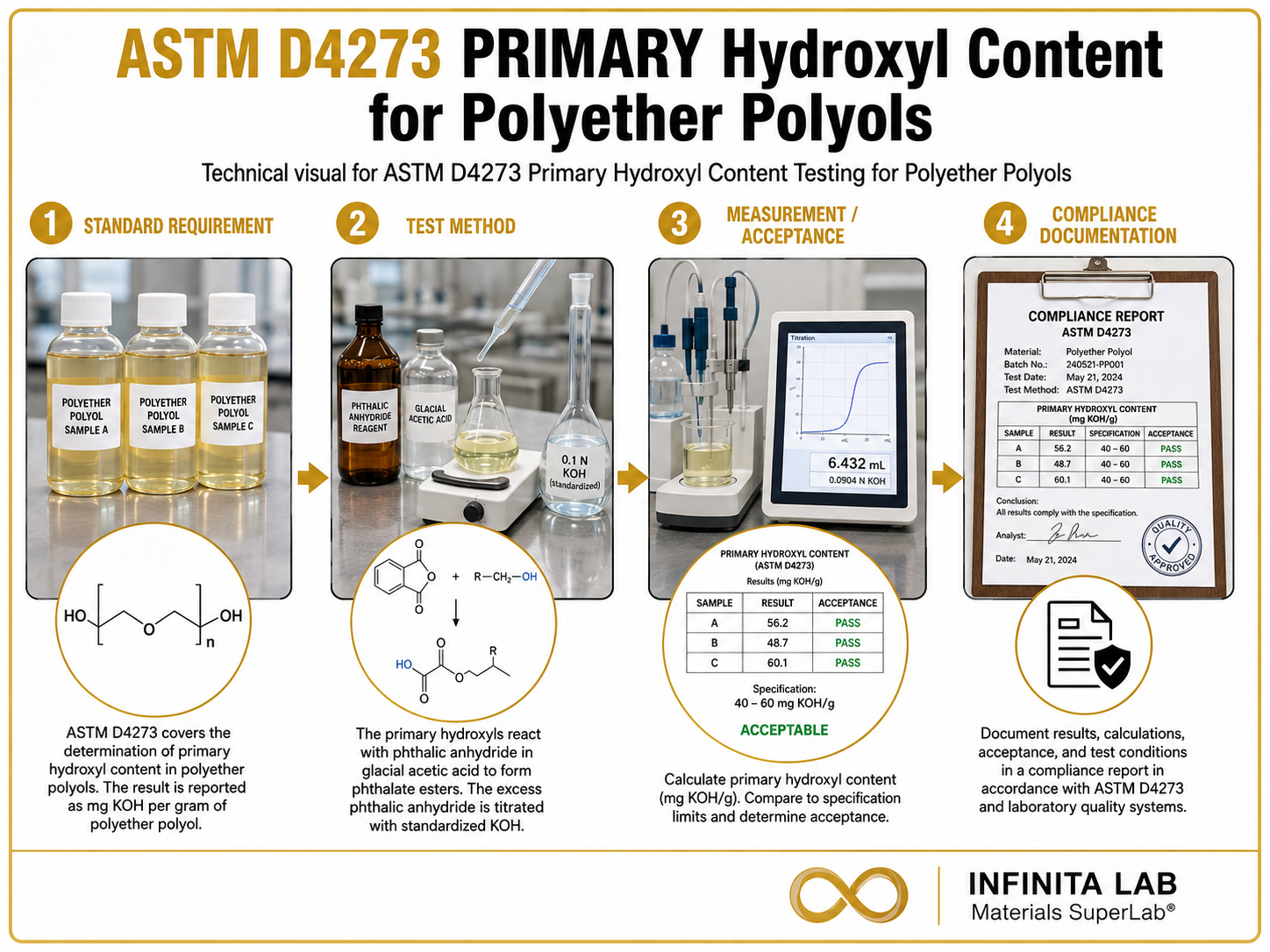
ASTM D4273 is used to determine the primary hydroxyl content of ethylene oxide (EO)-propylene oxide (PO) polyether polyols used to form flexible polyurethane foams. This method is highly efficient for polyether polyols with primary hydroxyl contents of 10 to 90%. The values are considered as a standard when expressed in SI units.
TRUSTED BY


Get ASTM D4273 compliant results — request your polyol primary hydroxyl content testing quote
- Overview
- Scope, Applications, and Benefits
- Test Process
- Specifications
- Instrumentation
- Results and Deliverables
What Is ASTM D4273 Polyol Primary Hydroxyl Content?
ASTM D4273 defines a standardized method for determining the primary hydroxyl content of polyether polyols used in polyurethane formulations. In polyurethane chemistry, the reactivity of a polyol with isocyanate is strongly dependent on the ratio of primary to secondary hydroxyl groups — primary hydroxyls react approximately three times faster than secondary hydroxyls. Therefore, knowing the primary hydroxyl content is critical for controlling reaction kinetics, gel time, and the properties of the resulting polyurethane foam or elastomer.
The method uses ¹H NMR spectroscopy or a chemical derivatization technique to distinguish and quantify primary and secondary hydroxyl groups in the polyol. The primary hydroxyl content is expressed as a percentage of total hydroxyl groups, providing formulators with the data needed to optimize catalyst selection, processing temperatures, and reactant ratios for their polyurethane systems.

Applications and Benefits of ASTM D4273 Polyol Primary Hydroxyl Content Testing
Scope
ASTM D4273 evaluates:
- Primary hydroxyl content as a percentage of total hydroxyl groups
- Ratio of primary to secondary hydroxyl groups in polyether polyols
- Effect of oxyalkylation conditions on hydroxyl group distribution
- Batch-to-batch consistency of polyol reactivity
- Compliance with polyol specification for primary OH content
- Correlation of primary OH content with polyurethane reactivity
Applications
- Flexible and rigid polyurethane foam production
- Polyurethane elastomer and RIM formulation
- Adhesive and sealant polyol characterization
- Coating polyol raw material qualification
- Polyurethane CASE (Coatings, Adhesives, Sealants, Elastomers) applications
- Polyol manufacturer quality control
- Research and development in polyurethane chemistry
Benefits
- Enables control of polyurethane reaction kinetics
- Supports consistent foam and elastomer processing
- Detects batch deviations in polyol reactivity
- Guides catalyst and formulation optimization
- Provides data for polyol specification compliance
- Reduces processing defects from unexpected reactivity variation
Our ASTM D4273 Testing Procedure
Sample Preparation
Polyol specimen is dissolved in the appropriate deuterated solvent for NMR analysis.
1NMR Acquisition
¹H NMR spectrum is acquired with sufficient signal-to-noise for hydroxyl group assignment.
2Peak Assignment
Primary and secondary hydroxyl-associated proton resonances are identified and integrated.
3Calculation
Primary hydroxyl percentage is calculated from the integrated peak areas.
4ASTM D4273 Test Parameters and Requirements
| Parameter | Details |
|---|---|
| Test Principle | ¹H NMR spectroscopy or chemical derivatization |
| Applicable Materials | Polyether polyols |
| Output Units | Mole percent (%) primary hydroxyl |
| Measured Outputs | Primary OH content (%), secondary OH content (%) |


- ¹H NMR spectrometer (300 MHz or higher)
- Deuterated solvents (CDCl₃, DMSO-d₆)
- NMR sample tubes
- Data processing and integration software
- Analytical balance
- Calibration reference standards
Equipment and Instrumentation Used for ASTM D4273 Testing
What You Receive: Test Report, Data, and Certification
- Primary hydroxyl content (mole percent)
- Secondary hydroxyl content (mole percent)
- NMR spectrum with peak assignments
- Batch comparison data
- Compliance reports
ASTM D4273 Polyol Primary Hydroxyl Content FAQs
ASTM D4273 determines primary hydroxyl content of polyether polyols. It evaluates reactivity and chemical structure, helping assess suitability for polyurethane production and ensuring consistent performance in foam and elastomer applications.
Key parameters include sample preparation, titration method, reagent concentration, temperature, and reaction time. Controlled conditions ensure accurate determination of hydroxyl content in polyether polyols.
The test measures primary hydroxyl content, typically expressed as percentage. Results indicate reactivity of polyols and influence processing behavior and final properties of polyurethane products.
ASTM D4273 applies to polyether polyols used in polyurethane foams, coatings, adhesives, and elastomers where hydroxyl functionality affects curing and performance.
ASTM D4273 results depend on accurate titration and sample purity. Interfering substances may affect results, and additional analytical methods may be required for comprehensive characterization of polyol chemistry.
Why Choose Infinita Lab for Polyol Primary Hydroxyl Content Testing?
At the core of this breadth is our network of 2,000+ accredited laboratories across the USA, offering access to over 10,000 testing methods and analytical services. From advanced materials characterization (SEM, TEM, RBS, XPS) to mechanical, chemical, environmental, biological, and standardized ASTM/ISO-compliant testing, we deliver unmatched flexibility, specialization, and scale. You are never limited by geography, facility, or methodology — Infinita Lab connects you to the right expertise and testing solution, every time.

Looking for an Accredited Partner for ASTM D4273 Polyol Primary Hydroxyl Content Testing?
Send query us at hello@infinitalab.com or call us at (888) 878-3090 to learn more about our services and how we can support you.



Request a Quote
Submit your material details and receive testing procedures, pricing, and turnaround time within 24 hours.
 Quick Turnaround and Hasslefree process
 Confidentiality Guarantee
 Free, No-obligation Consultation
 100% Customer Satisfaction
