


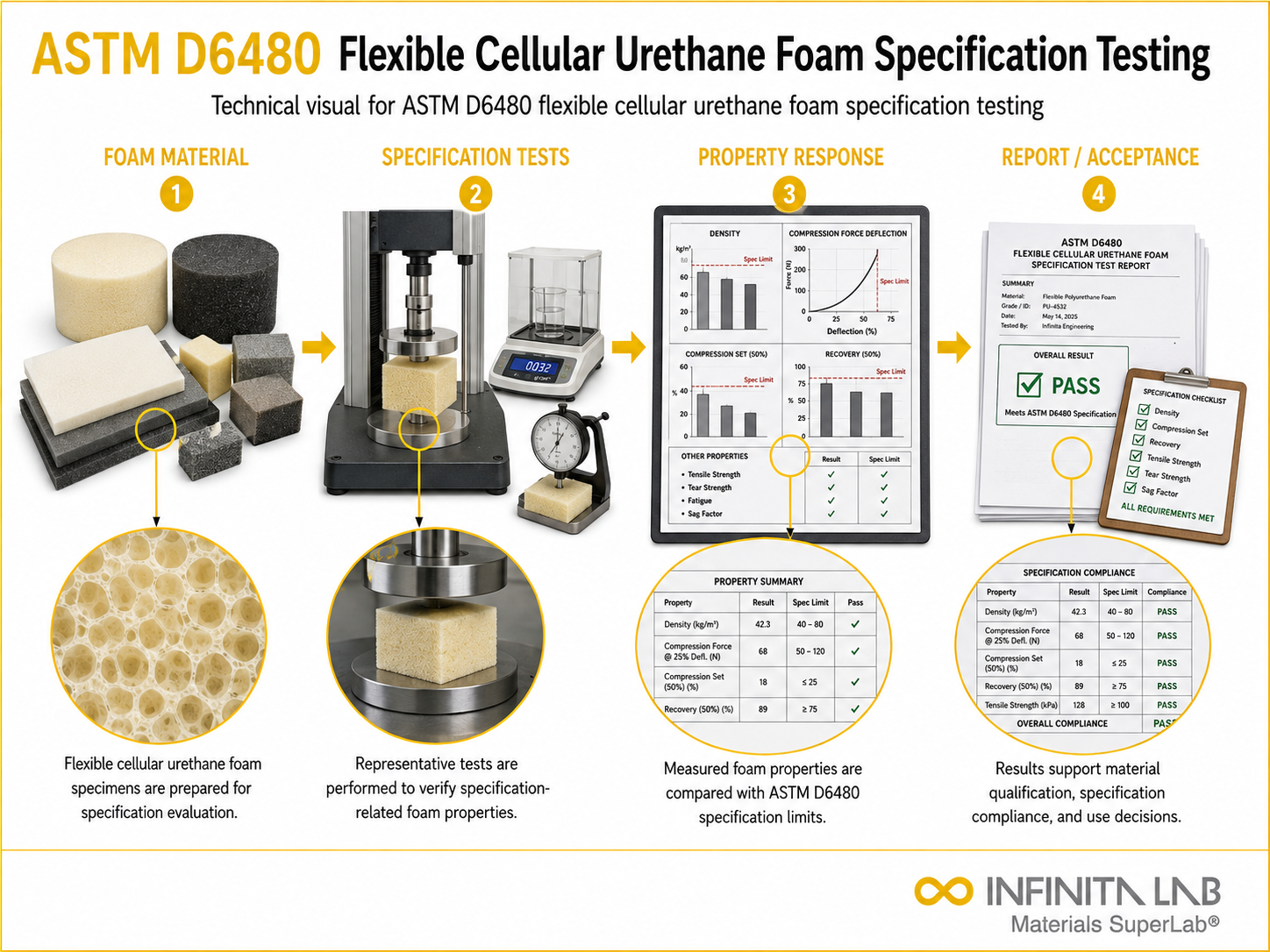
ASTM D6480 Flexible Cellular Urethane Foam Specification Testing
ASTM D6480-05 describes a procedure for detecting asbestos in wiped-off surface samples and calculating the concentration of asbestos as the number of structures per unit area of the tested surface. The final results of this test method are expressed in SI units.
TRUSTED BY


Precision-driven testing for dimensional accuracy and compliance
- Overview
- Scope, Applications, and Benefits
- Test Process
- Specifications
- Instrumentation
- Results and Deliverables
Overview
ASTM D6480 provides a method for collecting surface wipe samples to detect and quantify asbestos fibers using Transmission Electron Microscopy (TEM). It is used to assess contamination on surfaces in buildings, industrial sites, and environmental areas where asbestos exposure is a concern.
The method ensures high-resolution identification and measurement of asbestos fibers, enabling accurate evaluation of potential exposure risks. It is widely applied in environmental monitoring, occupational hygiene, and clearance testing after asbestos abatement activities to confirm safe conditions.

Scope, Applications, and Benefits
Scope
This method focuses on detection and analysis of asbestos fibers on surfaces using wipe sampling.
- Surface collection of asbestos contamination
- Identification using Transmission Electron Microscopy
- Applicable to building and environmental surfaces
- Detection of asbestos fiber types and dimensions
- Used for clearance and contamination assessment
- Supports regulatory compliance and exposure evaluation
Applications
- Asbestos abatement clearance verification
- Environmental contamination assessment
- Industrial hygiene monitoring
- Building inspection and safety evaluation
- Occupational exposure assessment
- Post-remediation validation
Benefits
- High sensitivity for detecting asbestos fibers
- Accurate identification of fiber morphology
- Supports regulatory compliance requirements
- Helps ensure safe environments
- Enables quantitative contamination assessment
- Provides detailed microscopic analysis
Test Process
Sample Collection
A sterile wipe is used to collect surface dust containing potential asbestos fibers from a defined area.
1Sample Preparation
The collected sample is processed and prepared on a suitable substrate for microscopic examination.
2Microscopic Analysis
The prepared sample is analyzed using Transmission Electron Microscopy to identify and characterize fibers.
3Data Interpretation
Fiber concentration, type, and dimensions are evaluated and reported based on analytical results.
4Technical Specifications
| Parameter | Details |
|---|---|
| Sampling area | Defined surface area for consistent collection |
| Wipe material | Non-contaminating, fiber-free wipes |
| Detection method | Transmission Electron Microscopy (TEM) |
| Fiber identification | Morphology, composition, and size analysis |
| Sample preparation | Filter or grid-based TEM preparation |
| Detection limit | Extremely low fiber concentration detection capability |
| Fiber length criteria | Based on regulatory definitions |
| Fiber diameter | Nanoscale resolution via TEM |


Instrumentation Used for Testing
- Transmission Electron Microscope (TEM)
- Sampling wipes and collection kits
- Sample preparation equipment
- Microscopy grid system
- Laboratory filtration apparatus
- Analytical data processing system
- Clean laboratory environment tools
Results and Deliverables
- Asbestos fiber identification (type and morphology)
- Fiber concentration per unit area
- TEM micrographs of fibers
- Analytical report with measurements
- Contamination assessment results
- Compliance and clearance evaluation
Frequently Asked Questions
TEM provides significantly higher magnification and resolution than light microscopy, allowing identification of extremely fine asbestos fibers. It also enables elemental analysis, ensuring accurate differentiation between asbestos and non-asbestos fibers for reliable contamination assessment and regulatory compliance.
Surface wipe sampling directly evaluates settled asbestos fibers on surfaces, providing a practical measure of contamination and potential exposure risk. It is particularly useful in post-remediation verification and indoor environments where airborne sampling alone may not represent actual exposure levels.
Accuracy depends on sampling technique, surface type, wipe material, and contamination control. Improper handling or uneven sampling can lead to underestimation or overestimation of fiber presence, affecting interpretation of contamination levels and safety decisions.
Asbestos fibers are highly sensitive to cross-contamination. Strict contamination control ensures that collected samples reflect true surface conditions, preventing false positives or inaccurate exposure assessments that could impact safety decisions and regulatory compliance.
Surface wipe sampling does not measure airborne fibers and may not represent overall exposure risk. It is also influenced by surface texture and sampling efficiency, requiring careful interpretation alongside other environmental monitoring methods.
Why Choose Infinita Lab for Advanced Materials Testing and Characterization?
At the core of this breadth is our network of 2,000+ accredited laboratories across the USA, offering access to over 10,000 testing methods and analytical services. From advanced materials characterization (SEM, TEM, RBS, XPS) to mechanical, chemical, environmental, biological, and standardized ASTM/ISO-compliant testing, we deliver unmatched flexibility, specialization, and scale. You are never limited by geography, facility, or methodology — Infinita Lab connects you to the right expertise and testing solution, every time.

Looking for a Trusted Partner for Accurate and Reliable Testing Services?
Send query us at hello@infinitlab.com or call us at (888) 878-3090 to learn more about our services and how we can support you.



Request a Quote
Submit your material details and receive testing procedures, pricing, and turnaround time within 24 hours.
 Quick Turnaround and Hasslefree process
 Confidentiality Guarantee
 Free, No-obligation Consultation
 100% Customer Satisfaction
