


ASTM C674: Ceramic Flexural Strength Testing Services
ASTM C674 determines flexural properties of Ceramic Whiteware by calculating the modulus of rupture and modulus of elasticity. Flexural properties are the properties that describe how material gets deformed. Standard values are reported in imperial units.
TRUSTED BY


Get ASTM C674 compliant results — request your ceramic flexural strength testing quote
- Overview
- Scope, Applications, and Benefits
- Test Process
- Specifications
- Instrumentation
- Results and Deliverables
What Is ASTM C674 Ceramic Flexural Strength?
ASTM C674 is the standard test method for determining the flexural properties of ceramic whiteware materials. Whiteware ceramics -a category that includes porcelain, vitrified china, stoneware, earthenware, and similar fired ceramic products -are used in sanitary ware, tableware, electrical insulators, and technical ceramic applications. Knowing how these materials respond to bending stress is essential for product design, quality control, and comparing formulations or firing conditions during development.
The standard determines two properties from a single three-point bending test on bar specimens: the modulus of rupture (MOR) and the modulus of elasticity (MOE). Modulus of rupture is the maximum bending stress at the point of fracture -essentially the flexural strength of the material. Modulus of elasticity is the ratio of stress to strain in the elastic region of loading, describing how stiff the material is before it breaks. Both values are reported in imperial units (psi) as specified by the standard.
Testing is straightforward but sensitive to specimen preparation. Ceramic whitewares are brittle, and their strength is influenced by surface finish, edge condition, porosity, and any flaws introduced during cutting or grinding. The standard specifies specimen dimensions, surface preparation requirements, and loading geometry to ensure consistent, reproducible results that can be meaningfully compared across materials and laboratories.

Applications and Benefits of ASTM C674 Ceramic Flexural Strength Testing
Scope
ASTM C674 applies to fired ceramic whiteware materials, including porcelain, vitrified china, stoneware, earthenware, and similar products. The test uses rectangular bar specimens loaded in three-point bending on a defined span. The modulus of rupture is calculated from the maximum load at fracture, the span length, and the specimen’s cross-sectional dimensions. The modulus of elasticity is determined from the load-deflection data in the elastic region, using a deflectometer to measure midspan deflection under incrementally applied loads before the fracture test. Specimen dimensions and surface preparation are specified to minimize the effects of edge and surface flaws. Results are reported in psi. The standard falls under ASTM Committee C21 on Ceramic Whitewares and Related Products and is published in BOS Vol. 15.02.
Applications
- Sanitary ware and vitreous china product quality control -toilets, basins, bathtubs
- Tableware and dinnerware strength qualification for flatware, cups, and bowls
- Electrical porcelain insulator mechanical property verification
- Technical ceramic whiteware component performance evaluation
- Body and glaze formulation development -comparing strength across different clay body compositions
- Firing schedule optimization -evaluating the effect of peak temperature and soak time on flexural properties
- Raw material qualification -assessing the effect of different clays, feldspar, or flux additions on fired strength
- Incoming material verification for ceramic components used in electrical or structural applications
Benefits
- Determines both flexural strength (MOR) and stiffness (MOE) from a single test specimen and loading event
- Three-point bending geometry is simple to set up and produces consistent results with properly prepared specimens.
- Directly applicable to product and material specifications written in imperial units
- Sensitive enough to detect strength differences caused by formulation changes, firing variations, or raw material substitutions
- Widely recognized within the ceramic whiteware industry for product qualification and supplier comparison.n
- Results complement other characterization data, ta such as water absorption, apparent porosity, and thermal expansion.
- Applicable across the full range of whiteware types,s from earthenware to fully vitrified porcelain
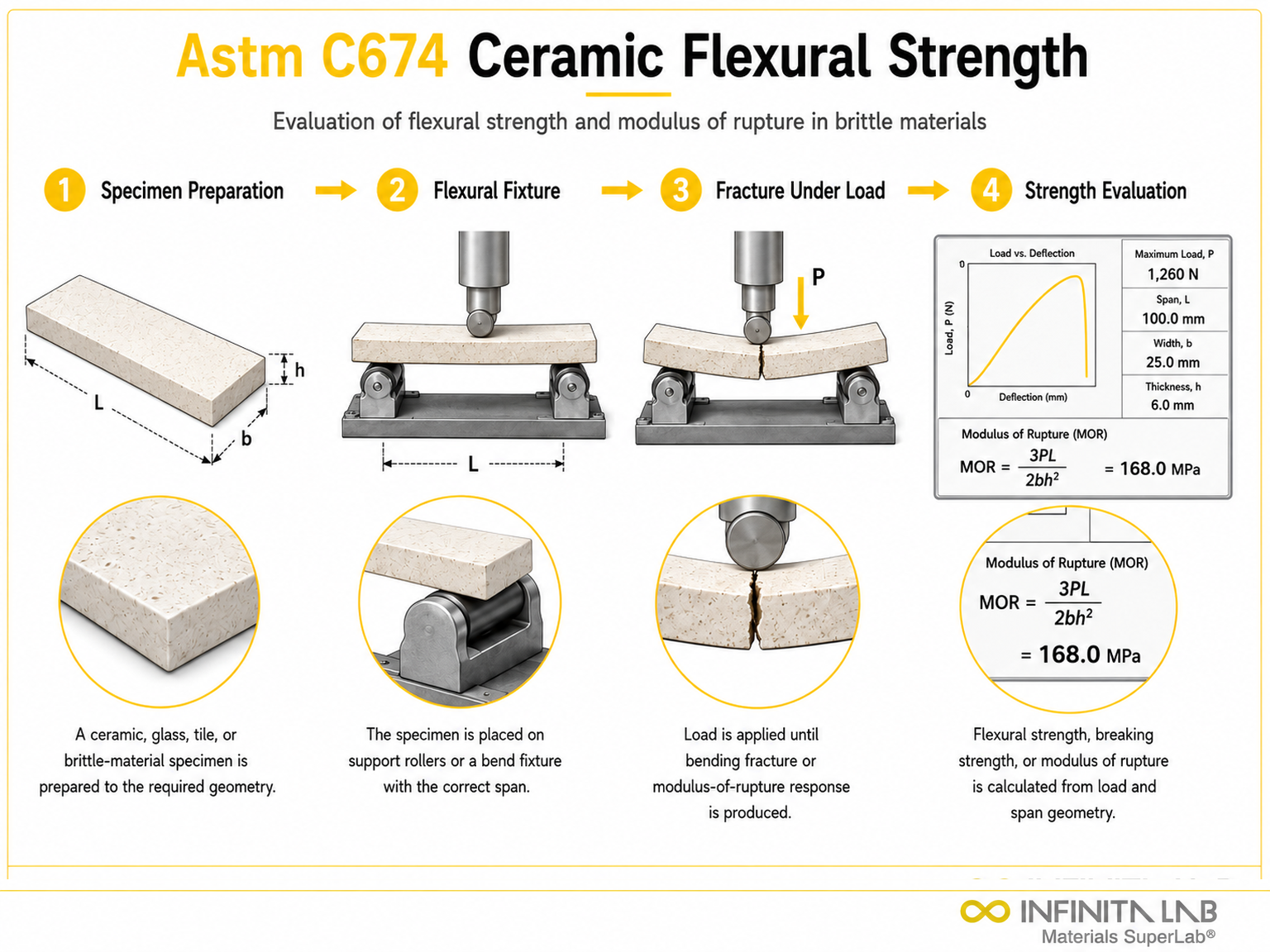
Our ASTM C674 Testing Procedure
Specimen Preparation
Rectangular bar specimens are cut from fired whiteware products or test tiles using a diamond saw.
1Modulus of Elasticity Determination
The specimen is placed on the two support rollers of the three-point bending fixture at the specified span.
2Modulus of Rupture Test
After the MOE measurement, loading is continued at a steady rate until the specimen fractures.
3Data Recording and Reporting
The moduli of rupture and elasticity are calculated and recorded for each specimen.
4ASTM C674 Test Parameters and Requirements
| Parameter | Details |
|---|---|
| Standard | ASTM C674-88 (Reapproved 2016) |
| ASTM Committee | C21 – Ceramic Whitewares and Related Products |
| BOS Volume | 15.02 |
| Test Method | Three-point bending on rectangular bar specimens |
| Material Types | Ceramic whitewares -porcelain, vitrified china, stoneware, earthenware |
| Determined Properties | Modulus of Rupture (MOR), Modulus of Elasticity (MOE) |


- Universal testing machine or dedicated flexure test frame with load cell
- Three-point bending fixture with support rollers and loading nose at specified span
- Deflectometer or LVDT for midspan deflection measurement during MOE loading
- Diamond saw for specimen cutting from fired whiteware products or test tiles
- Surface grinder for specimen face preparation and parallelism
- Micrometer for specimen dimension measurement to 0.001 inch
- Calibrated load cell covering the expected fracture load range
Equipment and Instrumentation Used for ASTM C674 Testing
What You Receive: Test Report, Data, and Certification
- Modulus of rupture (MOR) for each specimen in psi
- Modulus of elasticity (MOE) for each specimen in psi
- Average MOR and MOE for the test lot with a range of individual values
- Fracture location for each specimen and notation of any specimens excluded due to out-of-span fracture
- Specimen dimensions -length, width, and depth at test section
- Span length and loading geometry used
- Material description and product identification
- Test report with all individual and average values formatted for quality control records, product specification review, or material development documentation
ASTM C674 Ceramic Flexural Strength FAQs
ASTM C674 determines the flexural strength (modulus of rupture) of ceramic whiteware under bending load. It helps assess how the material behaves under mechanical stress before fracture.
Flexural strength indicates resistance to cracking or breaking during handling, processing, and end-use. It is a key quality parameter for structural reliability in ceramic products.
The method is used for ceramic whiteware such as porcelain, stoneware, sanitary ware, and electrical ceramics where brittle fracture behavior must be characterized.
A ceramic specimen is subjected to a controlled bending load until fracture occurs, typically using a three-point or four-point bending setup. The breaking stress is then calculated.
Results can be influenced by porosity, firing temperature, microstructural defects, specimen geometry, surface finish, and internal residual stresses from processing.
Why Choose Infinita Lab for Ceramic Flexural Strength Testing?
At the core of this breadth is our network of 2,000+ accredited laboratories across the USA, offering access to over 10,000 testing methods and analytical services. From advanced materials characterization (SEM, TEM, RBS, XPS) to mechanical, chemical, environmental, biological, and standardized ASTM/ISO-compliant testing, we deliver unmatched flexibility, specialization, and scale. You are never limited by geography, facility, or methodology — Infinita Lab connects you to the right expertise and testing solution, every time.

Need ASTM C674 Ceramic Flexural Strength Testing You Can Rely On?
Send query us at hello@infinitalab.com or call us at (888) 878-3090 to learn more about our services and how we can support you.



Request a Quote
Submit your material details and receive testing procedures, pricing, and turnaround time within 24 hours.
 Quick Turnaround and Hasslefree process
 Confidentiality Guarantee
 Free, No-obligation Consultation
 100% Customer Satisfaction
