


ASTM D6385: Activated Carbon Acid Extractable Ash Testing Services
ASTM D6385-99 test method is used to determine the amount of acid-extractable content present in a sample of activated carbon. This test method applies to any form in which activated carbon may exist.
TRUSTED BY


Get ASTM D6385 compliant results — request your activated carbon acid extractable ash testing quote
- Overview
- Scope, Applications, and Benefits
- Test Process
- Specifications
- Instrumentation
- Results and Deliverables
What Is ASTM D6385 Activated Carbon Acid Extractable Ash?
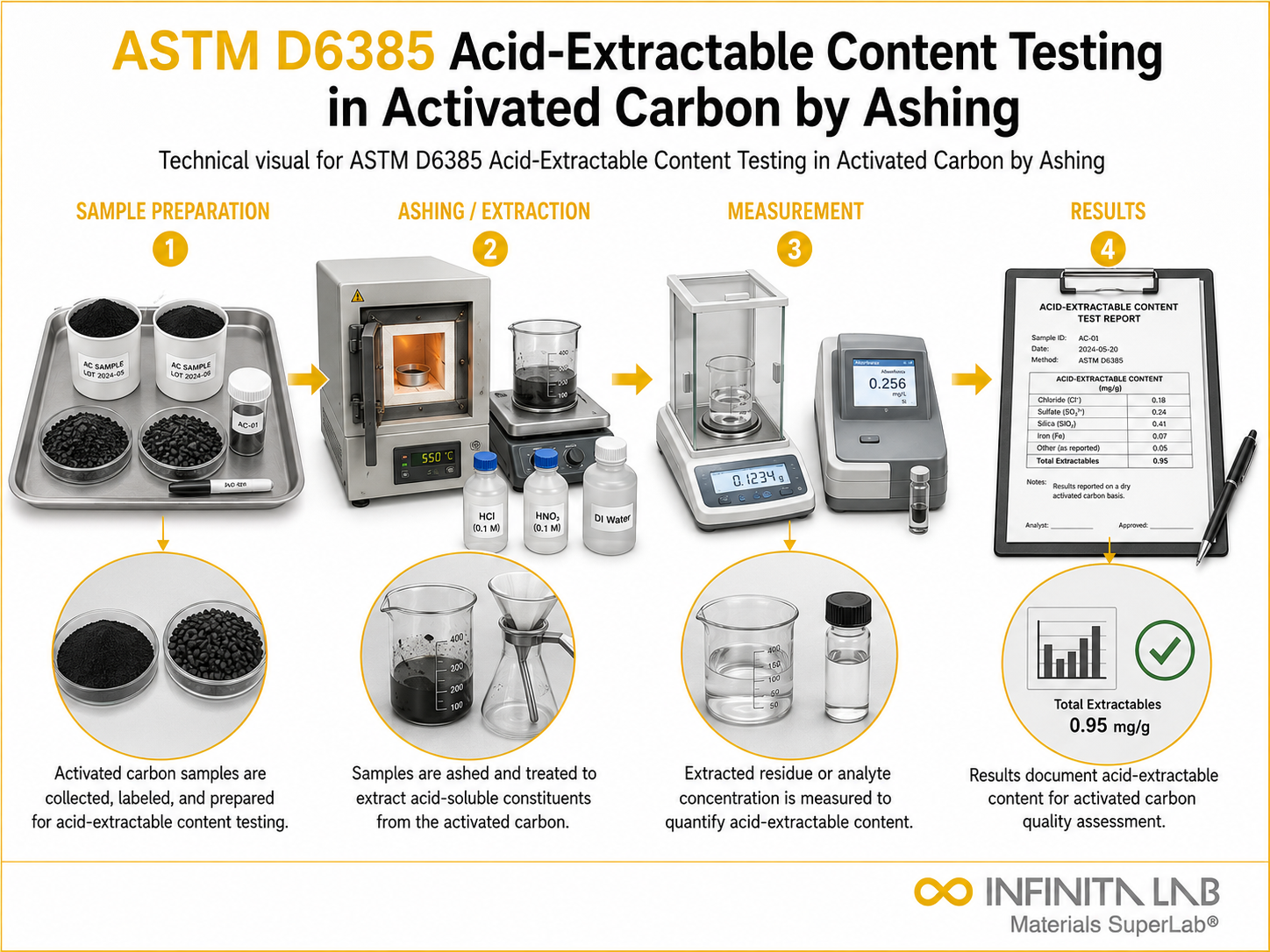
ASTM D6385 determines the acid-extractable content in activated carbon by first ashing the material and then treating the residue with acid to quantify soluble inorganic components. This method evaluates impurities that may affect adsorption performance and chemical stability.
The standard is essential for ensuring activated carbon quality in purification, filtration, and adsorption applications. It helps identify unwanted mineral content, assess material purity, and confirm suitability for use in water treatment, air purification, and chemical processing systems.

Applications and Benefits of ASTM D6385 Activated Carbon Acid Extractable Ash Testing
Scope
This standard is used to quantify acid-soluble inorganic constituents in activated carbon after combustion.
- Determination of acid-extractable inorganic content
- Applicable to powdered and granular activated carbon
- Evaluation after controlled ashing process
- Assessment of residual mineral impurities
- Used for quality control and material specification compliance
- Helps in purity verification for adsorption applications
Applications
- Water treatment and purification systems
- Air filtration and gas adsorption
- Chemical and pharmaceutical processing
- Activated carbon manufacturing quality control
- Environmental monitoring and remediation
- Catalyst support material evaluation
Benefits
- Ensures high purity of activated carbon
- Improves adsorption efficiency
- Detects inorganic contamination
- Enhances product consistency
- Supports regulatory and quality compliance
- Provides reliable compositional analysis
Our ASTM D6385 Testing Procedure
Sample Ashing
The activated carbon sample is heated at high temperature to burn off organic components and obtain ash residue.
1Acid Extraction
The ash is treated with a specified acid solution to dissolve acid-soluble inorganic compounds.
2Filtration and Separation
The solution is filtered to separate undissolved residue from the acid extract.
3Quantitative Analysis
The extract is analyzed to determine the amount of acid-soluble inorganic content present in the sample.
4ASTM D6385 Test Parameters and Requirements
| Parameter | Details |
|---|---|
| Sample type | Activated carbon (powdered or granular) |
| Ashing temperature | High temperature sufficient to remove organic matter |
| Acid type | Specified acid solution for extraction |
| Extraction time | Controlled duration for consistent dissolution |
| Filtration method | Standard filtration for residue separation |
| Measurement accuracy | High precision analytical balance |
| Residue analysis | Determination of undissolved inorganic content |
| Temperature control | Strict control during ashing process |


- Muffle furnace for ashing
- Analytical balance
- Filtration apparatus
- Beakers and glassware
- Acid-resistant containers
- Drying oven
- Desiccator
Equipment and Instrumentation Used for ASTM D6385 Testing
What You Receive: Test Report, Data, and Certification
- Acid-extractable inorganic content percentage
- Ash content measurement
- Filtration residue data
- Purity assessment of activated carbon
- Complete analytical report
- Compliance evaluation against specifications
ASTM D6385 Activated Carbon Acid Extractable Ash FAQs
ASTM D6385 identifies acid-soluble inorganic impurities remaining after ashing. By quantifying these extractable components, it provides a clear indication of material purity, helping manufacturers ensure the activated carbon meets stringent performance and quality standards.
Ashing removes all organic carbon content, leaving only inorganic residues. This step is essential because it isolates the mineral fraction, ensuring that only acid-extractable inorganic components are measured accurately without interference from organic matter.
High levels of inorganic impurities can block pores or reduce active surface area, lowering adsorption efficiency. Measuring acid-extractable content helps ensure optimal performance in purification and filtration applications.
Ash content represents the non-combustible inorganic fraction. High ash content can reduce adsorption capacity and efficiency, making its measurement critical for performance evaluation.
Limitations include potential variability in acid solubility and sensitivity to experimental conditions. Accurate results require strict adherence to procedure and proper instrumentation.
Why Choose Infinita Lab for Activated Carbon Acid Extractable Ash Testing
At the core of this breadth is our network of 2,000+ accredited laboratories across the USA, offering access to over 10,000 testing methods and analytical services. From advanced materials characterization (SEM, TEM, RBS, XPS) to mechanical, chemical, environmental, biological, and standardized ASTM/ISO-compliant testing, we deliver unmatched flexibility, specialization, and scale. You are never limited by geography, facility, or methodology — Infinita Lab connects you to the right expertise and testing solution, every time.

Looking for an Accredited Partner for ASTM D6385 Activated Carbon Acid Extractable Ash Testing?
Send query us at hello@infinitalab.com or call us at (888) 878-3090 to learn more about our services and how we can support you.



Request a Quote
Submit your material details and receive testing procedures, pricing, and turnaround time within 24 hours.
 Quick Turnaround and Hasslefree process
 Confidentiality Guarantee
 Free, No-obligation Consultation
 100% Customer Satisfaction
