

What Is ASTM D5649 Adhesive Threaded Fastener Torque Strength?
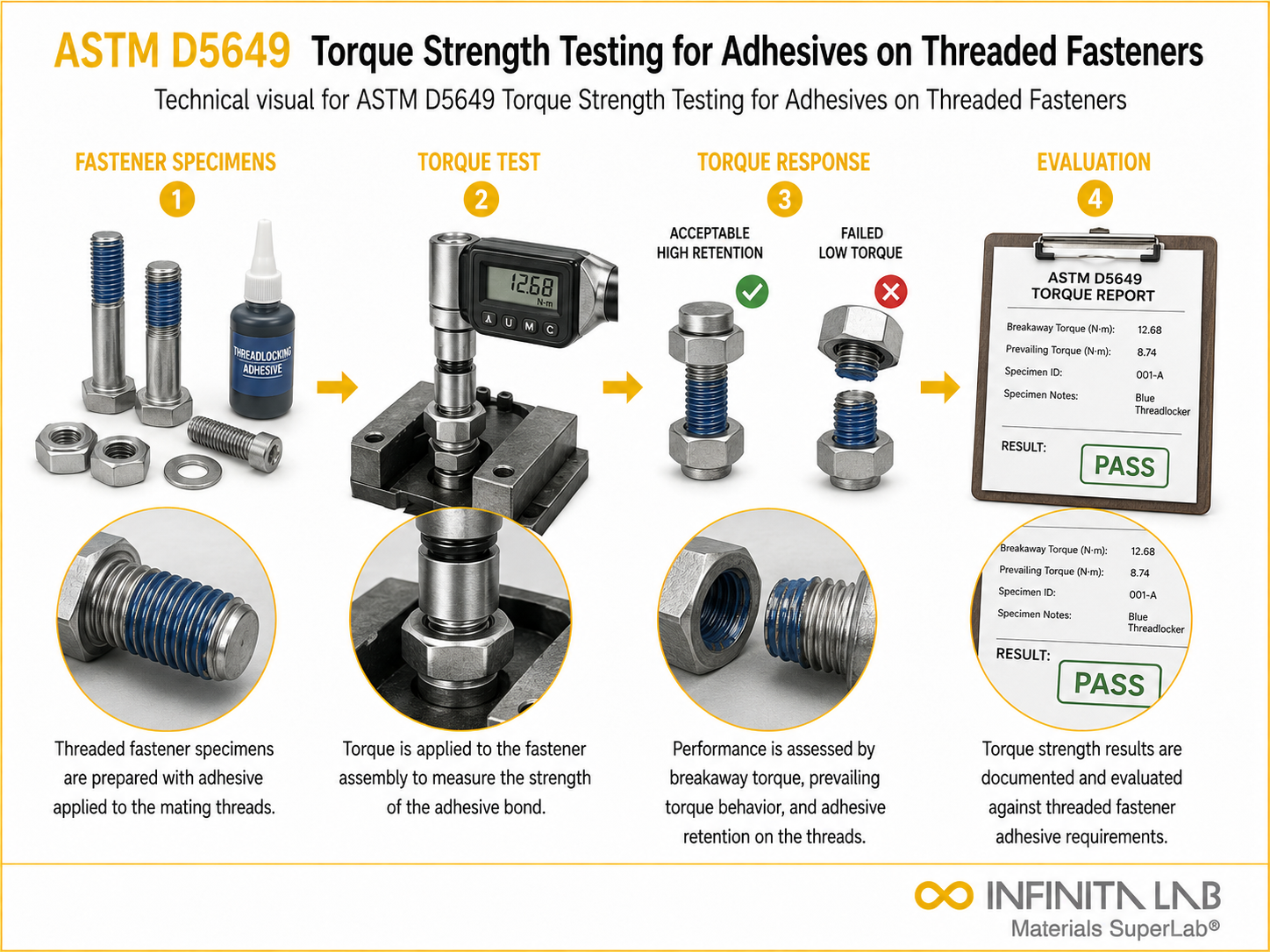
ASTM D5649 determines the torque strength of adhesives used on threaded fasteners by measuring the resistance to rotation after curing. It evaluates the locking capability of adhesives in preventing loosening under applied torque conditions.
This method is essential for assessing the effectiveness of thread-locking adhesives in maintaining joint integrity. It helps ensure reliable fastening performance, especially in applications subjected to vibration, dynamic loads, or thermal variations.

Applications and Benefits of ASTM D5649 Adhesive Threaded Fastener Torque Strength Testing
Scope
ASTM D5649 covers the measurement of torque strength of adhesives applied to threaded fasteners after curing. It focuses on determining breakaway and prevailing torque required to rotate the fastener.
- Applicable to threaded fasteners with adhesives
- Measures breakaway and prevailing torque
- Evaluates adhesive locking performance
- Suitable for cured adhesive systems
- Supports quality control and product validation
Applications
- Thread-locking adhesive performance testing
- Automotive and aerospace assemblies
- Industrial machinery fastening systems
- Vibration-resistant joint evaluation
- Maintenance and repair applications
- Quality assurance in manufacturing
- Research and development of adhesives
Benefits
- Ensures strong locking performance
- Prevents fastener loosening
- Improves joint reliability and safety
- Supports optimal adhesive selection
- Enhances product durability
- Enables consistent assembly quality
Our ASTM D5649 Testing Procedure
Sample Preparation
Adhesive is applied to threaded fasteners and allowed to cure under specified conditions.
1Assembly Setup
Fastener is installed into a test fixture designed to measure torque resistance.
2Torque Application
Rotational torque is applied to determine breakaway and prevailing torque values.
3Data Evaluation
Torque values are recorded and analyzed to assess adhesive strength and locking performance.
4ASTM D5649 Test Parameters and Requirements
| Parameter | Details |
|---|---|
| Property Measured | Torque strength |
| Sample Type | Threaded fasteners with adhesive |
| Output | Breakaway and prevailing torque |
| Units | Torque (Nm) |
| Test Condition | After adhesive curing |
| Measurement Method | Controlled rotational torque |
| Adhesive Type | Thread-locking adhesives |
| Data Recording | Torque vs rotation |


- Torque measurement device
- Fastener holding fixture
- Rotational testing system
- Data acquisition system
- Calibration equipment
- Surface preparation tools
Equipment and Instrumentation Used for ASTM D5649 Testing
What You Receive: Test Report, Data, and Certification
- Breakaway torque values
- Prevailing torque values
- Adhesive locking performance assessment
- Comparative analysis of adhesive products
- Test observations and conditions
- Detailed analytical report
ASTM D5649 Adhesive Threaded Fastener Torque Strength FAQs
ASTM D5649 is important because it evaluates the torque required to overcome adhesive locking in threaded fasteners. This ensures joints remain secure under vibration and load, preventing loosening and improving overall mechanical reliability in critical assemblies.
ASTM D5649 defines breakaway torque as the initial torque required to start fastener movement after adhesive curing. It reflects the strength of the adhesive bond and its resistance to loosening under static conditions.
ASTM D5649 focuses on rotational resistance after curing, while torque-tension tests evaluate clamp load during tightening. ASTM D5649 specifically measures adhesive locking performance rather than preload generation.
ASTM D5649 ensures adhesives provide sufficient resistance to rotation, reducing the risk of loosening due to vibration or dynamic loads.
ASTM D5649 ensures adhesives provide sufficient locking strength, improving joint durability and resistance to loosening in real-world applications.
Why Choose Infinita Lab for Adhesive Threaded Fastener Torque Strength Testing
At the core of this breadth is our network of 2,000+ accredited laboratories across the USA, offering access to over 10,000 testing methods and analytical services. From advanced materials characterization (SEM, TEM, RBS, XPS) to mechanical, chemical, environmental, biological, and standardized ASTM/ISO-compliant testing, we deliver unmatched flexibility, specialization, and scale. You are never limited by geography, facility, or methodology — Infinita Lab connects you to the right expertise and testing solution, every time.

Looking for an Accredited Partner for ASTM D5649 Adhesive Threaded Fastener Torque Strength Testing?
Send query us at hello@infinitalab.com or call us at (888) 878-3090 to learn more about our services and how we can support you.





