


ASTM D2396 PVC Resin Testing by Torque Rheometer
These ASTM D 2396 standard test procedures are intended to assess the conventional poly(vinyl chloride) (PVC) resin's powder-mixing time, which is frequently utilized for a variety of applications. The consistency of the quality and performance of PVC-based goods, from pipes to coatings, depends on the precise measurement of this mixing time.
TRUSTED BY


Precision-driven testing for dimensional accuracy and compliance
- Overview
- Scope, Applications, and Benefits
- Test Process
- Specifications
- Instrumentation
- Results and Deliverables
Overview
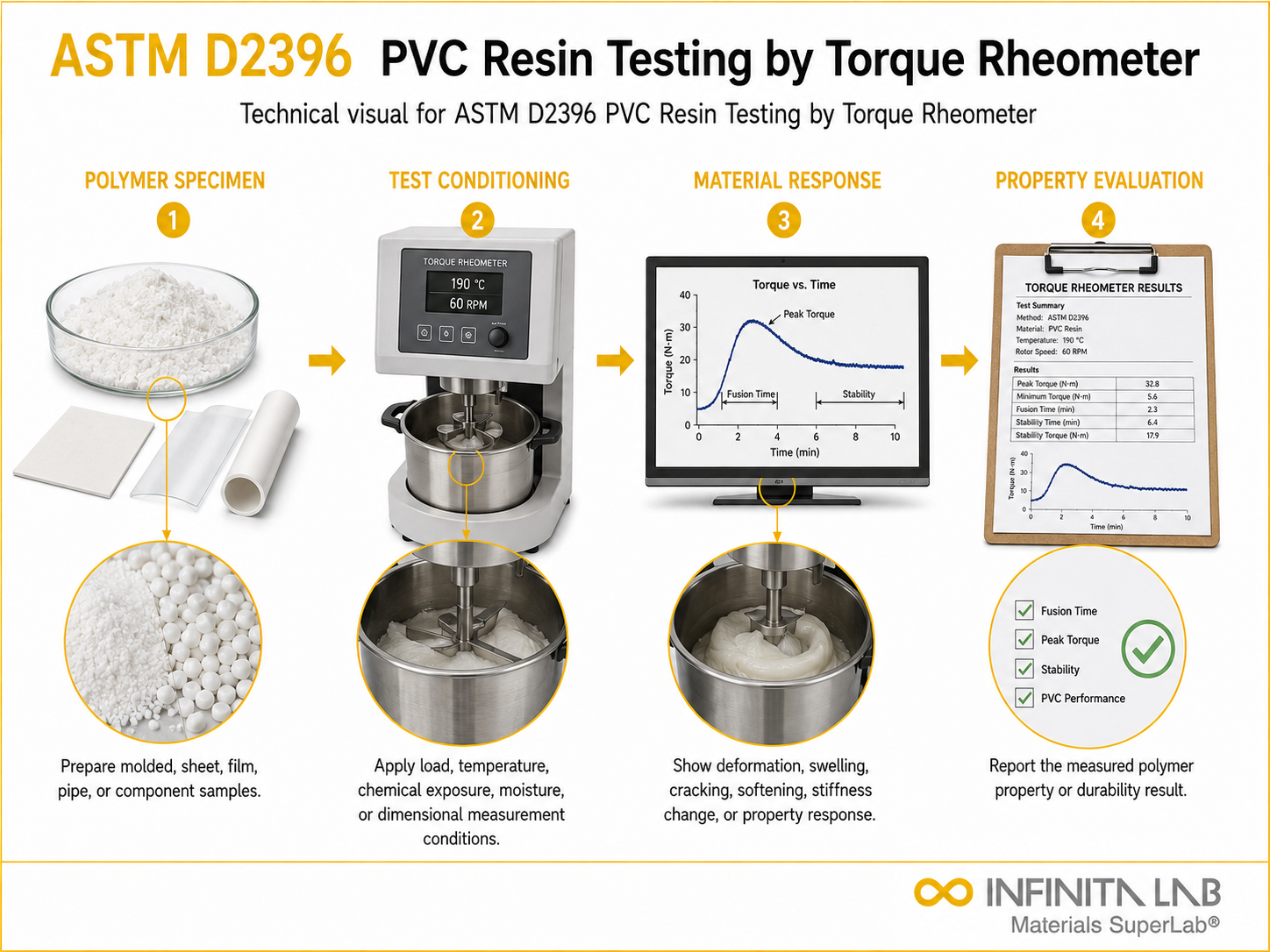
ASTM D2396 evaluates the processing behavior of polyvinyl chloride (PVC) resins using a torque rheometer. The test measures torque over time during mixing, providing insight into fusion characteristics and thermal stability.
This method is widely used in PVC processing, compounding, and product development. It helps optimize formulations and ensures consistent processing performance.

Scope, Applications, and Benefits
Scope
ASTM D2396 assesses the behavior of PVC resin during thermal and mechanical processing by monitoring torque response. The test evaluates fusion, gelation, and degradation characteristics.
The test evaluates:
- Fusion behavior of PVC resins
- Torque response during processing
- Thermal stability of compounds
- Gelation and processing characteristics
- Suitability for extrusion and molding
Applications
- PVC compounding and formulation
- Cable insulation and sheathing
- Pipe and profile manufacturing
- Film and sheet production
- Polymer processing research
- Quality control in PVC production
Benefits
- Provides real-time processing data
- Helps optimize PVC formulations
- Detects thermal degradation behavior
- Supports process control and consistency
- Enables comparison of resin performance
Test Process
Sample Preparation
PVC resin or compound is prepared for testing.
1Instrument Setup
Sample is loaded into the torque rheometer chamber.
2Mixing and Heating
Material is subjected to controlled temperature and shear.
3Data Recording & Evaluation
Torque vs time curve is analyzed to assess processing behavior.
4Technical Specifications
| Parameter | Details |
|---|---|
| Applicable Materials | PVC resins and compounds |
| Temperature Range | ~160°C to 200°C |
| Rotor Speed | ~20 rpm to 100 rpm |
| Test Duration | ~5 minutes to 20 minutes |
| Torque Range | Torque Range |
| Measured Outputs | Torque-time curve, fusion time |


- Torque rheometer
- Heating and control system
- Mixing chamber and rotors
- Temperature sensors
- Sample preparation tools
- Data acquisition system
Instrumentation Used for Testing
Results and Deliverables
- Torque vs time curve
- Fusion time and peak torque values
- Processing behavior evaluation
- Thermal stability assessment
- Test condition summary
- ASTM compliance report
Frequently Asked Question
ASTM D2396 evaluates processing behavior of PVC resins using a torque rheometer. It measures fusion characteristics and flow behavior, helping optimize processing conditions and ensure consistent product quality.
Key parameters include temperature, rotor speed, sample weight, and mixing time. These factors influence torque response and fusion behavior during testing.
The test records torque versus time curves, indicating fusion time, peak torque, and stability. Results reflect processing characteristics and material performance.
ASTM D2396 applies to polyvinyl chloride (PVC) resins used in pipes, profiles, cables, and other extrusion or molding applications.
ASTM D2396 results depend on test conditions and equipment setup. It may not fully represent industrial processing variations, requiring correlation with real manufacturing conditions for accurate interpretation.
Why Choose Infinita Lab for Advanced Materials Testing and Characterization?
At the core of this breadth is our network of 2,000+ accredited laboratories across the USA, offering access to over 10,000 testing methods and analytical services. From advanced materials characterization (SEM, TEM, RBS, XPS) to mechanical, chemical, environmental, biological, and standardized ASTM/ISO-compliant testing, we deliver unmatched flexibility, specialization, and scale. You are never limited by geography, facility, or methodology — Infinita Lab connects you to the right expertise and testing solution, every time.

Looking for a Trusted Partner for Accurate and Reliable Testing Services?
Send query us at hello@infinitalab.com or call us at (888) 878-3090 to learn more about our services and how we can support you.



Request a Quote
Submit your material details and receive testing procedures, pricing, and turnaround time within 24 hours.
 Quick Turnaround and Hasslefree process
 Confidentiality Guarantee
 Free, No-obligation Consultation
 100% Customer Satisfaction
