


ASTM D5113 Adhesive Attack Testing on Rigid Cellular Foam
Rigidity of Cellular Polystyrene (RCPS) foam cavitation damage is measured using the ASTM D5113 test method when an adhesive is used to bond this substrate. This would help the end-user decide which adhesive to use with the RCPS foam.
TRUSTED BY


Precision-driven testing for dimensional accuracy and compliance
- Overview
- Scope, Applications, and Benefits
- Test Process
- Specifications
- Instrumentation
- Results and Deliverables
Overview
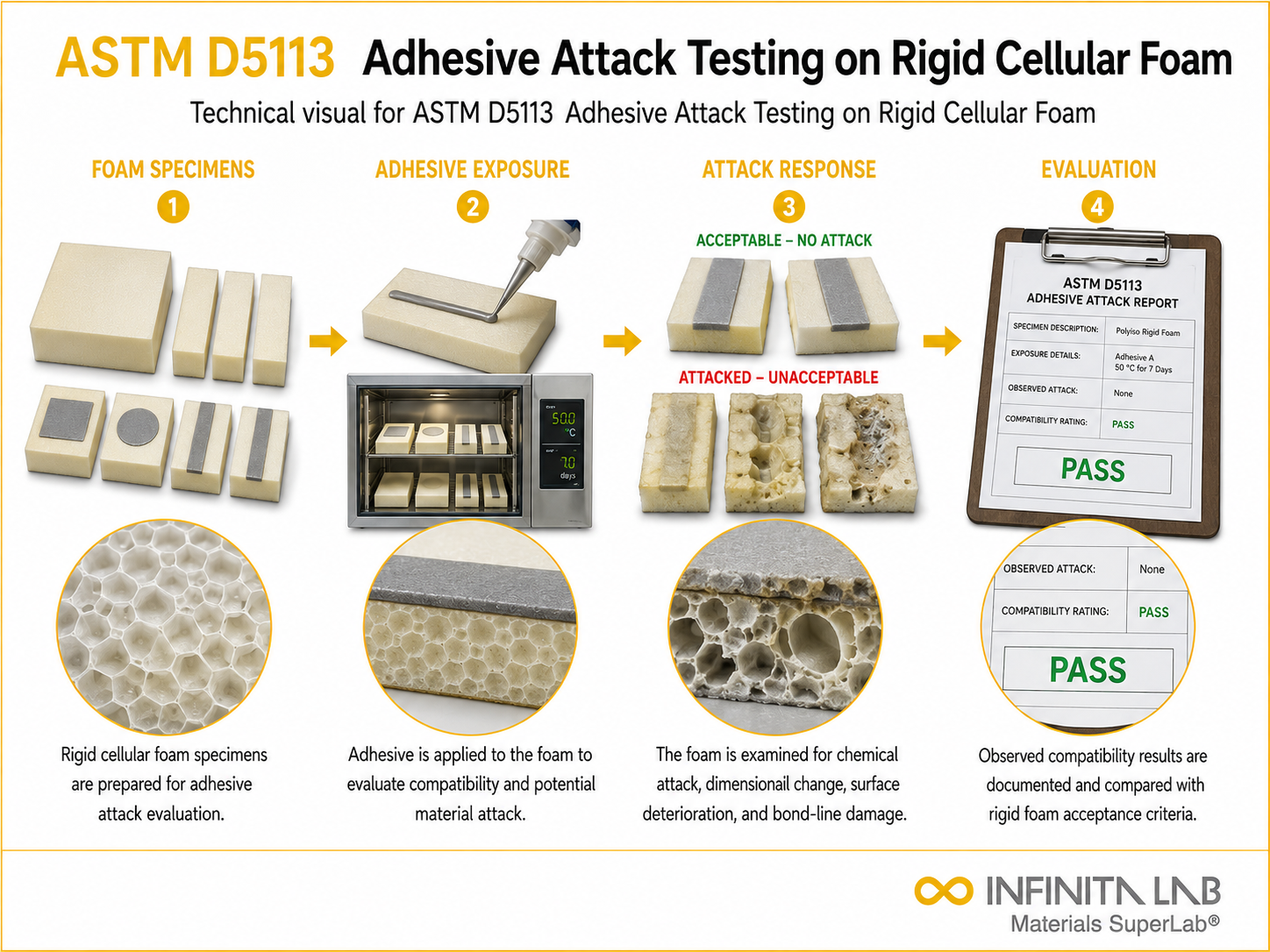
ASTM D5113 evaluates the effect of adhesives on rigid cellular foam by determining whether the adhesive causes degradation, distortion, or structural damage to the foam material. It is commonly used to assess compatibility between adhesives and foam substrates before application in bonded assemblies.
This test is critical for ensuring that adhesives do not chemically or physically attack foam structures, which could compromise insulation, strength, or dimensional stability. It helps manufacturers select suitable adhesive systems, ensuring long-term performance and preventing premature failure in foam-based applications.

Scope, Applications, and Benefits
Scope
ASTM D5113 covers the qualitative and visual assessment of adhesive interaction with rigid cellular foam under controlled conditions. It focuses on identifying signs of attack such as softening, shrinkage, or dissolution after adhesive application.
- Applicable to rigid cellular foam materials
- Evaluates chemical compatibility with adhesives
- Identifies physical damage or deformation
- Supports adhesive selection for foam bonding
- Used for screening and quality assurance
Applications
- Insulation panel bonding evaluation
- Construction material compatibility testing
- Packaging foam adhesive assessment
- Automotive interior foam bonding
- HVAC insulation system validation
- Product development and material selection
- Quality control of adhesive formulations
Benefits
- Prevents foam degradation in bonded systems
- Ensures compatibility between materials
- Reduces risk of structural failure
- Supports reliable product design
- Enhances durability of foam assemblies
- Saves cost by avoiding material mismatch
Test Process
Specimen Preparation
Rigid foam samples are cut and conditioned as per standard requirements.
1Adhesive Application
Adhesive is applied uniformly on the foam surface under controlled conditions.
2Conditioning Period
Specimens are allowed to react for a specified time to observe interaction effects.
3Visual Evaluation
Foam is inspected for signs of attack such as shrinkage, softening, or distortion.
4Technical Specifications
| Parameter | Details |
|---|---|
| Material Type | Rigid cellular foam substrates |
| Evaluation Method | Visual and qualitative assessment |
| Adhesive Type | Liquid or paste adhesives |
| Conditioning Time | Defined exposure duration |
| Temperature | Ambient or controlled conditions |
| Damage Indicators | Shrinkage, dissolution, softening |
| Test Nature | Compatibility screening method |
| Result Type | Pass/Fail or descriptive evaluation |


- Cutting tools for foam specimen preparation
- Applicators for adhesive spreading
- Conditioning chamber (optional)
- Measuring scale or caliper
- Visual inspection tools (magnifier/microscope)
- Timer or stopwatch
Instrumentation Used for Testing
Results and Deliverables
- Compatibility assessment report
- Visual inspection findings
- Identification of foam degradation
- Pass/Fail evaluation criteria
- Photographic evidence (if required)
- Detailed test report with observations
Frequently Asked Question
ASTM D5113 is used to evaluate whether an adhesive causes damage to rigid cellular foam. It helps determine compatibility by identifying chemical or physical attack, ensuring that the adhesive will not degrade or weaken foam materials during application.
Incompatible adhesives can dissolve, shrink, or weaken foam structures. This affects insulation properties, strength, and dimensional stability. Testing ensures that the adhesive maintains foam integrity and prevents long-term failure in bonded systems.
Common signs include foam softening, shrinkage, surface distortion, discoloration, or complete dissolution. These effects indicate chemical incompatibility and potential failure in real applications.
The test is qualitative and does not provide numerical data. It may not capture subtle chemical interactions, so it is often used alongside other tests for comprehensive material evaluation.
Following ASTM D5113 ensures standardized procedures and consistent results. It allows reliable comparison across materials and laboratories, supporting quality assurance and regulatory acceptance in industrial applications.
Why Choose Infinita Lab for Advanced Materials Testing and Characterization?
At the core of this breadth is our network of 2,000+ accredited laboratories across the USA, offering access to over 10,000 testing methods and analytical services. From advanced materials characterization (SEM, TEM, RBS, XPS) to mechanical, chemical, environmental, biological, and standardized ASTM/ISO-compliant testing, we deliver unmatched flexibility, specialization, and scale. You are never limited by geography, facility, or methodology — Infinita Lab connects you to the right expertise and testing solution, every time.

Looking for a Trusted Partner for Accurate and Reliable Testing Services?
Send query us at hello@infinitalab.com or call us at (888) 878-3090 to learn more about our services and how we can support you.



Request a Quote
Submit your material details and receive testing procedures, pricing, and turnaround time within 24 hours.
 Quick Turnaround and Hasslefree process
 Confidentiality Guarantee
 Free, No-obligation Consultation
 100% Customer Satisfaction
