

Overview
ASTM D4339 provides a standardized practice for evaluating the odor of adhesive materials. Odor is an important quality and safety attribute of adhesives, particularly those used in consumer products, food packaging, automotive interiors, and medical devices, where objectionable odors can indicate the presence of volatile organic compounds (VOCs), residual solvents, or degradation products that may affect user comfort, indoor air quality, or regulatory compliance.
The standard describes a sensory evaluation method in which trained panelists assess the intensity and character of an adhesive sample’s odor under controlled conditions. The odor intensity is rated on a defined numerical scale, and the character of the odor (e.g., chemical, musty, sweet) is described. Results are used for quality control, product development, and compliance with odor-related specifications in automotive, packaging, and consumer product applications.

Scope, Applications, and Benefits
Scope
ASTM D4339 evaluates:
- Odor intensity of adhesive materials
- Odor character and description
- Batch-to-batch odor consistency
- Effect of curing or aging on adhesive odor
- Compliance with odor specification limits
- Comparative odor ranking of adhesive formulations
Applications
- Automotive interior adhesives (OEM odor specifications)
- Food packaging adhesives
- Consumer product bonding adhesives
- Medical device adhesive qualification
- Office and school supply adhesives
- Furniture and flooring adhesives
- Research and development in low-odor adhesive formulation
Benefits
- Ensures adhesive odor meets product and OEM specifications
- Detects formulation changes that increase VOC emissions
- Supports the development of low-odor adhesive systems
- Provides documentation for automotive interior air quality compliance
- Reduces consumer complaints from odorous adhesive products
- Enables comparative odor evaluation during formulation development
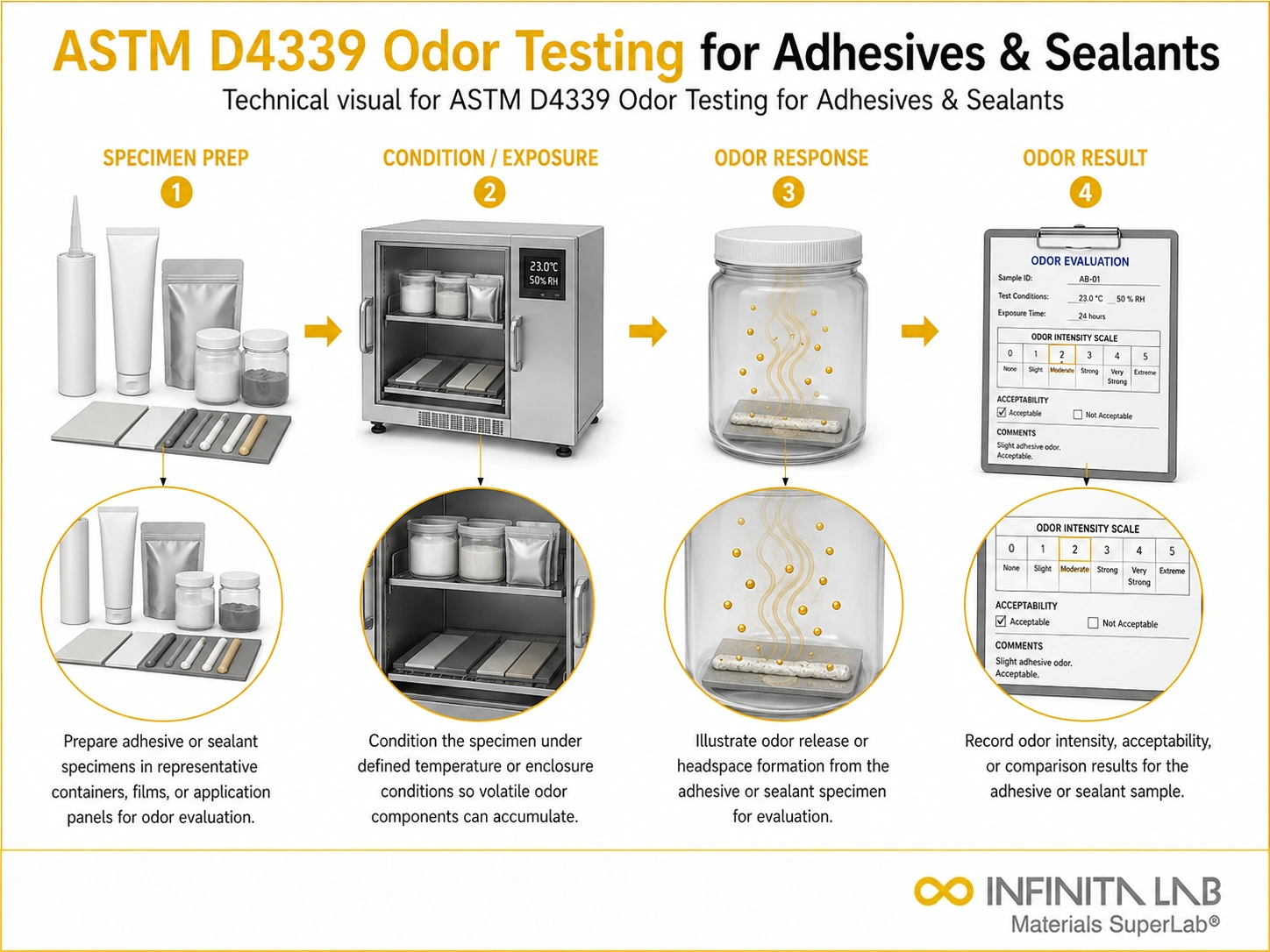
Test Process
Sample Preparation
Adhesive specimen is prepared in a clean glass vessel of specified size and sealed.
1Conditioning
Sample is conditioned at the specified temperature and time before evaluation.
2Panel Evaluation
Trained panelists open the vessel and evaluate odor intensity and character.
3Rating and Recording
Odor intensity is rated on the standard numerical scale; character is described.
4Technical Specifications
| Parameter | Details |
|---|---|
| Test Principle | Sensory odor evaluation by trained panelists |
| Conditioning | 23°C or 40°C (as specified) |
| Applicable Materials | Adhesive materials |
| Output Units | Numeric odor intensity rating |
| Measured Outputs | Odor intensity rating, odor character description |


- Clean glass sample containers with seals
- Temperature-controlled conditioning chamber or oven
- Trained sensory evaluation panel
- Odor intensity rating scale reference
- Ventilated evaluation room
- Data recording forms
Instrumentation Used for Testing
Results and Deliverables
- Odor intensity rating per panelist and average
- Odor character description
- Conditioning temperature and time records
- Statistical summary of panel results
- Compliance evaluation against the specification
- Quality assurance and product development reports
Frequently Asked Question
ASTM D4339 evaluates odour characteristics of adhesives through controlled sensory assessment. It helps determine acceptability of adhesive products for indoor applications where odour can impact user comfort and product perception significantly.
Key parameters include sample preparation, conditioning environment, evaluation chamber, and trained panel assessment. Controlled conditions ensure consistent evaluation of odour intensity and acceptability.
The test measures odour intensity and qualitative characteristics using sensory panels. Results indicate acceptability levels and potential impact of adhesives in enclosed environments.
ASTM D4339 applies to adhesives used in construction, automotive interiors, packaging, and consumer products where odour can influence product quality and user experience.
ASTM D4339 relies on human sensory evaluation, introducing subjectivity. Results may vary between panels, and additional chemical analysis may be required for precise identification of odour-causing compounds.
Why Choose Infinita Lab for Advanced Materials Testing and Characterization?
At the core of this breadth is our network of 2,000+ accredited laboratories across the USA, offering access to over 10,000 testing methods and analytical services. From advanced materials characterization (SEM, TEM, RBS, XPS) to mechanical, chemical, environmental, biological, and standardized ASTM/ISO-compliant testing, we deliver unmatched flexibility, specialization, and scale. You are never limited by geography, facility, or methodology — Infinita Lab connects you to the right expertise and testing solution, every time.

Looking for a Trusted Partner for Accurate and Reliable Testing Services?
Send query us at hello@infinitalab.com or call us at (888) 878-3090 to learn more about our services and how we can support you.





